


Recall what you know of the 1960s Civil Rights movement – the leaders involved, their goals, and what they ultimately achieved. If you’ve retained even a cursory knowledge about this era in U.S. History, you might be able to recount some of the major players in the movement. However, it’s unlikely for any of those names to be Bayard Rustin, a gay Civil Rights hero who helped usher in a lot of change to 1960s America. While most students in the U.S. were of course educated about Martin Luther King Jr., Malcolm X, Rosa Parks, etc., just as many students were not given the opportunity to learn about Bayard. Such a key architect of the movement being left out of the annals of history seems like an injustice, and indeed that’s why Higher Ground, the Obamas’ production company, has helped finance and bring Rustin to life with Netflix.
This isn’t Barack and Michelle Obama’s first time acknowledging Bayard Rustin’s immeasurable contribution to the fight for civil rights either. Barack Obama posthumously awarded Bayard the Presidential Medal of Freedom in 2015. With Rustin, written by Julian Breece and Dustin Lance Black, the former President and Netflix continue to highlight Bayard’s importance and the selfless work he did for the betterment of his community. Regrettably, though, Netflix’s Rustin is far too average for a subject who led such an incredibly storied and important life. It is a biopic where the only memorable element, or indeed aspect worth mentioning, is the performances on display.
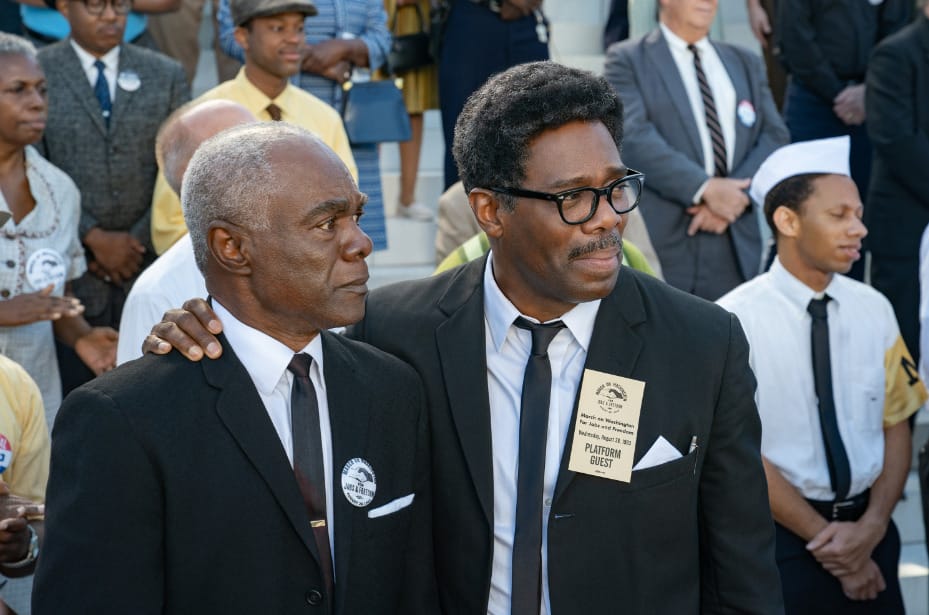
Colman Domingo is the beating heart of Rustin and it is only through his tremendous talent and charisma that this biopic is able to leave an impression on you. He fully dedicates himself to the role and embodies Bayard Rustin in his totality – his quirks, mannerisms, and way of speaking. It truly is something to behold and if Rustin has to be the vehicle for Domingo to receive the recognition he deserves, then so be it. It could always be worse. Director George C. Wolfe (Ma Rainey’s Black Bottom) at least tries to make the movie itself feel energetic with his frequent use of hand-held camera work, and the snappy, frenetic energy he manages to capture in some of the busier scenes, but there’s only so much that can be done when the script is this dull.
To be fair to Rustin, biopics tend to be stale and predictable. It’s rare to come across one that stands out and while predictability doesn’t always equate to a film being bad per se, the cliches and formulaic storytelling that is often present do hold many, like Rustin, back from being truly great. The familiar narrative patterns and emotional beats that you would expect in a biopic are all present, and in the vein of more recent examples in the genre, Rustin decides to hone in on one specific period in Bayard’s life. The story starts with his ousting from the NAACP and subsequent split from Dr. Martin Luther King Jr., and then jumps forward a few years to when he’s working independently of the establishment and endeavors to build and engage with other grassroots activists, via the SNCC (Student Nonviolent Coordinating Committee).
Choosing this section of Bayard’s life to focus on was the obvious and correct choice, not just because of what his activism during this period led to, but also because of the crucial and interesting relationships the film chooses to explore. The preeminent one of course being Bayard’s friendship with Martin Luther King Jr. (Al Ameen). Rustin manages to thoughtfully highlight how important each man was to the other as well as underline that it is only through the strength of their brotherhood that they were able to accomplish great things. Al Ameen is serviceable in his portrayal of Dr. King, yet he often gets overshadowed by just how brightly Domingo shines.
The only other actor in Rustin who’s able to match Colman is Jeffrey Wright as the indomitable Adam Clayton Powell Jr, a politician who loathes Bayard and seeks to use his sexuality as an excuse to excise him from the movement. Wright commands the screen with ease, and even though his character is an antagonist to Bayard, the narrative benefits from every scene he’s in. The same can not be said of Chris Rock’s portrayal of Roy Wilkins, another one of Bayard’s vocal detractors. Rock blunders through his lines, barely attempting to act, and it takes you out of the film constantly. Perhaps he’s just too recognizable a star to blend in seamlessly, or perhaps, and this is more likely, he’s just not very good.

As previously stated, the filmmakers were right to focus on this specific moment in Bayard’s life as it is the cornerstone from which his legacy is built. However, there is a real missed opportunity to delve into the interiority of existing at the crossroads of being both Black and gay, and how both of these identities shape and influence everything you do. There are perhaps two stirring scenes in Rustin where this element is touched upon with alacrity and purpose, but the moments are fleeting and end far too soon. One such scene features Bayard and his lover, Elias Taylor (Johnny Ramey), calling it quits. It’s a very somber and sneakingly emotional interaction, yet the movie explores so little of their relationship on screen that much of the emotion elicited at this moment is again, due to Colman’s acting.
It could be argued that the central purpose of Netflix’s Rustin is to show what Bayard contributed to the Civil Rights Movement and how the 1963 March on Washington wouldn’t have been successful without his invaluable work, and that would be a valid point. But the film has the rare opportunity to thoroughly discuss what it was like for Rustin to live his unique life when he did and it just never ceases this potential. At almost every turn, it falls back to the standard biopic formula. Even the momentous March on Washington feels like it’s just there to check a box. Visually, it’s dull and it relies heavily on close-ups, utilizing poor CGI and never giving the audience a chance to feel what should be an incredibly powerful moment that the story has been building up to for the entire runtime.
Despite all of this, Rustin should still be seen, especially if you’re unfamiliar with Bayard’s contributions. While it isn’t doing anything new, or particularly interesting, this Netflix original film is very informative and tells a side of American history that deserves to be told. Too often queer folks are left out of the narrative because it’s easy to do so and too inconvenient to bother including them in their totality. Civil Rights activist Bayard Rustin shouldn’t be a footnote but rather celebrated for the courage, passion, and grace he possessed and for his contribution to the establishment of the rights many people benefit from to this day. If only the first adaptation to tell his story had done it complete justice.