

In the recent years that Godzilla has been conquering Hollywood, Toho has been working on a bold new vision for their staple monster. It was originally reported that Godzilla’s home studio was interested in building a cinematic universe from 2016’s Shin Godzilla after the release of Godzilla vs. Kong, which was then thought to be the last chapter in Warner Bros. and Legendary’s MonsterVerse franchise. Of course, the success of that crossover has now led to a spin-off series on Apple TV+, Monarch: Legacy of Monsters, and another sequel due next year, Godzilla x Kong: The New Empire. But this didn’t stop Toho from moving ahead with their first original live-action Godzilla feature in 7 years, Godzilla Minus One. Though it’s unfortunate that we didn’t get a follow-up to Shin Godzilla, especially after its bone-chilling cliffhanger ending, Godzilla Minus One is just as much a masterpiece in its own right.
Written and directed by award-winning Japanese filmmaker Takashi Yamazaki – best known for the Always: Sunset on Third Street trilogy, Lupin III: The First, and his Parasyte and Stand by Me Doraemon films, Godzilla Minus One is a visually stunning powerhouse of emotion. Western audiences have long complained about the expectations for giant monster flicks, and the MonsterVerse has faced these criticisms from the very beginning. Only in America will you hear complaints about there needing to be “less talking and more fighting” when it comes to Godzilla movies. And to be fair, the MonsterVerse didn’t really make a good case for itself either since it took a few sequels for its human drama to improve. Toho’s timing with Godzilla Minus One couldn’t be sweeter then, showcasing how to make the perfect Godzilla picture with a compelling human ensemble and breathtaking action that’s savored from start to finish.
Our story is led by Kōichi Shikishima (Ryunosuke Kamiki), a former Kamikaze pilot who first encounters Godzilla, in a more dinosaur-like form, in 1945 on Odo Island during the final days of World War II. A few years after barely making it out of that encounter alive, Kōichi returns to Tokyo to find it in ruins from the U.S. firebombings – as if the atomic bombings of Hiroshima and Nagasaki weren’t enough already. Kōichi’s parents were both lost in the air raids and his home is nothing but rubble now. As a kamikaze pilot who failed to fulfill his duty to his country by giving his life “honorably” in combat, Kōichi is looked down upon and plagued by survivor’s guilt. On top of this, his brutal memories of Godzilla haunt him every night. Nonetheless, he tries his best to move on and do his part in rebuilding post-war Japan.
Kōichi’s saving grace soon comes in the form of Noriko Ōishi (Minami Hamabe), a total stranger who also lost everything during the air raids. The two befriend each other and take it upon themselves to raise their adopted child named Akiko (Sae Nagatani), whom Noriko found abandoned as a baby in the aftermath of the war. Brought together by tragedy, the three are inseparable as a family despite not being related. Kōichi eventually finds a new government job disarming old war mines off Japan’s coast with a colorful crew, including Captain Yōji Akitsu (Kuranosuke Sasaki), the “Doc” Kenji Noda (Hidetaka Yoshioka), and the “Kid” Shirō Mizushima (Yuki Yamada). Likewise, Noriko finds work in the booming city district of Ginza, with their neighbor Sumiko Ōta (Sakura Ando) agreeing to babysit Akiko. For the first time in years, Japan has seemingly found peace after starting again from ground zero.

Courtesy of Toho
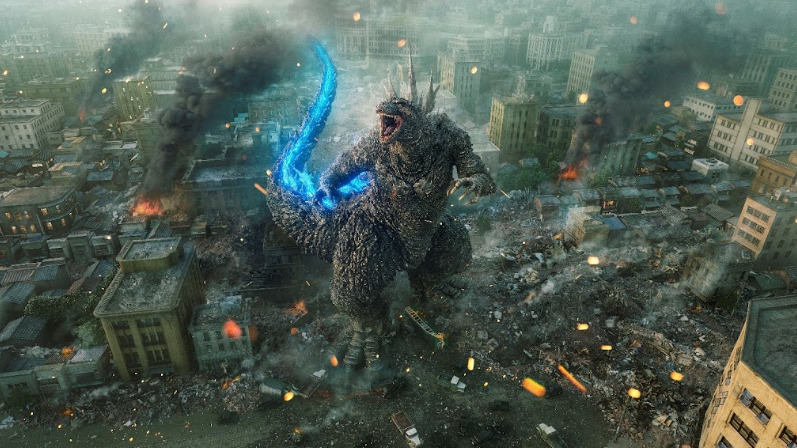
All of this progress is threatened when Godzilla resurfaces in a more powerful form thanks to the U.S. nuclear tests at Bikini Atoll. And what do you get when you destroy ground zero? Minus One. Takashi Yamazaki’s film is a testament to the historical perseverance of the Japanese people. Coming off the heels of WWII and one of the greatest tragedies in human history, Japan is now faced with something far more inexplicable: Godzilla. Yamazaki’s interpretation of the titular titan is an unstoppable force of nature. This Gojira sports a more traditional look, blending different design elements from various classic movies. Though he may only be 50.1 meters tall, which was roughly the consistent height of the monster throughout the Shōwa Era (1954-1975), Godzilla is as horrifying as ever. There’s no reason for his rampage, he’s a mutated wild beast that mankind must answer for.
With the United States refusing to help in order to avoid rising tensions with the Soviet Union, and the Japanese government working overtime on damage control, the burden of Godzilla’s wrath falls on the working class. With no other options, the people take it upon themselves to stop the creature. More specifically, we follow a citizen-led effort made up entirely of volunteers who previously served in the Japanese Navy during WWII. The ensemble-driven story allows Godzilla Minus One to excel as an immersive period piece, with Kōichi’s arc as a former Kamikaze pilot overcoming survivor’s guilt right at the center. This is how Yamazaki’s movie sets itself apart from any other Godzilla tale. There’s no role too small in the cast of Godzilla Minus One. While Ryunosuke Kamiki and Minami Hamabe power the film’s core and give it a strong beating heart, the supporting characters really elevate the stakes.
From Kuranosuke Sasaki’s Captain Yōji to Hidetaka Yoshioka’s “Doc” to even Sakura Ando’s Sumiko, each character in Godzilla Minus One not only serves a narrative purpose but also gets their own inspiring moments that leave a deep impression on the viewer. The human drama is so captivating that you are never thinking about Godzilla appearing again to keep your attention. The fact that we get a terrifying introduction to this new interpretation of Godzilla – with some nods to Jurassic Park no less – right at the beginning of the film helps too. Yamazaki doesn’t spend much time explaining his origins either. Instead, he uses a familiar Godzilla origin from past movies and goes from there, wasting no time to dive right into the story. It’s funny to think that whereas Hollywood has struggled to find a balance between human characters and monster action, this film makes it look all too easy.

Speaking of the action, however, Godzilla Minus One will leave audiences walking away incredibly satisfied. Yamazaki’s visual scaling is epic and often imaginative in some very shocking ways, to the point where fans will think to themselves, “I can’t believe we haven’t seen anything like this before.” The film pulls no punches in showcasing the horror of Godzilla’s destruction as well. It all makes for the kind of grand spectacle that stays with you forever. Yamazaki, with a career steeped in both live-action and animation, is known for leading the visual effects teams on his projects. Working with studio Shirogumi, Yamazaki’s VFX work in Godzilla Minus One is superb, with the completely CGI Godzilla always maintaining a palpable screen presence. Yamazaki’s most awe-inspiring images are brought to life with a spectacular blend of practical sets and VFX, proving that the best cinematic innovations don’t always come from Hollywood.
Featuring jaw-dropping sequences such as Godzilla chasing a small wooden boat in the middle of the ocean or him charging up and firing his signature atomic breath on the level of a spirit bomb from Dragon Ball Z (yes, seriously), Godzilla Minus One isn’t just an astonishing kaiju film but one of the best films of the year, period. The few instances of fan service come in composer Naoki Satō’s operatic score, where he chooses to bring back Akira Ifukube’s iconic Godzilla theme. Although this is common for Toho’s Godzilla films, Godzilla Minus One uses the classic theme to great effect. Writer-director Takashi Yamazaki has created a new masterpiece that puts the majority of modern Hollywood blockbusters to shame. This tale of everyday citizens, who have already sacrificed way too much, coming together to beat the odds pulls at the heartstrings, and strikes a loud chord in today’s world.
Ultimatley, Godzilla Minus One is a gripping contemplation on the value we need to put on our own lives. Whether or not Toho chooses to follow this up with a sequel doesn’t matter because just like Shin Godzilla, Godzilla Minus One is unique and powerful enough to stand the test of time. However, considering that we’re left with yet another hair-raising cliffhanger, we wouldn’t say no to a sequel! Should Takashi Yamazaki return, of course.