

Kung Fu Panda 4 marks the return of one of DreamWorks Animation’s most iconic franchises after an 8-year hiatus. 2016’s Kung Fu Panda 3 tied a nice bow on Po’s journey to mastering his skills as the Dragon Warrior and bringing unity to the Valley of Peace, which raises eyebrows as to why another sequel is necessary besides the need to make more money. However, Kung Fu Panda 4 is coming at a very fascinating time for DreamWorks. The beloved studio is seemingly in the early years of a new creative renaissance, with original films like The Bad Guys and legacy sequels like Puss in Boots: The Last Wish proving that DreamWorks can still deliver innovative, cutting-edge visuals with clever storytelling that doesn’t talk down to children. But last year’s Ruby Gillman, Teenage Kraken and Trolls Band Together didn’t reach those same levels of critical or financial success.
So, the timing worked out well for DreamWorks to now rely on a Kung Fu Panda sequel to get them back on track while preparing for their next original release, The Wild Robot. Additionally, Kung Fu Panda 4 and The Wild Robot are the last two productions to be fully animated in-house at DreamWorks for the foreseeable future due to budget cuts. Starting in 2025, DreamWorks will start relying heavily on third-party studios to animate their films. There’s been a lot of change happening at the studio, visible both on the screen and behind the scenes, and to say that a lot is riding on the success of Kung Fu Panda 4 would be an understatement. Luckily, director Mike Mitchell (Shrek Forever After, Trolls) and co-director Stephanie Ma Stine (She-Ra and the Princesses of Power) have crafted a worthy follow-up that cements the Kung Fu Panda franchise as near-perfect.
We pick up with Po (Jack Black) still at the height of his fame as the Dragon Warrior. An opening fight sequence between him and a giant monstrous stingray establishes Po as a sort of superhero, no longer needing the Furious Five to constantly save his skin. Now, with the Staff of Wisdom at his disposal — gifted to him by Grand Master Oogway (Randall Duk Kim) in the Spirit Realm at the end of the third film — there’s no threat too big or dangerous that Po can’t face alone. Therefore, Master Shifu (Dustin Hoffman) believes it’s time for Po to face his next challenge: choosing the next Dragon Warrior. But Po doesn’t want to give up the title so easily as being the Dragon Warrior is all that he knows. While he is full of pride, it’s obvious that Po is more afraid of change than anything else.

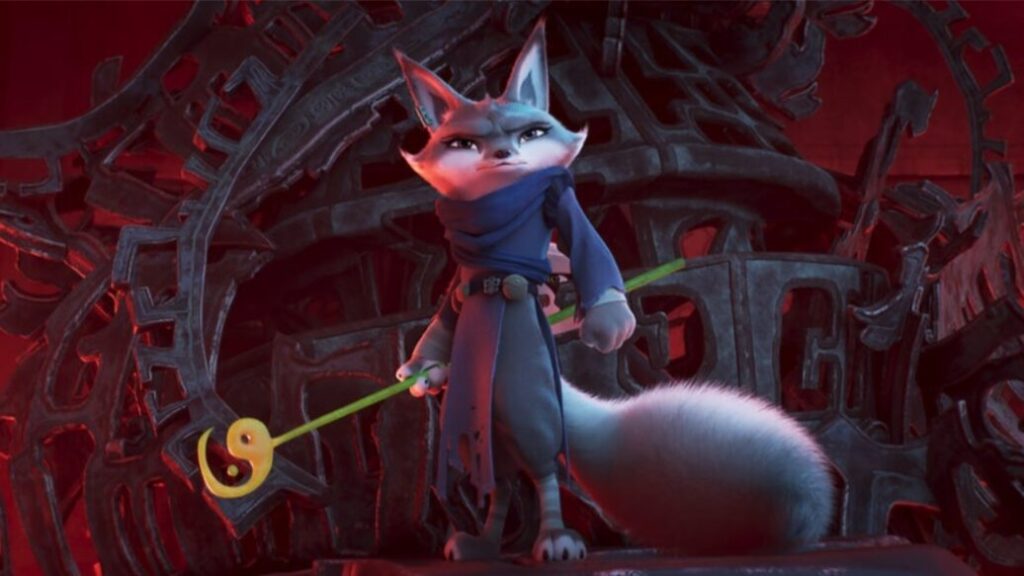
Unfortunately for Po, a new powerful foe who is the literal embodiment of change is on the rise. The shapeshifting sorceress known as The Chameleon (Viola Davis) has devised a plan that will allow her to absorb the signature kung fu skills of Po’s past nemeses and beyond. This, of course, includes the move-sets of previous franchise villains General Kai, Lord Shen, and Tai Lung (Ian McShane). With the Furious Five busy elsewhere, Po’s only hope of finding the elusive Chameleon comes in the form of a mysterious thieving Corsac fox named Zhen (Awkwafina). After a messy scuffle, the two reluctantly join forces as they travel from the Valley of Peace to the faraway land of Juniper City where the Chameleon rules with an iron fist. Along the way, Po starts to see a lot of himself reflected in Zhen, convincing him that he might have accidentally found his successor.
Kung Fu Panda 4 doesn’t feel like any of the previous movies, for a variety of deliberate reasons. For starters, the Furious Five (Master Tigress, Monkey, Mantis, Crane, and Viper) are not featured at all for the first time in the franchise. This opens up more time to focus on the core relationship between Po and Zhen. Secondly, the busy urban streets of Juniper City are so far removed from the Valley of Peace that nobody knows anything about the Dragon Warrior here, making Po feel like he’s truly on his own. Considering that the main cast of characters kept growing with the last three Kung Fu Panda films, this fourth entry acts almost like a soft reset. The stakes are still huge but the conflict is more personal between Po, Zhen, and The Chameleon, similar to the conflict between Po, Shifu, and Tai Lung from the first movie.
The biggest downfall of Kung Fu Panda 4, though, is a slightly predictable plot. It’s easy to see where Po and Zhen’s journey is heading early on. This holds Zhen’s character back as she doesn’t get to connect with the audience until the second half. Even if the narrative is playing with this humorous sense of irony given how blinding Po’s kindness can be, it still takes a while for you to care about Zhen. Also, the Chameleon’s plan of absorbing past villains’ kung fu moves is perhaps too silly even for this series. Nonetheless, returning screenwriters Jonathan Aibel and Glenn Berger, now joined by writer Darren Lemke, overcome these missteps by homing in on the story’s heartfelt messages of self-growth and accepting change. Kung Fu Panda 4 gracefully highlights how taking steps to better yourself is always progress worth acknowledging no matter how big or small they may be.
Jack Black’s comedic timing and delivery are still on point, the Giant Panda hasn’t lost one bit of his wholesome charm. Just because he’s no longer going to be the Dragon Warrior doesn’t mean he’s left without a cool title. Po must choose his successor and learn to accept his promotion as the next “Spiritual Leader of the Valley of Peace,” the role that Master Oogway previously held. It’s an exciting step forward for the character that paves the way for loads of comedy, the funniest bits being Po trying to give wisdom in the form of poorly worded proverbs. Awkwafina’s Zhen, on the other hand, is surprisingly more level-headed and self-composed. It’s rather refreshing to see Awkwafina in a voice-acting role where she’s not the comedic relief for once. Po and Zhen bounce off each other naturally, making their friendship feel all the more genuine by the end.
The great James Hong and Bryan Cranston get the most time to shine from the supporting voice cast as Po’s two dads, Mr. Ping and Li Shan. It’s fantastic to see Kung Fu Panda 4 lean harder into the dynamic between the Panda-Goose father duo, a unique element that isn’t seen in any other animated franchise. Both Hong and Cranston get to join in on the action, steal a few laughs, and more importantly, have emotional moments with Po. Oscar-winner Ke Huy Quan has a minor yet memorable role as Han, a mean Sunda pangolin. Comedian Ronny Chieng also leaves a funny impression as a fish captain living in a pelican’s mouth. But, of course, the fans want to know about Tai Lung. Thankfully, Ian McShane’s reprisal of the iconic villain avoids cheap nostalgia. His presence is sweet and savory, packing a thematic punch for Po’s progression.
Fans should go into Kung Fu Panda 4 expecting something different. The true spirit of the series is felt and the movie’s got a real beating heart, that’s undeniable. However, this sequel operates more like a soft reset that opens the door to a new trilogy of possibilities rather than lazily repeating what worked in the last Kung Fu Panda movies. The creative potential of the franchise is on full display, and the stylized animation continues to impress with vibrant colors and energetic editing. Moreover, the martial arts fight sequences have never been better. Brought to life with the help of a professional stunt team, every punch and kick is felt and carries electric waves across the screen. The final battle between Po and the Chameleon (Viola Davis eating up the scene per usual) is some of the best action DreamWorks has ever animated, period.
While it may not be as amazing as the first two films as a whole, the inspired craftsmanship and sincere messages of Kung Fu Panda 4 make up for its few flaws. Will this sequel find the success that DreamWorks Animation is currently looking for? It certainly deserves that kind of reception, especially when compared to some of the recent lesser efforts seen from competing animation studios. Plus, Kung Fu Panda 4 has both a Tenacious D cover of Britney Spears’ ‘Baby One More Time’ and a Hans Simmer orchestral cover of Ozzy Osbourne’s ‘Crazy Train.’ What’s not to love? It’s not a sequel many originally thought we needed but one we’ll be happy that it exists either way.
Release Date: March 8, 2024.
Directed by Mike Mitchell.
Written by Jonathan Aibel, Glenn Berger, & Darren Lemke.
Produced by Rebecca Huntley.
Main Cast: Jack Black, Awkwafina, Viola Davis, Dustin Hoffman, James Hong, Bryan Cranston, Ian McShane, Ke Huy Quan, Lori Tan Chinn, & Ronny Chieng.
Composers: Hans Zimmer & Steve Mazzaro.
Production Company: DreamWorks Animation.
Distributor: Universal Pictures.
Runtime: 94 minutes.
Rated: PG.