

Director Pablo Larraín’s ability to craft cinematic portraits of iconic women throughout history is no secret. It all began with Larraín’s 2016 English-language debut Jackie, which starred Natalie Portman as Jacqueline Kennedy in the days following the assassination of her husband, President John F. Kennedy. A “spiritual trilogy” of sorts began to take shape, with the second installment manifesting in the form of 2021’s Spencer — the Kristen Stewart-led character study on Princess Diana. Alongside screenwriters Noah Oppenheimer (Jackie) and Steven Knight (Spencer), Larraín formulated a new rendition of the traditional Hollywood biopic by fixating on precise moments in each subject’s life rather than attempting to explore them comprehensively in two-plus hours.
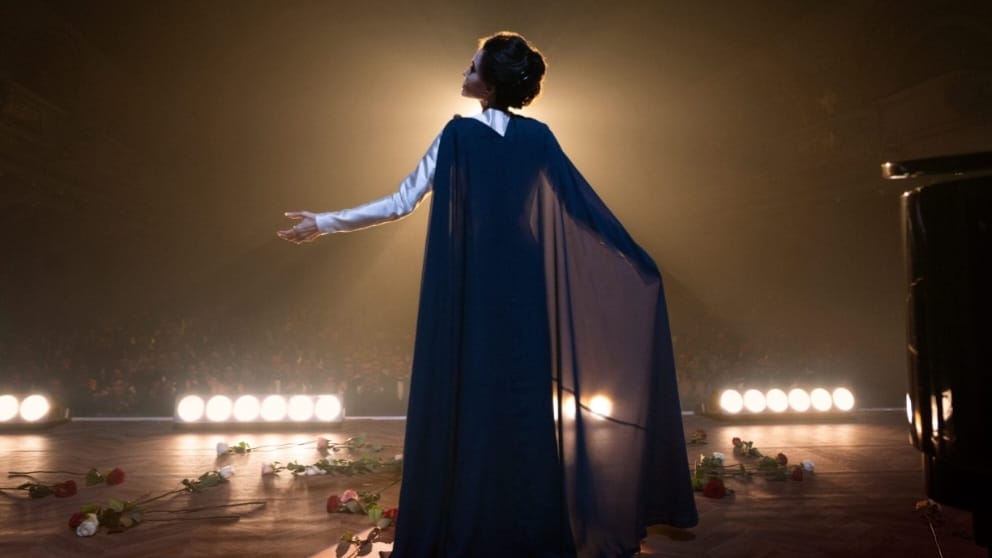
Coming after these two celebrated, rule-breaking biopics, it seemed only right for Maria, the third and seemingly final addition to this collection, to have its world premiere at the Venice Film Festival. In her first role since playing Thena in Marvel Studios’ Eternals, actress Angelina Jolie stars as Maria Callas, one of the most celebrated and influential opera singers of all time. Knicknamed La Divina, or “The Divine One,” the American-Greek soprano is also famously renowned as one of the defining divas of the 20th century, advocating for herself as both an artist and a woman in a way that was revolutionary for her time. To onlookers, Maria’s life might have seemed full of glamour, but as with many who have had fame bestowed upon them, her reality was riddled with tragedy and psychological struggle.
In the haziness of a lavish pastel living room, a body covered in a single white sheet is the somber centerpiece. Pablo Larraín’s snapshot of Maria Callas begins at the very end, with the plot literally picking up in the final week of her life in 1970s Paris, France. Though Maria lives with her butler Ferruccio (Pierfrancesco Favino), housemaid Bruna (Alba Rohrwacher), and her beloved poodles, the grand Parisian residence somehow feels eerily hushed and hollow. It is brought to life only by Maria’s transcendent singing, a sound that has become all too infrequent in the lead-up to the events that transpire throughout the film. She internally battles the desire to belt opera as gloriously as she once did years before. However, being a perfectionist, Maria has grown frustrated with her diminishing vocal chords.
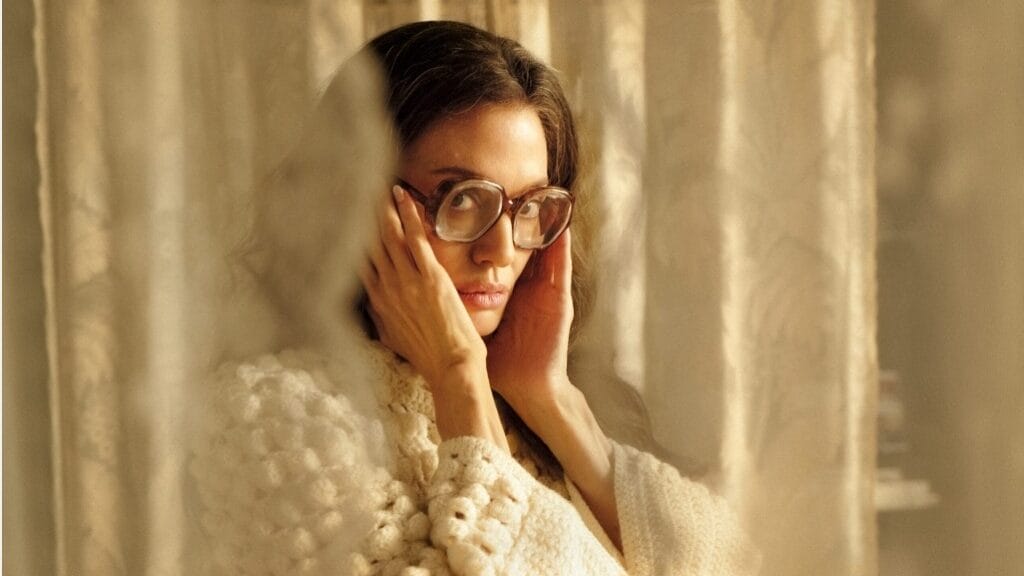
When Maria was still married to Italian industrialist Giovanni Battista Meneghini, she met Greek-Argentine business magnate Aristotle Onassis, the man who many consider to be the true love of her life (bar opera, of course). The script, written by Steven Knight, who reunites with Pablo Larraín after writing Jackie and is also known for creating BBC’s Peaky Blinders, fails to dive into Onassis’ romantic betrayal, which contributed to Maria’s declining mental state that began to gnaw away at her enthusiasm for life. Her stash of brightly colored bottles containing Mandrax (more commonly known as Quaaludes) and a plethora of other drugs hidden away in a bureau in her quiet home is Maria’s sole supply of solace. The cocktail of pills paired with a non-existent appetite has catastrophic effects on her already frail body.
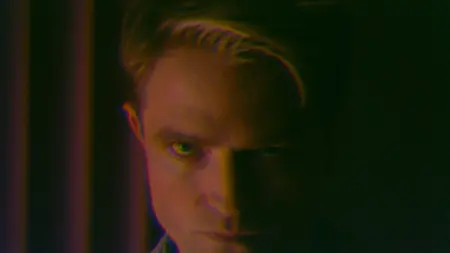
It makes sense that Angelina Jolie, a modern superstar and diva in her own right, was cast to portray a one-of-a-kind historical figure like Maria Callas. Yet, her casting is equally distracting for that reason, as it’s difficult to view her as a different icon when she isn’t given as much complexity to work with. Jolie delivers a performance that is on the cusp of being fantastic and truly heart-rendering but is held back by the unwarranted restraint of Steven Knight’s screenplay. With limited knowledge of the actual art of opera, Jolie’s physicality and vocal movements while singing feel unconvincing despite being performed live on set. Meanwhile, actor Kodi Smit-McPhee (The Power of the Dog) plays a physical embodiment of the drug Mandrax. It’s an interesting idea that, unfortunately, offers nothing more than being a vessel for Maria to be interviewed — character work that mainly exists on the surface.
The most compelling aspect of Pablo Larraín’s Maria is the dynamic shared between Angelina Jolie and her co-stars Pierfrancesco Favino and Alba Rohrwacher. Ferruccio and Bruna’s adoration of Maria, both on screen and in reality, is not to be understated. The housekeeping duo continuously tries to keep Maria afloat but can ultimately only provide as much help as she will willingly accept. Their relationship proves the magic that Maria brought to the world was in her power to bring people together, whether that was in her personal life or through her music.
Both Jackie and Spencer succeed at pinpointing specific periods in each subject’s life because the large majority of audiences already have crucial context on these women who are household names. Although Maria Callas was certainly an irreplaceable artist who garnered well-deserved fame, the intricacies of her private life have not been explored as deeply in the public eye. Maria, for better or worse, refuses to delve into these fine details, leaving the viewer in the dark about much of what is being alluded to. Pablo Larraín’s film is unable to benefit from the format used in the rest of the trilogy since not much of Callas’ life is widely known public knowledge. A single, brief flashback to Maria’s adolescent years uncovers the tumultuous relationship she had with her mother, who took advantage of her talents. However, that’s all the context that is given to supplement the rest of the story.
Maria leaves much to be explored in the titular character’s life. Be it how she discovered that Aristotle Onassis was to marry the widowed Jackie Kennedy just three weeks before their ceremony or further fleshing out the dynamic she shared with her estranged sister, Yakinthi Callas (Valeria Golino). This necessary information and character-building would have only emotionally enriched her final days seen in the movie. While Maria is not an unpleasant viewing experience remotely, with much credit due to Angelina Jolie, it still feels like a staggering downgrade in quality from the high standard previously set by filmmaker Pablo Larraín in Jackie and Spencer. The most disheartening aspect of this biographical effort is that its true potential to be as special and effective as its predecessors is clear for all to see on screen.
Maria premiered at the 2024 Venice Film Festival. The film will be released on Netflix at a later date!
Release Date: TBA.
Directed by Pablo Larraín.
Written by Steven Knight.
Produced by Jonas Dornbach, Janine Jackowski, Juan De Dios Larraín, & Lorenzo Mieli.
Executive Producers: Mike Emmrich & Helmut Hutter.
Main Cast: Angelina Jolie, Valeria Golino, Haluk Bilginer, Alba Rohrwacher, Pierfrancesco Favino, Kodi Smit-McPhee, Alessandro Bressanello, & Aggelina Papadopoulou.
Cinematographer: Edward Lachman.
Production Companies: Fremantle, FilmNation Entertainment, Komplizen Film, Fabula, & The Apartment Pictures.
Distributor: Netflix.
Runtime: 124 minutes.