

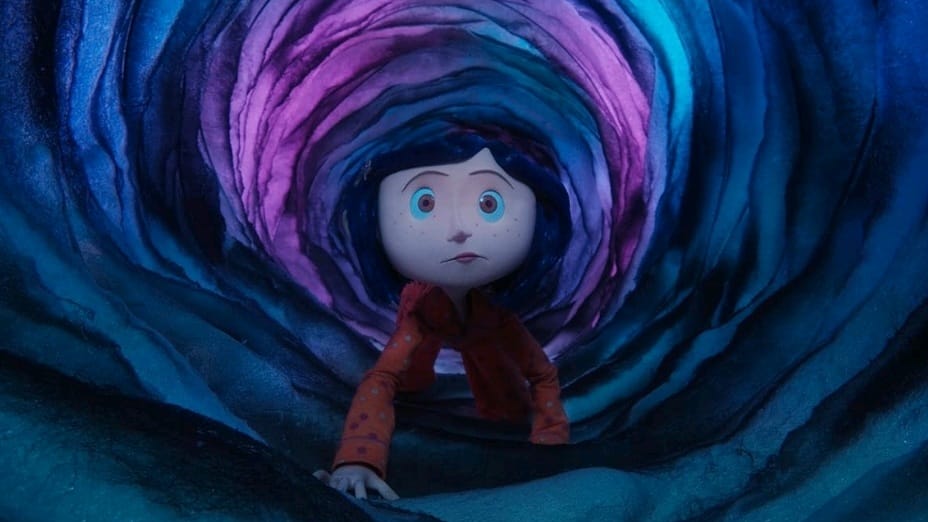
In 2009, Laika Studios released their first feature-length animated film, Coraline, under the stewardship of prolific animator/writer-director Henry Selick. Fifteen years after its initial release, this groundbreaking and eerily whimsical stop-motion story, based on the novella of the same name by fantasy author Neil Gaiman, has become a timeless classic. From its meticulously crafted sets to its unforgettable characters, Coraline has only grown in popularity over time, captivating multiple generations of audiences. In honor of its 15th anniversary this year, Focus Features re-released Coraline in a newly remastered 3D edition, offering both longtime fans and new audiences the chance to experience the animated tale on the big screen for the first time or all over again.
Coraline Jones (Dakota Fanning) flaunts a curious nature and cheeky charm that couldn’t be more different from the seemingly mundane nature of her new Victorian home in Ashland, Oregon. In a fit of boredom, the eleven-year-old discovers a small hidden door in her living room, leading to an alternate, seemingly perfect version of her life. In this “Other World,” everything appears more exciting and ideal. Her parents are attentive, the food is mouth-watering, and every day is full of magical fun, or so it seems. Things quickly take a dark turn when Coraline realizes that her “Other Mother” harbors sinister intentions. She must summon the courage to escape this twisted reality and save not only herself but also the lost souls of other children who have fallen prey to the Other Mother’s trap.
Writer-director Henry Selick is a stop-motion animation veteran and considered one of the greatest in his field. His feature directorial debut, The Nightmare Before Christmas, is another beloved classic — one that casual audiences often mistake as being directed by writer-producer Tim Burton (even though he did contribute a lot to the project). Throughout his illustrious animating and directing career, which also includes the fan-favorite James and the Giant Peach and Netflix’s Wendell & Wild, Henry Selick has become renowned for his ability to blend the whimsical with the macabre, creating visually striking films with lasting cultural impact.
While the film’s titular character, voiced by Dakota Fanning (Ripley, Man on Fire), is the story’s beating heart, it would be nothing without its antagonist, the Other Mother (or The Beldam). Known best for her work as Lois Lane in the ’90s television series Lois & Clark: The New Adventures of Superman and as Susan Mayer in Desperate Housewives, actress Teri Hatcher made her voice acting debut in Coraline. Hatcher nails the stark duality between Other Mother’s comforting and sinister nature. To honor the 15th anniversary of Coraline, DiscussingFilm sat down with both Henry Selick and Teri Hatcher to reflect on the film’s enduring legacy and the lessons they each learned from creating such an unforgettable and unique piece of cinema.
How does it feel getting the opportunity to revisit Coraline 15 years after its initial release, especially with the cult following it’s gained since?
Henry Selick: Pretty wonderful. It’s a real bonus that, over time, the audience has grown to the point where Laika decided to do a re-release and remaster the original. Nothing could be better than to be part of something you worked so hard on years ago and to know that there’s a new audience now, as well as the old.
Teri Hatcher: I just feel honored to be a part of something that is such a beautiful art piece that it ended up feeling almost like a classic fairytale and a story that still needs to be told.
What did you learn from the making of Coraline that you have carried onto other projects since?
Teri Hatcher: I don’t know if this is something I didn’t know, meaning that I learned it, but it was certainly reinforced. [Coraline] was a beautiful example of how it takes a team. It’s a collaboration of many brilliant, talented people working really hard for a long time to execute something this fantastic. It reinvigorates my belief that all good things come after a sustained amount of hard work.
I think it’s a good thing to remind people of this because we live in a society where people tend to think things are instant, and if they can’t get that instant gratification, it’s not valuable. I think the opposite: when you put a great amount of effort in, that is how you get something that lasts 15 years.
Henry Selick: We didn’t make a disposable movie.
Teri, you come from a background in both film and TV, and Henry, before Coraline, you directed stop-motion films like James and the Giant Peach and The Nightmare Before Christmas. How did your previous experiences play into the making of Coraline?
Teri Hatcher: Other than what I believe to be a core acting tenant, which is to listen, and is kind of crazy because in a recording booth, you’re not necessarily hearing the other actors, but you still are imagining what it’s like listening to them. Then, communicate in a conversation where you’re trying to get something that you want, facilitate what you need, and understand the stakes of the situation. I think that’s what I tried bringing to it.
Henry Selick: I’ve worked with a fair number of actors who had never done animation before. There are always two kinds: the ones who show up and take it seriously, as Teri did, even if she’s not familiar with it, and the others who show up thinking it’s just a lark. These actors will phone it in, but they have always made the adjustment. I think it’s harder for them than most live-action performances because, as Teri said, acting is reacting. It’s reacting to what the other performers are doing, and maybe I’m there reading the other lines, but it’s not the same. So I think it’s more of a challenge, and [Teri] rose to it beautifully.

Did you, at any point during the production of Coraline, know that this would gain a cult following?
Henry Selick: I knew it would be special. I didn’t make any compromises, ever, which is a very rare thing. It’s not about being a dictator, but there were many times when the easier thing would have been to use CG, like to make the jumping mouse circus or the big Scotty dog for example, but I had this gut feeling that it would be better if it was all one piece as stop-motion. I knew it would be special and very well made because we had incredible talent. The crew, the animators, were as good as can be assembled. That doesn’t necessarily equate to success or longevity, but I was hopeful.
One of the things that makes Coraline distinct from other stop-motion films is the fantastical world the story inhabits. There is so much variety and life in each of the sets. What were your favorite parts of this world that you are perhaps still drawn to?
Teri Hatcher: I actually just mentioned to someone that something as small as Coraline hanging off the door, and when the door goes, “squeak, squeak, squeak.” It’s those little details that make a big impact. That little moment wraps up the whole thing about who Coraline is as a human being and how she is going to go about getting what she wants in the world. Of course, the garden scene is just a spectacular feat for the eyes, and I love the cat. The choo-choo train, the food — I love it all.
Henry Selick: I’ve mentioned several things in the past, but I’m going to pick something different now. When Coraline first meets Other Father, there’s a piano. She says, “My father can’t play piano,” and he responds, “I don’t have to; this piano plays me!” That performance and the little short song are just wonderful, amazing, and magical. I love all the giant bug furniture that glows from within and comes to life. I find it fun and charming, even if it’s in a scarier moment. There are plenty of moments throughout that I’m drawn to and proud of, and they make me want to go back and revisit the world.

In the movie, Coraline is attracted to the Other World because it offers attentive parents, lavish food, and an exciting escape. If you were lured to the Other World, what would draw you in?
Teri Hatcher: Have you ever seen the movie Defending Your Life? If not, it should be on your list. It’s with Meryl Streep and Albert Brooks, and there’s a scene in it where Meryl discovers that she can eat all the pasta she wants and never gain any weight. That’s one of my favorite movies anyway, but it just feels like an immediate choice for me. It’s more than just weight; if I had my version of the Other World, eating anything I want would be a must.
Other than that, I’m pretty satisfied with my life, and I don’t know if I spend a ton of time imagining what it could be that it isn’t. In fact, bringing it back to the actual plot, it is this classic human struggle of not being happy with what you want, and that is so valuable and important in the film. Imagining that there is something better out there that’s going to make you happier, and then getting it and finding that it doesn’t solve all your problems is a reason people still really resonate with Coraline.
Henry, when you were adapting the novella for this script, how did you go about balancing staying true to the original story and adding new material and characters?
Henry Selick: My very first draft of the script was too close to the book because I had so much respect for those pages, but it wasn’t a movie. So I had to go into hiding, tear it all apart, and reassemble it. I found the freedom I needed to not be afraid of the audience that would be coming because they loved the book because the book hadn’t actually been published yet. I use the term “smell” because it needed to smell like the book and not piss off the fans that would be coming to watch the movie.
I did piss them off in a few areas, like adding Wybie, this annoying neighbor kid of whom there’s another version who can’t speak, and Coraline clearly likes that other version better. Tonally in the original novel, the Other Mother is kind of creepy and off-putting right away, but I felt like that doesn’t give us room to grow. I wanted to make her beyond perfection initially, because at first, everything about the Other World is wonderful, aside from button eyes, but even the button eyes are kind of cute. So, it’s a much more gradual transition in terms of Coraline learning that it’s not so perfect and there is a price to pay when she meets the kids who did pay with their lives.
The Coraline 15th Anniversary re-release is now playing in theaters!
Release Date: August 14, 2024 (re-release).
Directed by Henry Selick.
Screenplay by Henry Selick.
Based on Coraline by Neil Gaiman.
Produced by Bill Mechanic, Claire Jennings, Henry Selick, & Mary Sandell.
Executive Producers: Jeffrey Katzenberg & Michael Zoumas.
Main Voice Cast: Dakota Fanning, Teri Hatcher, Jennifer Saunders, Dawn French, Keith David, John Hodgman, John Linnell, Robert Bailey Jr., Ian McShane, Aankha Neal, George Selick, Hannah Kaiser, Marina Budovsky, & Carolyn Crawford.
Cinematographer: Pete Kozachik.
Composer: Bruno Coulais.
Production Companies: Laika & Pandemonium Films.
Distributor: Focus Features.
Runtime: 100 minutes.
Rated PG.