


Roofman (2025) is based on the peculiar true story of Jeffrey Manchester, a former army ranger-turned-thief who gained headlines for his unusual M.O. and apologetic demeanor during his string of robberies (mainly from McDonald’s restaurants) across the United States in the late ’90s. Following his capture by the authorities, Jeffrey cunningly escapes from prison and initially dodges a 45-year sentence. Now a free man, he makes his next move to Charlotte, North Carolina, where he chooses to lay low in a secluded nook he sets up for himself inside a local Toys “R” Us store.
Channing Tatum (Magic Mike, 21 Jump Street) shines as Manchester, aka the “Rooftop Robber” or “Roofman.” He’s given a lot of time without anyone else to bounce off in scenes where he’s hiding from the law. It’s in these solo moments that Tatum is able to play up the restraint and pain that come with this army veteran’s unusual life of crime. Boredom, loneliness, heartbreak, and goofiness all collide in Jeffrey’s struggle, and the Toys “R” Us setting effectively captures the childlike nature of many of these emotions. Manchester spends the majority of the runtime balancing his maturity (or lack thereof) with his responsibilities, building him up as an endearing anti-hero of sorts.
A Brilliant Idiot You Can’t Help But Root For
Jeffrey Manchester is summed up by his best friend, Steve (LaKeith Stanfield), in their first conversation together, calling him a brilliant idiot. This dual-sided characterization could easily stray into cartoonish territory, but Channing Tatum finds a way to make the titular burglar believable. He brings a youthful energy that makes Manchester feel more like a gifted kid working his way through a puzzle than a mastermind putting together a heist. While he’s good at planning, that doesn’t mean he particularly excels at thinking things through, a trait from which a lot of the film’s comical bits and complications arise.
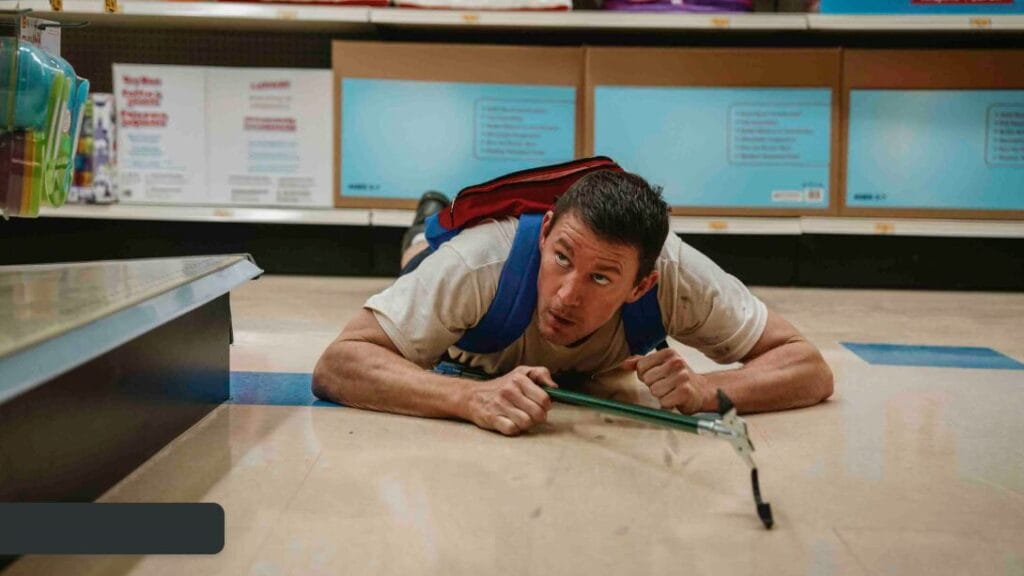
It’s here that Roofman particularly excels. The gentleman thief is a classic stock character, and not one that has fallen to the wayside. Yet, Jeffrey spends so much time juggling his adult responsibilities, his ultimate desires, and everything that he’s running away from, that he begins to mutate that trope. At the end of the day — despite his crimes generally being committed with the goal of minimizing damage and presenting himself in a lovable, silly demeanor — his choices nonetheless hurt people, especially those closest to him. The movie uses this to contrast his simple worldview with the reality of his actions.
Kirsten Dunst Rises From a Strong Supporting Cast
The supporting cast, led by Kirsten Dunst, LaKeith Stanfield, Lily Collias, Kennedy Moyer, and Peter Dinklage, are all given their own moments to shine in Roofman. Though the plot never branches far from Jeffrey, Dunst feels especially fleshed out as Leigh Wainscott, a Toys “R” Us employee and divorced mom who soon forms a romantic bond with the titular thief, unaware of his deceptive double life. Ben Mendelsohn and Uzo Aduba are also fun additions as the head of Leigh’s congregation.

It’s hard to put a perfect ending on a biopic. How do you hit the time-honored narrative beats when you’re dealing with a series of events that actually happened? There is always a level of fictionalizing that’s required. However, it ultimately comes down to the artist to find the balance between authenticity to the original story and their own interpretation of events. Roofman is fairly transparent with the familiar beats that it hits, but it never strays from being set in the real world, which comes with very tangible consequences.
Director Derek Cianfrance Doesn’t Take this Tragic True Story for Granted
In fact, Roofman uses an epilogue to further contrast its movie-friendly depictions of the characters with the harsh reality of Jeffrey’s actions. The authenticity of some of the comedic gags not only makes them funnier but also serves to remind the viewer that there is much more to this true tale beyond the credits. Co-writer/director Derek Cianfrance, best known for Blue Valentine (2010) and The Place Beyond the Pines (2012), is fully conscious of Roofman’s position as a comedy-biopic and ensures that the film never relies on any of the tropes of said genres too faithfully.

As with its protagonist, Roofman excels at improvising. Jumping from the initial wave of crimes that lands Jeffrey in prison to a jail break to a Toys “R” Us hangout flick to a rom-com, Cianfrance manages to keep things rolling at a brisk pace without sacrificing character. Once the romance — the element that the script seems the most interested in and a staple of Cianfrance’s previous works — between Jeffrey and Leigh is introduced, Roofman really finds its legs. This momentum carries the movie all the way to the finish line. Cianfrance utilizes each of these tonal shifts to craft a distinct identity that distinguishes Roofman from similar entries of its kind.
Roofman is an Evolution of Channing Tatum’s Best Roles
Despite all the good things Roofman has going for it, the stakes can be a little difficult to follow at times. Near the end, Jeffrey is discovered hiding in Toys “R” Us in one of the film’s most hilarious sequences. Police presence is increased around the store as the holiday season approaches. Management is concerned that the incident could lead to negative publicity during such a lucrative time of year. While this throws a loop in some of Jeffrey’s fragile relationships, it isn’t enough of a significant obstacle, as he continues to operate freely as he had before.
The film appears to be more interested in presenting a slice-of-life view of its flawed protagonist than exploring the challenges he faces, an unusual approach for a story about a criminal in hiding. For audiences who are willing to meet it on these terms, Derek Cianfrance’s Roofman proves to be a charming and entertaining comedy that places its energy in constant reinvention. Channing Tatum excels in capturing the dual hilarity and tragedy of Jeffrey Manchester, delivering an evolution on many of the roles he’s known for. The script steps into some clichés, but it doesn’t rely too heavily on them, which puts it one league above others in the genre.
Roofman premiered at TIFF 2025 and hits theaters on October 10!

Release Date: October 10, 2025.
Directed by Derek Cianfrance.
Screenplay by Derek Cianfrance & Kirt Gunn.
Produced by Jamie Patricof, Lynette Howell Taylor, Alex Orlovsky, Duncan Montgomery, & Dylan Sellers.
Executive Producers: Channing Tatum, Derek Cianfrance, Charles M. Barsamian, Jonathan Glickman, Kirt Gunn, Rick Covert, Cedar Miller, Jonathan Montepare, Chris Parker, Jeff Portnoy, Sam Romano, Jack Selby, Becky Sloviter, Randy Jones Toll, Steven Toll, D. Mark von Waaden, Matthew von Waaden, Tyler Zacharia, & Thom Zadra.
Main Cast: Channing Tatum, Kirsten Dunst, Ben Mendelsohn, Peter Dinklage, Uzo Aduba, Juno Temple, Emory Cohen, LaKeith Stanfield, Melonie Diaz, Molly Price, Lily Collias, Tony Revolori, Jimmy O. Yang, & Kennedy Moyer.
Cinematographer: Andrij Parekh.
Composer: Christopher Bear.
Production Companies: High Frequency Entertainment, Hunting Lane Films, 51 Entertainment, & Limelight.
Distributors: Miramax & Paramount Pictures.
Runtime: 126 minutes.
Rated R.