
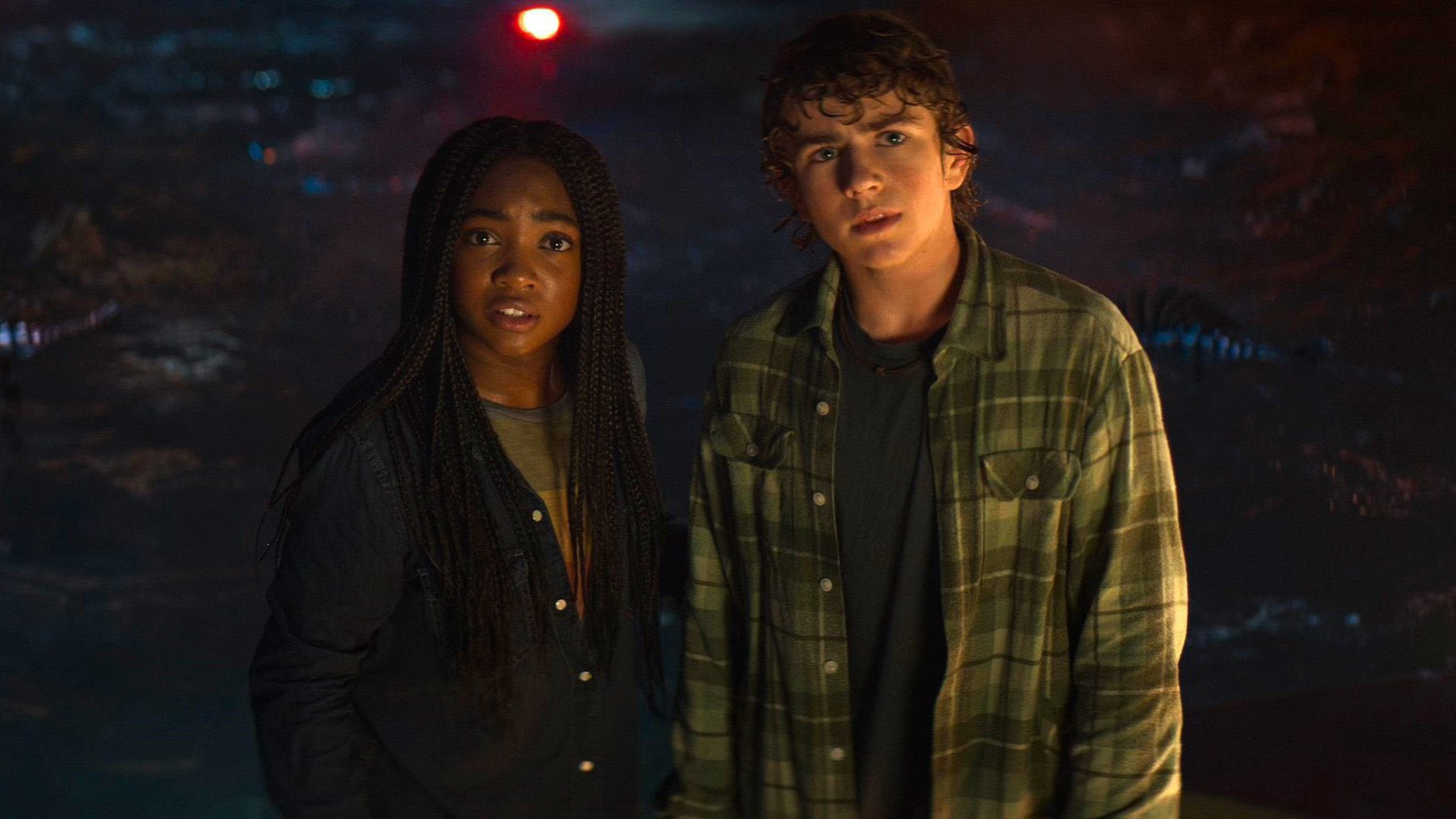

Not to be confused with its critically panned big-screen predecessor, the Disney+ adaptation of Rick Riordan’s middle-grade phenomenon novel series Percy Jackson and the Olympians is a labor of love for both the original texts and the fans themselves. Working to translate books written for a young audience into television that holds appeal to the many ages of current, former, and future Percy Jackson readers required a faithful yet transformative filmmaking lens. In the end, Disney’s new iteration of Percy Jackson and the Olympians has been lauded by many as the definitive adaptation of the series, bringing book-accurate versions of characters to the screen in actors Walker Scobell, Aryan Simhadri, and Leah Sava Jeffries while also carefully updating its story, themes, and subtexts to speak true to the creative voices of the team, including showrunners Jonathan E. Steinberg and Dan Shotz.
From Page to Screen
Middle schooler and “troubled kid” Percy Jackson’s life is flipped upside down when he is attacked by a monster during a class trip and learns he’s a demigod – half mortal, half Olympian god. When his mother is seemingly killed, the young hero finds himself fleeing the legendary Minotaur with his half-goat satyr companion and friend Grover. He takes refuge at a camp designed to keep half-bloods safe from harm, but once he is claimed by the sea god Poseidon, he is tasked with preventing a war amongst the Greek gods by recovering Zeus’ stolen master bolt. The only lead points to the Underworld, the land of Hades, where Percy also comes to believe he may be able to rescue his mother. With new purpose and resolve, he is joined by Grover and longtime camp-goer and Athena-spawn Annabeth Chase on a cross-country adventure full of peril and self-discovery.
At its core, Percy Jackson and the Olympians on Disney+ is a coming-of-age tale about children finding belonging in a world of hardship, from uncaring absentee parents to ADHD and dyslexia to life-threatening mythical monsters. Telling this story through the perspective of young people is sink-or-swim – the key to the drama, heart, and soul of the original novels. In the words of Percy Jackson showrunner and executive producer Dan Shotz (AppleTV’s See) from our exclusive interview with the cast and creatives of the Disney+ original series, “The reason why this book has lasted the way it has for 20 years and beyond is because of how kids have connected to these characters.”
Enter Scobell, Simhadri, and Jeffries, the trio tackling iconic protagonists Percy Jackson, Grover Underwood, and Annabeth Chase. Despite bearing the pressure of embodying among the most popular characters in the pantheon of modern YA fiction, the actors found freedom in their roles. “We all have that chemistry that Percy, Grover, and Annabeth had in the books, which is very helpful,” said Grover’s Aryan Simhadri. “We were all pretty big fans of the books already, so […] it was a lot easier for us to kind of click into character faster,” added Walker Scobell who plays the titular Percy.
When asked what it was like to create a series surrounding such a young cast, Percy Jackson co-creator and showrunner Jonathan E. Steinberg (Black Sails) admitted that “It is easy to forget how young they are.” On the announcement of his casting in April 2022, Walker Scobell was only thirteen. When the rest of the trio was announced in June of the same year, Aryan Simhadri was sixteen and Leah Sava Jeffries was only twelve. “There are certain things that are unavoidable challenges when you’re working with kids… some things feel like they could be restrictions on content and the complexity of the material,” Steinberg states. “What we found is, we never wrote anything assuming they couldn’t do the tougher version of it. We never dumbed anything down because we felt like they couldn’t handle it.”
Diving Deeper into the Characters
Though the original novel on which the season is based on, titled Percy Jackson & the Olympians: The Lightning Thief, is aimed at readers nine through twelve, it does reach for deeper emotions and feelings that could be seen as too mature for young actors to fully convey. And yet, Steinberg couldn’t help but sing the praises of the young cast; “Everything that was thrown at them, they didn’t just do but they wrestled with. Watching a 13-year-old try to wrestle with really complicated material and dialogue and want to get it right… very quickly you forget that person is thirteen because they’re working just as hard as anyone else we’ve ever worked with – and they’re doing just as good a job.”
Disney+’s Percy Jackson and the Olympians leans into the externalized pre-teen angst even more than its literary counterpart, channeling a more directly angry response to absentee parentism and the unfair, neglectful world of Greek gods and real-life myth. It’s not necessarily “dark” or mature, but it is a bold on-screen choice for a series led by such a young cast. “It was an education for us,” claimed Steinberg. “Sometimes when you approach these things, you ask people to do things you don’t imagine they can, they will.”
Leah Sava Jeffries echoed a similar sentiment. When it came to becoming their characters, she said, “I feel like we’re all very much mature for our age.” She plays Annabeth, a daughter of Athena neglected by her mortal father. A former 7-year-old runaway left alone to fend off hordes of mythological horrors before running into like-minded demigods, Jeffries brings a perhaps slightly more rugged and jaded perspective to Annabeth. “When us young adults are acting with actual adults, these celebrities, I feel like the dynamics were super good,” she explained. Percy Jackson stirs much of its drama by placing its young leads up against gods and monsters, and it’s that juxtaposition – in addition to their interactions with one another – that allows its stars to show off some range and bring both authenticity and originality to the adaptation.
Finding a New Identity
Adaptation can be a tricky game. Translating a story conceived and tailor-made for a different medium with its own storytelling conventions raises many challenges. Percy Jackson and the Olympians on Disney+ foregoes its first-person narration, gaining perspectives separate from the protagonist but also losing direct insight into his internal world. The fundamental question at the heart of adaptation: what does it look like to tell the same, or a similar story in a different way?
The direct involvement of author Rick Riordan and his wife and producing partner, Becky Riordan, was a major selling point of this series to those put off by previous adaptations, which they famously had gone on to publicly hate. With his guiding hand, the show promised a retelling of Percy Jackson that understood its responsibility to respect the novels and their existing audience. “Obviously, working with the Riordans, Rick and Becky, brought an authenticity to it,” Jonathan E. Steinberg explained matter-of-factly. “You are getting to work every day from minute one with the author who envisioned this and getting to really pick his brain and have him in all of these conversations from the very beginning all the way through the entire process. You’re getting to ask all the questions and have the source right there, all day every day.”
Nonetheless, adaptation is an art, and it cannot always simply echo the same words of the original work. From Jaws to The Wizard of Oz to Harry Potter, the best adaptations often improve, rework, and add to their texts, creating a distinct identity that stands alone According to Steinberg, who was involved in creating both the show’s larger story and penning individual episodic scripts, the adaptation process involved “a lot of conversations” to find the identity of Disney+’s Percy Jackson. “100-and-however-many million people read this book, and there are just as many versions of that that exist in people’s heads. So reducing it to one, to an articulated tone was a conversation amongst everyone.”
Fellow Percy Jackson showrunner and EP Dan Shotz pointed to the show’s identity stemming from subtext and emotion. “How far could you push the emotional resonance of what was underneath all of this, to bring it out in an adaptation? How far can we push this material? There are so many deep, complicated themes happening every step of the way. Especially for these kids: feeling different, feeling like you don’t fit in, feeling outside. And how far could you tell that story?” Though these elements were all present “in the writing of it,” the Disney+ series aimed to bring them to the subconscious forefront using the many tools available to the medium.
Exploring the Nuances of Parenthood
When asked about a specific element they chose to focus on and amplify from the novel, Steinberg didn’t hesitate to respond. “I think the space that Sally occupies, and what that means for all of the parents in the story – for Poseidon; Hermes with Luke; for Athena, who’s not really ever on camera but is a real character in this season.”
In the show’s first episode, Percy is suddenly thrust into the world of Greek mythology when his algebra teacher turns into a winged demon on the steps of New York’s Metropolitan Museum of Art. His close encounter with death causes him to reflect on a childhood of “imaginary” sights, from a Colchis Bull to a black pegasus, and he expresses this to his mother as a matter of concern. Percy says, “Something must be wrong with me, right?” To his surprise, his mother Sally Jackson is not surprised. It comes as a shock to Percy, but Sally talks as if she has rehearsed it for years; long ago, she met a man – a god – and Percy is their son. For Percy, this is a moment of revelation and contention, a moment that serves to contextualize his inner struggle.
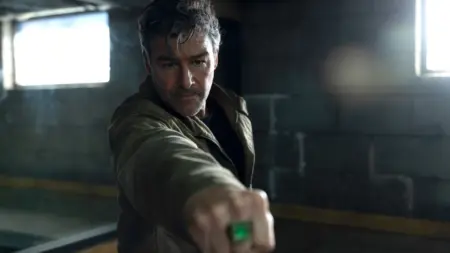
As much as “[Percy Jackson] was the story about being a different kid,” Steinberg explained, “it was important to try to make the experience of parenting a different kid present in the story.” As such, Virginia Kull’s nuanced and emotive performance as Sally evokes this moment of coming clean, revealing Percy’s visions and dysfunctions as symptoms of his godly heritage, as the culmination of her own struggle as a mother. She is a woman who can see beyond the mortal world and is forced to exist outside of it, but her child, whom she raised largely alone, suffers because of it. She has sacrificed her life and happiness to prepare him for this life – and this is the moment that sheltering barrier comes crashing down. It is a fresh perspective, a new layer to the text.
As Steinberg mentioned, this goes on to reflect upon the story’s many other parents. Percy’s positive, loving relationship with his mom compounds his strife with his father Poseidon, whom he blames for his mother’s disappearance – and for using him as a vessel to clear his name. But it goes further; parents are unavoidable in Percy Jackson. Trainees at Camp Half-Blood are defined and labeled by their Olympian parents, influencing every aspect of their lives. The show also introduces a brand new mother figure for Grover, a forest spirit who offers him comfort before he reports to the council of elder satyrs.
From contempt to respect to adoration, the attitudes of demigods towards their divine parents across Percy Jackson are all reflections of unrealistic expectations paired with a lack of parental attention and love. While for many characters it is these godly relationships that drive them to heroic feats (or otherwise), it is not a god or divine prophecy that drives the story of Percy Jackson but the relationship between a mortal mother and demigod son. The conscious decision to make this the engine of plot and emotion can be seen throughout the adaptation. Sally’s importance as an on-screen parent – and a good one, at that – further contrasts the gods’ off-screen presence, especially Annabeth’s mother Athena, and begs consideration of their own perspective on parenting.
Building a Wider Audience
Parents may not be the target audience for Percy Jackson, however, this kind of holistic consideration was key to creating a story that spoke to all audiences. “I think the one thing that held [the adaptation process] together was a deep desire for this to work for everybody,” said Steinberg. “Whether you’re nine or forty-nine or older, whether you’ve read the books or you haven’t read the books, this should not just work but be compelling and fun and engaging. I think once you agree on that, then everything else starts to live in service of it, and it starts to become a question of ‘how’ and not ‘what’.” The show tries to balance its dramatic questions with a young cast to create a compelling, thrilling narrative that maintains a light-hearted tone appropriate for all ages.
Though their attention was centered on the books, they did look elsewhere for inspiration and guidance in achieving this goal. “We talked a lot about E.T. [the Extra-Terrestrial] as a good example of a story in a movie that I loved when I was seven years old and I still love today,” states Steinberg. Director Steven Spielberg’s 1982 coming-of-age classic shares a lot of similarities with Percy Jackson, between the antics of unsupervised children, an array of untrustworthy adult figures, and the juxtaposition of the mundane and the fantastic. More importantly, however, it is an enduring story that has helped define timeless, family-friendly cinema.
On comparing his experience of E.T. as a child to that of a father, Steinberg remarked, “They’re wildly different movies for those two experiences, but both of them still work and so do many other experiences in between. I think that was sort of the unbeatable target that was set for everybody [for Percy]. This is what it looks like when you make a movie that’s really for everyone.”
The first episode of Percy Jackson and the Olympians boasted 13.3 million first-week viewers across Disney+ and Hulu, landing in the platforms’ top five premieres for the year, surrounded by sequel series and follow-up seasons. In addition to its warm critical and popular reception, the large turn-out for the franchise’s refreshed and revised return to screens is a testament to the care and craft put into its adaptation. Showrunners Jonathan Steinberg and Dan Shotz have crafted an engaging fun-for-all mythical epic that is bound to endear familiar and newcoming audiences young and old, bringing their eyes to young Walker Scobell, Aryan Simhadri, and Leah Sava Jeffries as they find their way into the lives of Percy Jackson.