

Over the past few years, Netflix has set a new standard for television adaptations of video games. Through animated TV shows like Arcane and Castlevania, the streamer has shown the right way to translate these stories into new mediums. Despite their widespread successes, Netflix’s approach to these IPs is, surprisingly, far from formulaic. Arcane and Castlevania’s similarities end at being animated, with their tones and art styles being altered to suit those specific stories. Netflix’s Tomb Raider: The Legend of Lara Croft is also specific to its iconic character, finding the perfect way to express the appeal of the best-selling Tomb Raider video games in an animated series.
Passion for the franchise is a baseline requirement for anyone taking on an adaptation like this. Tasha Huo (The Witcher: Blood Origin), the showrunner of Tomb Raider: The Legend of Lara Croft, fits the criteria perfectly, first hearing about the project after its producer spotted Huo posting about her Shadow of the Tomb Raider playthrough on Facebook. Fittingly, Tomb Raider: The Legend of Lara Croft picks up where the Survivor trilogy of games (Tomb Raider (2013), Rise of the Tomb Raider, and Shadow of the Tomb Raider) leaves off, filling in the gaps of Lara’s story between the prequel series and classic era of the franchise.
Tomb Raider: The Legend of Lara Croft operates on a “problem of the week” structure as the titular heroine embarks on increasingly more perilous solo adventures each episode, with an overall arc running in the background. Lara Croft, voiced by Hayley Atwell of MCU and Mission: Impossible fame, has to confront man, nature, spirits, and her own past in pursuit of uncovering an Infinity Gauntlet–like ancient mystery revolving around the Peril Stones. However, the appeal of this Netflix original animated series comes less from its plot and more from its presentation.

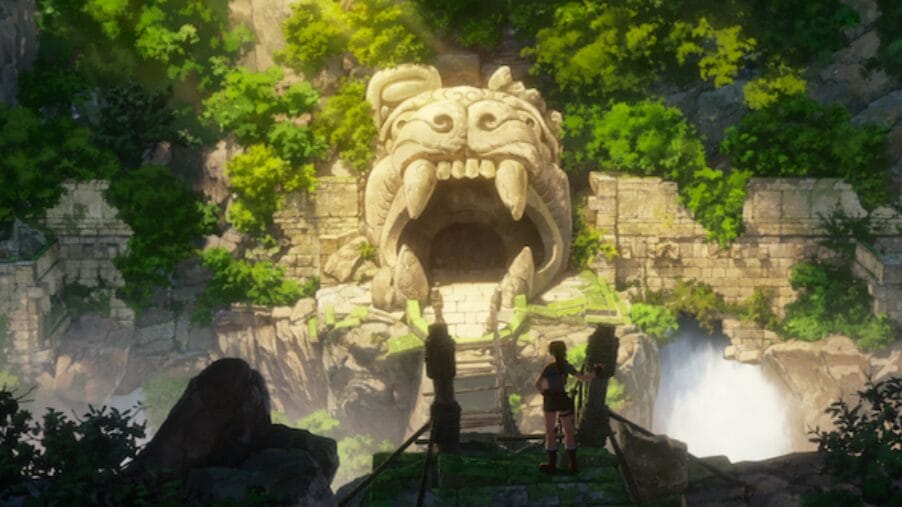
Animated by Powerhouse Animation Studios — the team behind Netflix adaptations like Castlevania, Masters of the Universe: Revelation, and Skull Island — the Netflix show is able to communicate the joys of playing the Tomb Raider games through its visual language. As Lara Croft trots from continent to continent, each locale is rendered with vibrant colors, distinct architecture, and unique puzzles for her to unravel. On that note, Tomb Raider: The Legend of Lara Croft excels at adding layers of surreality to existing cultures and histories, translating that feeling of never quite knowing what dangers lie around the corner that’s so present in the games.
The designs of secret passageways and abandoned tombs, as well as the elaborate schemes of art thieves and suspicious billionaire benefactors, are simply so fun to watch. Who wouldn’t get an adrenaline rush from placing a tile into the correct slot, inducing a gust of wind, indicating that you’ve completed the puzzle? These basic pleasures and the show’s puzzle/problem of the week structure not only simulate the progression of a video game but also make Tomb Raider: The Legend of Lara Croft feel like a cozy Saturday morning cartoon.
There are inherent limits that come with emulating a Saturday morning cartoon, though. While the 2D painted backgrounds are lush and gorgeous throughout the Netflix show, character models and facial expressions can look stiff and inexpressive. This limits the emotional depths that Tomb Raider: The Legend of Lara Croft is otherwise very interested in plowing. Lara Croft is raw, unformed, and traumatized here, and the surreal elements of the story allow her to explore her internal feelings and evolve into her true self. Complex emotions can require complex animation, not quite aligning with the way the rest of Netflix’s Tomb Raider animated series keeps things simple.
These same downfalls don’t apply to the action, which really thrives within this framework. Lara Croft’s emotional immaturity makes her a bruiser in battle with fight scenes that get as gnarly as the PG rating will allow. Real thought was put into Lara’s moveset and the dynamism in her fighting style. Parkour is a huge part of the Tomb Raider games, and Lara’s athleticism is on incredible display here as she chases and fights her opponents. Distinct fighting styles can be challenging to express, but Tomb Raider: The Legend of Lara Croft does a great job of distinguishing between characters holding back and someone like Lara — the kind of hero who is sometimes fuelled by revenge.
The writing of Lara Croft’s character adds some texture to what you would expect from a Saturday morning cartoon. There’s a balance to be struck between a genuine exploration of Lara’s demons and the pulpy, heavy-handed dialogue that is part of the cheesy joy of this kind of show. Hayley Atwell’s charming depiction of Lara’s sarcasm, stoicism, and resilience leaves enough room for it to be punctured by brief moments of softness, understanding, and empathy, usually brought about by her supporting cast.
These supporting roles are strong in terms of what they mean to Lara, bringing out different shades of her rage and pain. But, as individuals, they lack the depth to make the world of Tomb Raider: The Legend of Lara Croft living and breathing. Too many characters who are essential to the plot are written like NPCs waiting for Lara to interact with them — not something you want to maintain in video game adaptations.
This is symptomatic of the show’s dialogue, which is often too hollow. Exposition becomes a chore to get through, especially in a globe-trotting adventure series that otherwise highlights action and breezy transitions from one plot point to another, even if it means sacrificing some subtlety. Additionally, the banter between characters can hit and miss. Lines are robbed of their comedy by extreme predictability. The odd line will really land, like a hilarious one about Lara’s sparse use of deodorant, but many others just feel like empty air.
Ultimately, both the pros and cons of Tomb Raider: The Legend of Lara Croft contribute to the Saturday morning cartoon experience. It’s exhilarating and flawed, stunning and cheesy, colorful and messy, all in the same breath. It plays the notes it’s supposed to, making for an undeniably thrilling viewing experience. With only eight episodes, however, the show isn’t given the time to unlock its full potential. The best part about this Netflix series is the puzzle-of-the-week structure, which would thrive with more puzzles over more weeks. Classic cartoons became part of people’s lives because of their omnipresence, and shows like Tomb Raider: The Legend of Lara Croft deserve more time in a single season to cement their fantastic foundations.
Tomb Raider: The Legend of Lara Croft premieres on Netflix on October 10!
Premiere Date: October 10, 2024.
Developed by Tasha Huo.
Based on Tomb Raider by Crystal Dynamics.
Showrunner: Tasha Huo.
Executive Producers: Tasha Huo, Dmitri M. Johnson, Timothy I. Stevenson, Jacob Robinson, Dallas Dickinson, Noah Hughes, Howard Bliss, Jen Chambers, & Brad Graeber.
Main Voice Cast: Hayley Atwell, Allen Maldonado, Earl Baylon, Richard Armitage, & Zoe Boyle.
Production Companies: Crystal Dynamics, Legendary Television, DJ2 Entertainment, & Tractor Pants.
Episode Count: 8 (Season 1).