


When Insomniac Games first released Marvel’s Spider-Man for the PlayStation 4, the catchphrase “this game makes you feel like Spider-Man” quickly grew into a viral meme, pointing out a repetitive writing cliché many journalists would use to praise its mechanics. That phrase did carry some truth, though. Something special about Insomniac’s adaptation made it one of the most praised video games of 2018. In designing the game around his signature character traits and qualities, Marvel’s Spider-Man perfectly balanced all facets of the titular hero, not just narratively but also mechanically — the player’s experience was just as much about helping out the local homeless shelter, science experiments, and building community as it was about saving the world.
The success of Marvel’s Spider-Man has seemingly paved the way for a renewed interest in licensed games, catering both to gamers and fans of multimedia IPs. After an exclusivity license with Electronic Arts (EA) ended in 2021, Disney worked hard to push Lucasfilm properties to other game studios. This led to a project with Bethesda Softworks, fresh off its acquisition by Microsoft, based on Indiana Jones. Finally, the game has arrived as Microsoft’s Xbox/PC blockbuster holiday 2024 exclusive release. Thankfully, despite The Dial of Destiny ending the movie franchise on a lackluster note last year, Indiana Jones and the Great Circle is an outstanding globe-trotting adventure that captures the swashbuckling thrills of Steven Spielberg and George Lucas‘ original films.
Bethesda subsidiary studio MachineGames (known for the Wolfenstein games) has done exactly for Indy what Insomniac did for Spider-Man: craft fun gameplay and a compelling narrative that feels true to the brand but also personifies the character in their own unique way.
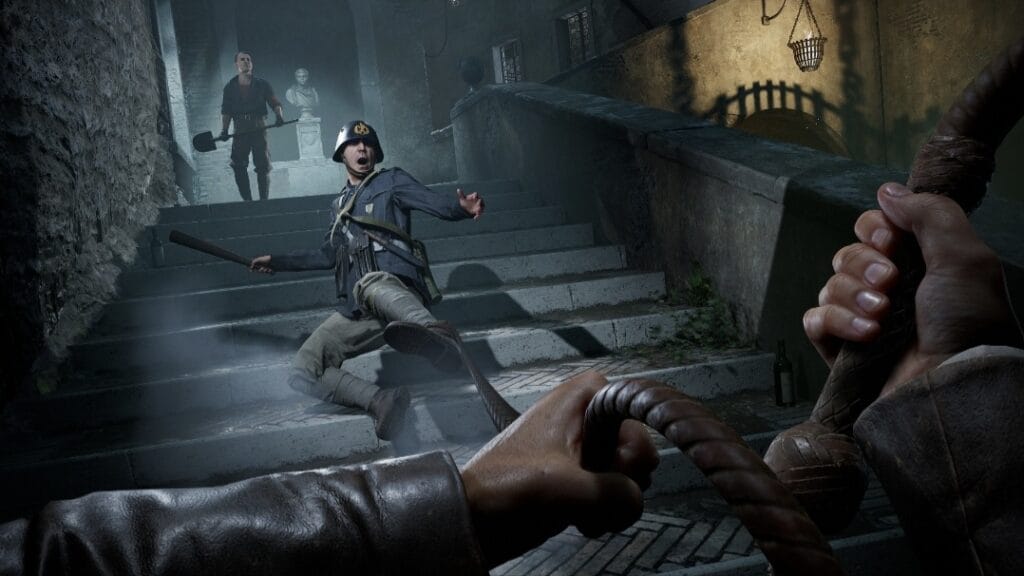
Set in 1937 between the events of Raiders of the Lost Ark (the game’s tutorial level being a recreation of the iconic boulder scene) and The Last Crusade, The Great Circle catches up with our beloved professor/archeologist after the theft of a seemingly unimportant artifact from the halls of Marshall College. When Indiana Jones (Troy Baker) then comes face to face with a mysterious colossal man named Locus (voiced by the late Tony Todd), he and his new companion, Gina Lombardi (Alessandra Mastronardi), are whisked away into a race against the Nazis. Once again, the Nazis are determined to unleash and conquer an ancient power, but one unlike anything seen before in the series.
Crucially, unlike many of the older “extended universe” Indy tales, Indiana Jones and the Great Circle cracks the tricky combination of reality and fantasy that the original trilogy excelled at. Though the initial first act starts out slow, mostly using the plot as a device to introduce the player to the game’s numerous level types and settings, the story eventually finds its footing and, more importantly, motivates the player to engage with everything the game has to offer. MachineGames opts for more traditional linear levels mixed between a vast array off dense open-area maps that are full of sidequests, collectibles, and optional lore.
As someone who is burnt out by the popularity of the open-world/sandbox genre, it’s refreshing to note that every piece of optional content that I engaged with in Indiana Jones and the Great Circle was rewarding and worth the time. Whether it was as small as photographing historical landmarks, tangential side stories, or traversing through entire temples, nothing in the game ever plays like filler or recycled content, which is often a problem with elongated and bloated big-budget titles. One sidequest in the sunken temples of Sukhothai is an interesting exploration of Indy’s psyche in the form of a surprising homage to Hideo Kojima’s P.T. I was floored that a sequence so well-designed could be missed entirely!

Indiana Jones and the Great Circle is mostly presented from the first-person perspective. This creative decision was first met with controversy, but it turns out to be a risk that was worth taking to build the game its own identity further. The beautiful vistas and meticulous details are a spectacle to behold, and there is a sense of scale and depth that the first-person camera benefits from. With the beefy technical requirements for PC (you must own a graphics card capable of ray tracing to run the game) or the expensive new console that is needed, it can at least be appreciated that The Great Circle is fully taking advantage of what the tech has to offer.
The way light bounces around walls and obstacles when you hold a torch through a dark cavern or the seamless transitions from cutscenes to gameplay make Indiana Jones and the Great Circle feel like one of the first truly “next-gen” experiences to be offered in this current gaming generation. Harrison Ford’s likeness is lovingly rendered in all of the cutscenes and platforming sections of the game. So, thankfully, you won’t be missing out on Indy’s ruggedly handsome face, either.
One thing that has inhibited the Indiana Jones franchise from growing is finding an actor who can match Ford’s inherent charm and abilities. While this is an uphill battle in live-action, there was still some natural skepticism when it was announced that Troy Baker (one of the most heard voices in gaming) would take on the role here through VA and motion capture. However, Baker proves that he’s earned his notable position in the VA industry for a reason. Baker’s performance as Indy is a great compromise between sounding enough like Harrison Ford and still bringing his distinct edge to the character.
Troy Baker’s Indy speaks much more often than Harrison Ford usually does, naturally, since this is a full 20 to 30-hour game compared to a 2-hour movie. To further compromise, Baker gives us perspectives into Indy’s inner thoughts as he commentates through fiendish puzzles or interacts with the NPCs. There’s a sense of vulnerability and quirkiness to the character that we don’t see in the break-neck speed of the films. When he’s not being a cool action hero, Indy is a little nutty and neurotic in those “between” moments, especially in contrast to his companions. Meanwhile, Alessandra Mastronardi’s Gina and Tony Todd’s Locus hold up their own and become truly lovable additions to the franchise’s prestigious supporting cast.
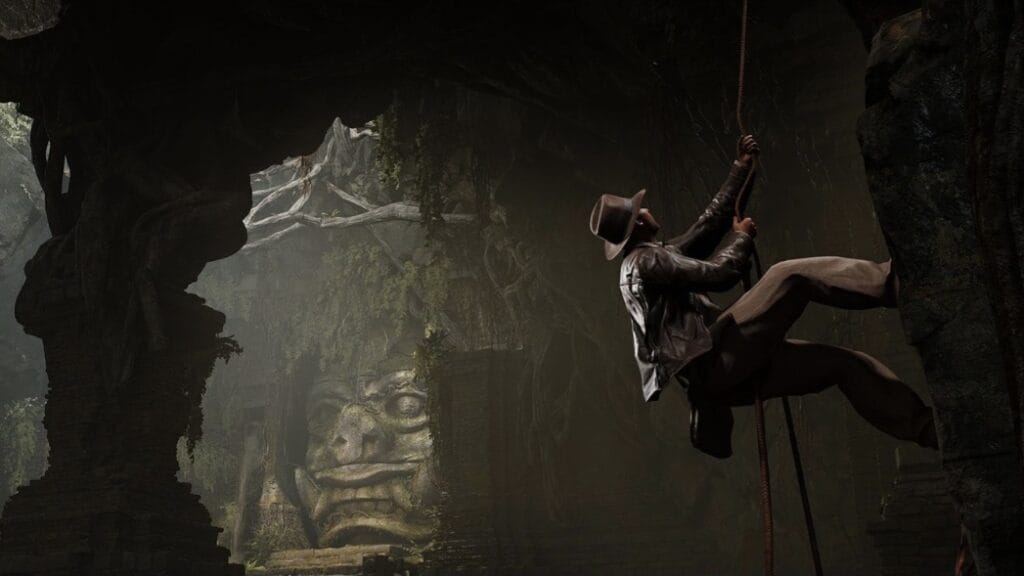
Gameplay-wise, Indiana Jones and the Great Circle balances the different tones of the IP with grace. Equal time is dedicated to energetic, high-stakes action setpieces and quieter moments of discovery. Typically, playing as Indy requires the player to approach combat situations stealthily and resourcefully. Players can scale the difficulty with preset or custom options (a wonderful accessibility feature, which this game has an abundance of). However, in all difficulties, just shooting everyone with a gun is incredibly ineffective.
Rather than simply heading into any scenario guns-blazing, Indy can pick up random objects in the environment and use them to beat up his enemies improvisationally. It makes for a clever and fitting approach to combat for a character that is often using his wit to defeat goons twice his size in the movies. It never gets tiring using a shovel to sneak attack a Nazi soldier or push them into pits, and it’s in these moments that you realize MachineGames completely understands what makes this character who he is.
The story and development team have left their mark on Indy in a way that the latest sequels have always struggled to. In The Great Circle, Indy is fully fleshed out as a person, and that is largely represented by what the player is allowed to do in moment-to-moment gameplay. MachineGames shows us that Indiana Jones is an archeologist/professor whose knack for adventuring is fueled by a passion for humanity and preserving history and culture. Moreover, the development team has put great care into ensuring every location you visit in the game is portrayed as authentically as possible.
You get to see Indy connect with people from all kinds of backgrounds, eat and engage in different cultural foods/traditions, and get to know Indy’s allies in a deeper sense than the antiquated way the movies did in their time. These are small details, yes, but they give the player an immediate sense of what can be lost if Indy doesn’t fight against his Nazi enemies. Indiana Jones and the Great Circle is a modern, inspired take on the titular hero that feels like a natural evolution of the franchise’s spirit, and it’s done with a sophistication that Lucasfilm is currently struggling to pull off in their live-action projects.
What’s most impressive about Indiana Jones and the Great Circle is that the film franchise has already made such a noticeable impact in the gaming world. Steven Spielberg and George Lucas’ core Indy adventures have served as inspiration for gaming icons such as Lara Croft of the Tomb Raider franchise and Nathan Drake from Uncharted. It would be simple and possibly effective enough to make an Indiana Jones game directly copying and pasting the gameplay and structure of those games to a tee. But MachineGames went back to the drawing board to make a superb game that is so distinct from its genre competitors that it reminds us why Indiana Jones is a character we have celebrated for decades.
Indiana Jones and the Great Circle releases on Windows and Xbox Series X/S on December 9!
Release Date: December 9, 2024 (Windows, Xbox Series X/S) & 2025 (PlayStation 5).
Developed by MachineGames.
Published by Bethesda Softworks.
Game Director: Jerk Gustafsson
Creative Director: Axel Torvenius.
Lead Writer: Tommy Tordsson Björk.
Producers: John Jennings, Mattias Duclos, & Mariusz Macieja.
Composer: Gordy Haab.