

The new musical biopic Better Man dares to ask: who is Robbie Williams? It’s a question that applies equally to those not in the know about the notorious, award-winning British pop star, as well as those who have been following his career in the limelight ever since he was a teen. While those two groups can generally be labeled as “Americans” and “Brits,” don’t discount us Yank Anglophiles — there are dozens of us!
It would have been easy — or, more to the point, lazy — to make a biopic about Robbie Williams that was too fawning, too ready-made for his fanbase, and too dull. After all, Williams’ life and career have followed a typical trajectory in the broadest of strokes: a cocky young man, desperate to prove himself and earn the admiration of a wayward parent, gains an overwhelming amount of music fame at a young age. Following a failed romantic relationship, struggles with substance abuse, and some controversial run-ins with the press, he falls from grace and stages what could be one of the greatest comebacks of all time.
But in the hands of co-writer/director Michael Gracey (The Greatest Showman) and Williams himself, Better Man is the most atypical biopic made yet. The biopic, particularly the music biopic, has been under intense scrutiny ever since Jake Kasdan and Judd Apatow’s Walk Hard: The Dewey Cox Story was released in 2007. Thanks to that film’s pitch-perfect satire of the subgenre (using James Mangold’s Walk the Line and Taylor Hackford’s Ray as its biggest touchstones), numerous critics and pundits hence declared the music biopic to be a thing of the past.
However, despite uninspired efforts like Bohemian Rhapsody, Back to Black, and Bob Marley: One Love (or perhaps because of their varied box office and awards success), the music biopic has continued unabated. To be sure, the subgenre has tried to grow beyond the shots fired at it from Walk Hard, the admirable efforts of Rocketman being one example. There’s also a distinct difference between Mangold’s Walk the Line and this year’s masterful A Complete Unknown. But in general, the musical biopic has survived for much of the same reason that the slasher movie endures: the tropes are all part of the pleasure.
Courtesy of Paramount Pictures
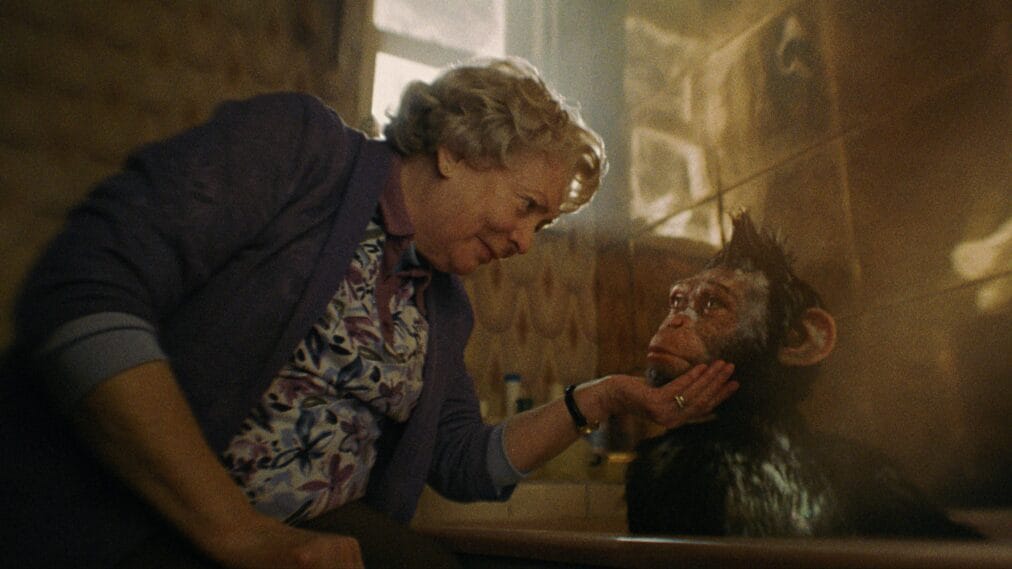
As previously mentioned, Michael Gracey’s Better Man doesn’t necessarily avoid such tropes in its rise-fall-rise-again structure. It introduces us to Robbie Williams as a young boy living in Stoke-on-Trent. The young Robbie enjoys the love of his grandmother, Betty (Alison Steadman), and his mother, Janet (Kate Mulvany), all while yearning for the approval of his father, Peter (Steve Pemberton), who soon leaves the family to pursue a comedy career. Then, upon landing a chance to audition for the opportunist producer Nigel Martin-Smith (Damon Harriman), his natural charm and snarky confidence open the floodgates, giving him a first taste of stardom as a member of the boy band Take That.
Robbie tragically falls down a self-destructive path, battling his own ego and image with substances, which leads to a falling out with the other members of Take That. Going solo, though, is what brings him face to face with one of the loves of his life, All Saints member Nicole Appleton (Raechelle Banno). Williams eventually finds his true voice as a solo artist, his songwriting acting as a transparent window into the tragedy he’s endured. Unfortunately, his self-hating downward spiral only gets worse, making Robbie push away whatever love and support he has left. Frankly, this is all fairly standard stuff for a biopic of a musician, especially one who’s still alive.
How Robbie Williams gets himself out of this dark hole and makes a successful comeback can be easily found on his Wikipedia page. However, and this is a massive however, there’s the elephant in the room, or should I say, monkey. That is the fact that Williams is not portrayed as a human being, as is everyone else in the film. No, in Better Man, he’s represented by a CGI monkey-man hybrid, with Jonno Davies and Williams himself sharing acting duties while wearing a mo-cap suit that has been replaced in post-production with a monkey character by the wizards at Wētā FX.
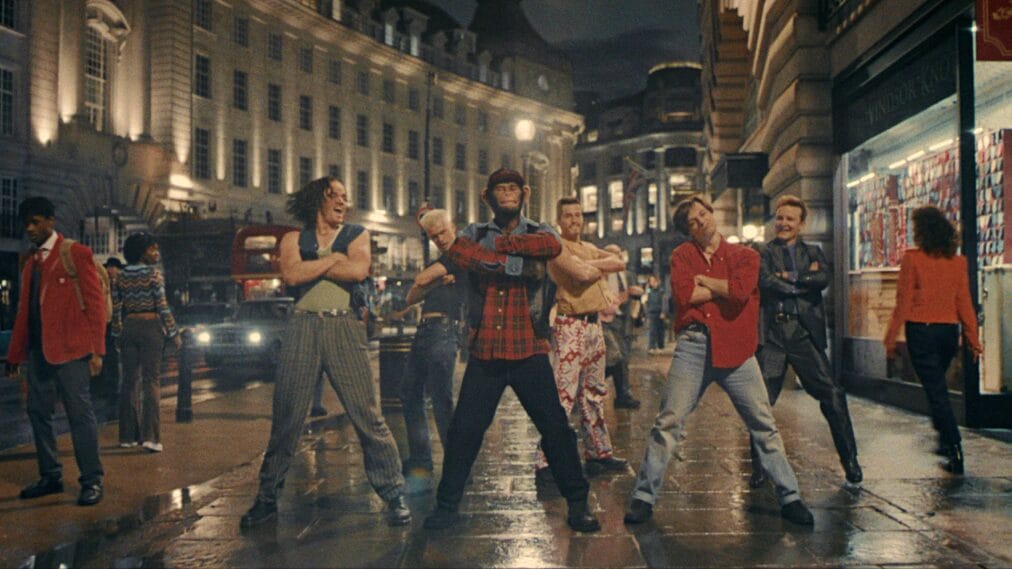
In terms of how monkey Robbie Williams looks and acts, he’s not all that different from the remarkable apes Wētā helped create earlier this year in Kingdom of the Planet of the Apes. Regarding why filmmaker Michael Gracey and company chose to have Williams represented by a monkey figure, stories vary; some sources say Gracey heard Williams refer to himself in one interview as a performing monkey, and others claim that Williams feels “less evolved” than those surrounding him. In truth, the “why” doesn’t matter, as the effect the monkey has on the movie as a whole is so audacious and astounding that it elevates Better Man from being a rote biopic into one of the most original ever made.
The inclusion of CGI monkey Robbie Williams is all the license Michael Gracey needs to really pull out all the stops for Better Man as a musical. Most biopics tend to avoid the trappings of an integrated musical, erring on the side of caution by presenting their musical sequences as staged performances. Even when Better Man has Williams and others performing to an audience, Gracey throws all pretense of realism to the wind, surprisngly more so than Baz Lurhmann did in the maximalist visual essay that he made out of Elvis.
Demonstrating his mastery of composition and choreography even beyond his previous work in The Greatest Showman, Michael Gracey makes every note of the musical numbers in Better Man count for as much as possible. Moreover, the precise and clever staging of the “Rock DJ,” “She’s the One,” and “Angels” musical sequences puts every other musical this year to shame. Gracey’s visual audacity lands somewhere between a modern Busby Berkeley picture and an alternate timeline where Michael Bay got super interested in dance combinations instead of explosions. At every turn where Robbie Williams’ external and internal conflicts might feel too overwrought or his arrogance might start to grate, Gracey illuminates these emotions with such visual aplomb that they become irresistibly compelling.
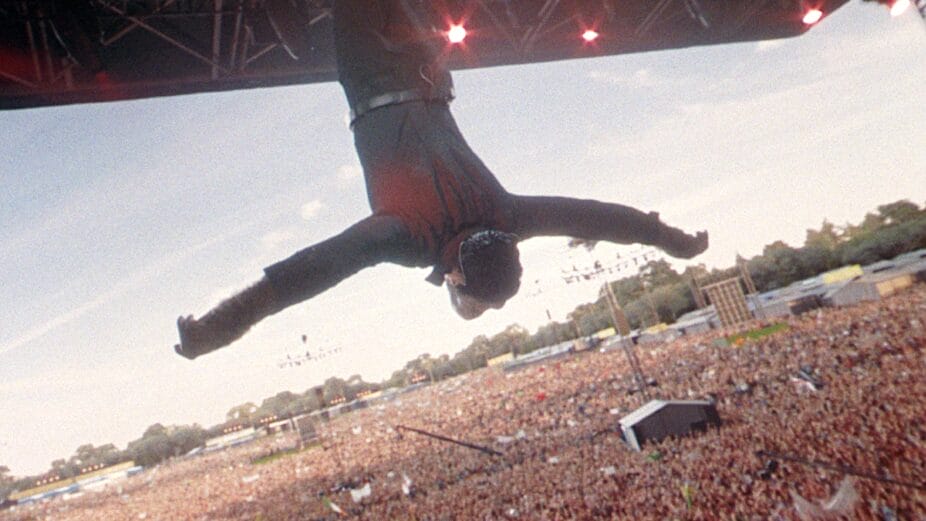
Despite all of its maximalism and flirtation with vulgar auteurism, Better Man isn’t a mere lark or a flight-of-fancy. It’s a fascinatingly complex biopic beneath the surface, one which sees the film and Williams himself vacillate between irreverence and seriousness, between arrogance and self-loathing. There are many potential villains in Better Man — a too-rabid fanbase, predatory music industry authority figures, terrible parenting — yet the script points out time and again how Williams, or at least different facets of himself, is his own true antagonist.
Early in the film, one scene demonstrates how “Robbie Williams” isn’t technically even the real man born Robert Peter Williams, as “Robbie” becomes an identity he can hide behind. In this case, the CGI monkey becomes just another facade, a way that Williams can be honest about himself without having to be himself. The totality of Williams’ life is not necessarily encompassed in Better Man, and it can’t really be until long after he’s left us. His still ongoing struggle with his fame and legacy, though, is what makes Better Man remarkable, and more than worthwhile to anyone who can or cannot answer the question of who Robbie Williams is. After all, Williams can’t quite answer that question, either.
Better Man releases in select theaters on December 25 and then expands nationwide on January 10, 2025!
Release Date: December 25, 2024.
Directed by Michael Gracey.
Written by Simon Gleeson, Oliver Cole, & Michael Gracey.
Produced by Michael Gracey, Craig McMahon, Coco Xiaolu Ma, Jules Daly, & Paul Currie.
Executive Producers: Markus Barmettler, Domenic Benvenuto, Gianni Benvenuto, Zhe Chen, Li-Wei Chu, Daniel Fluri, Adrian Grabe, Dean Hood, Gregory Jankilevitsch, Andres Kernen, Philip Lee, Michael Loney, Stephen O’Reilly, Nina Parnaby, David Ravel, Thorsten Schumacher, Klaudia Smieja, Lars Sylvest, Slava Vladimirov, Andjelija Vlaisavljevic, & Mark Williams.
Main Cast: Robbie Williams, Jonno Davies, Adam Tucker, Steve Pemberton, Alison Steadman, Damon Herriman, Raechelle Banno, Anthony Hayes, Kate Mulvany, Frazer Hadfield, Jake Simmance, Liam Head, Jesse Hyde, Chase Vollenweider, John O’May, Chris Gun, Jack McMinn, & Jamie Condon.
Cinematographer: Erik A. Wilson
Composers: Batu Sener (score) & Robbie Williams (songs).
Production Companies: Sina Studios, Facing East Entertainment, Rocket Science, Lost Bandits, Footloose Productions, Azure Centrum, Partizan Films, & VicScreen.
Distributors: Paramount Pictures (United States), Entertainment Film Distributors (UK), & Roadshow Films (Australia).
Runtime: 135 minutes.
Rated R.