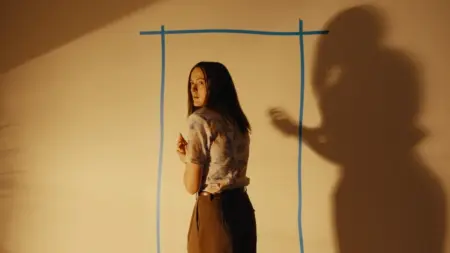


Josephine (2026) is a tale about the exact moment the world breaks open for a child, and the unbearable realization from their parents that it can’t be put back together again. Writer-director Beth de Araújo’s second feature film opens with the titular 8-year-old (played with remarkable clarity by newcomer Mason Reeves) bearing sole witness to a paralyzing act of sexual violence, one that immediately reframes everything that follows. From there, Josephine is not so much about the incident itself as about the fallout and the way trauma echoes, mutates, and embeds itself in daily life.
Araújo’s script focuses on the evils of man, specifically, the impossibility of explaining those evils to a kid without either lying to them or destroying something essential within them. How do you protect your child when the darkness of the world has already found them? Making its premiere at Sundance 2026, it’s no question that this devastating, formally immaculate drama is one of the very best of the fest.
Josephine is Psychologically Haunting
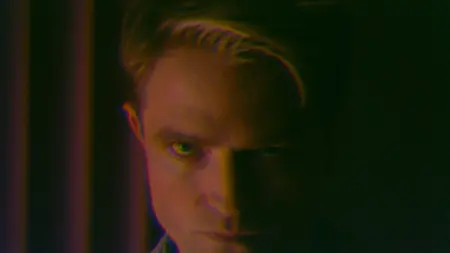
The film’s central horror is not just about what happens, but also what cannot be undone. Josephine begins seeing the perpetrator of the opening crime (played by a quietly terrifying Philip Ettinger) everywhere she goes — in public, at night, and in the privacy of her home, where safety should exist. It’s a brilliant layering of psychological horror, not because the movie leans into jump scare genre mechanics, but because it understands that trauma feels like being watched forever. The threat becomes omnipresent. Safety becomes theoretical.
Filmmaker Beth de Araújo, best known for the 2022 psychological thriller Soft & Quiet, flaunts astonishingly deliberate direction. Not a single frame is wasted, and no scene of reflection or meditation overstays its welcome. Every creative decision serves the emotional truth of the story. From Araújo’s dialogue to cinematographer Greta Zozula‘s camerawork to the beats of Miles Ross‘ score, each major narrative tool is precisely calibrated toward Josephine’s inner life. De Araújo’s vision is as honed as it can be, and she refuses to look away from the consequences.
The Weight Parents are Never Prepared to Carry
Channing Tatum (Roofman) delivers what is arguably the finest performance of his career as Josephine’s father, Damien, a man who is neither cruel nor negligent. However, as any loving father would be, he is fundamentally unsuited for this situation. Damien keeps saying the wrong things and giving his daughter questionable advice, not out of malice but out of desperation. He wants to fix what cannot be fixed, to muscle his daughter out of a reality that he knows no longer follows rules. That tension is where Josephine finds its deepest pain.
Parenthood is accurately framed in Josephine as an emotionally draining battle between comfort and confrontation; between sensitivity and sensibility; between protection and preparation. You are tasked with building your child into someone strong enough to endure the terrors of adulthood, while also preserving their innocence for as long as humanly possible. They are only going to be a kid once. When that window closes too soon, regardless of whether it’s by accident or not, there is no roadmap for what comes next.
Two Sides of the Same Parental Coin
Alongside Tatum, Gemma Chan (Crazy Rich Asians) turns in career-best work of her own as Josephine’s mother, Claire. She embodies a different kind of grief. It’s quieter and more internalized, though no less consuming. Where Tatum’s performance spirals outward, Chan’s collapses inward. Together, they form a portrait of a marriage under strain. While their love is as strong as ever, both parents are drowning in the same fear from opposite sides. The two are forced to continually reinvent themselves as role models for their rapidly changing daughter, a fear any parent can deeply relate to.
One of the film’s more excruciating elements involves the legal process surrounding the incident, forcing Josephine to relive her trauma again and again. The frustration is overwhelming for both the audience and Josephine herself, who is powerless in a system that prioritizes procedure over healing and (let’s face it) the comfort of men over the justice women deserve. It’s an infuriating, yet absolutely essential aspect of the movie. Trauma doesn’t resolve neatly, and justice, if it ever comes at all, rarely arrives gently.
Real-Life Horror Without Exploitation
What makes Josephine so extraordinary is its refusal to exploit its own darkness. Beth de Araújo is unapologetic in her visuals and themes; however, she refuses to let her movie collapse into a spectacle of misery. Even at its most harrowing, there is warmth to be found: brief occasions of tenderness, flashes of joy, and the silent resilience of a child who refuses to stop asking questions. Mason Reeves is nothing short of astonishing. It is rare to see a child actor carry this level of emotional complexity (and indeed, an entire film) without a single false note.
Rarer still is to see it handled with such respect by the camera. Josephine is never framed in a way that reduces her to a symbol or a victim. She is allowed confusion, curiosity, anger, bravery, and fear in equal measure. Josephine understands that the true loss of innocence is not the loss of joy, but the loss of certainty — the moment when a child finally realizes their parents are people too, wounded in their own ways, and that they do not have all the answers. That realization is, perhaps, the most frightening thing of all.
Hope Without Denial
Despite its incredibly heavy plot, Josephine is not a nihilistic film by any means. There is beauty to be found in the pouring rain. There is catharsis in honesty, and there is hope in the act of moving forward, even when the world reveals itself to be brutal, irrational, and unforgiving. Beth de Araújo correctly suggests that although fairness may wash away, whether gradually or all at once, the fight for justice, empathy, and understanding need not.
By the time the movie reaches its conclusion, the emotional weight is genuinely staggering. The kind of devastation that leaves you sobbing as the unavoidable nightmares of modern society come crashing in. Josephine is an essential film — intimate and earnest in its bold storytelling. A masterclass about the cost of growing up, the terror of parenting, and the impossible, yet endearingly hopeful task of teaching a child how to survive a world that has already failed them.
★ ★ ★ ★ ★
Josephine premiered at the 2026 Sundance Film Festival!
Release Date: TBD.
Directed by Beth de Araújo.
Written by Beth de Araújo.
Produced by Beth de Araújo, Channing Tatum, Gemma Chan, David Kaplan, Josh Peters, Marina Stabile, Joshua Beirne-Golden, Mark H. Rapaport, & Crystine Zhang.
Executive Producers: Eve Brigham, Reid Carolin, Diana Chen, Norman Chen, Brantley Gong, Hannah Janal, Masum Momaya, Rhian Moore, Heather Nodelman, Oleg Nodelman, Emanuel Nunez, Jennifer J. Pritzker, Jordan Rapaport, Robina Riccitiello, & Michelle K. Sugihara.
Main Cast: Gemma Chan, Channing Tatum, Mason Reeves, Philip Ettinger, Syra McCarthy, Eleanore Pienta, & Michael Angelo Covino.
Cinemotographer: Greta Zozula.
Composer: Miles Ross.
Editors: Anisha Acharya, Nico Leunen, & Kyle Reiter.
Production Companies: Kaplan Morrison, Vibrato, Kinematics, Spark Features, & Free Association.
Distributor: TBA.
Runtime: 120 minutes.