
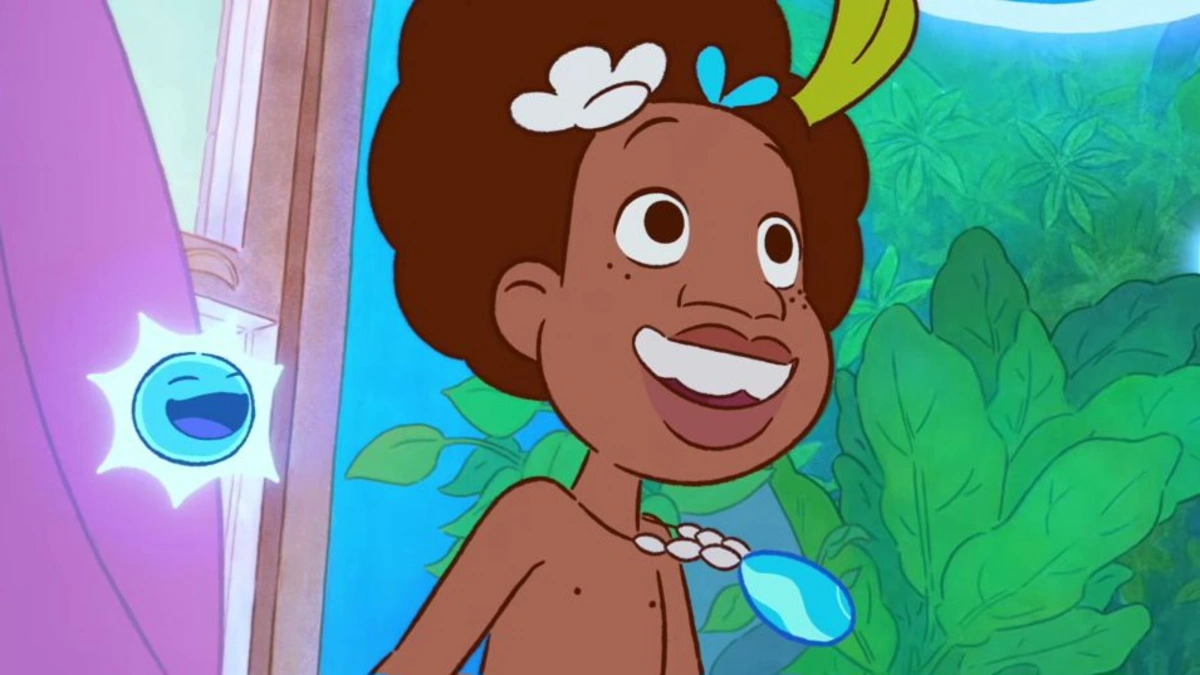

We didn’t need further proof that Cartoon Saloon are experts at animated wonder, whimsy, and charm, yet Julián (2026) exists. The Irish animation studio made its name by adapting folklore from its home country into epic 2D-animated masterpieces, including The Secret of Kells (2009), Song of the Sea (2014), The Breadwinner (2017), and Wolfwalkers (2010). Now, working alongside Aircraft Pictures, Melusine Productions, and Sun Creature, Saloon are removed from their home soil, setting the story in the melting pot of Brooklyn, New York. Julián‘s greatest strengths come from its vibrant environment, which perfectly matches the energy of its larger-than-life main character and his intimate journey to find his true self.
Julián (voiced by young newcomer Knyght Darius Jack) is a 7-year-old boy of Dominican descent who spends the summer with his abuela (Milcania Diaz-Rojas). This premise is a straightforward but effective arena for a coming-of-age tale. In cinema, grandparents often represent a path to understanding your roots, but are also usually enforcers of restrictive tradition. Both of these are put in front of Julián almost immediately, with the first meal his grandmother cooks being a far cry from the Americanized palette he’s developed. The film doesn’t feel the need to be too overt about Julián’s whitewashed upbringing; a simple line like “Thank–Gracias” fully conveys the divergence between his Caribbean heritage and how he was raised in the States.
What Comes Before a Queer Awakening
Personal conflict arises when Julián, forever obsessed with marine life, is smitten by a mermaid parade taking place in town, and looks to tailor his own flamboyant costume. The story is not subtle about Julián being gay. It’s one of the main reasons why Oscar-nominated director Louise Bagnall (Late Afternoon) and screenwriter Juliany Taveras looked to adapt Jessica Love’s award-winning 2018 children’s book Julián Is A Mermaid. However, Julián himself is not aware of his own identity yet, without the language or the tools to truly understand the concept of sexuality. This puts him in a wonderfully liminal space, one that perfectly resembles the pre-teen phase we all go through.
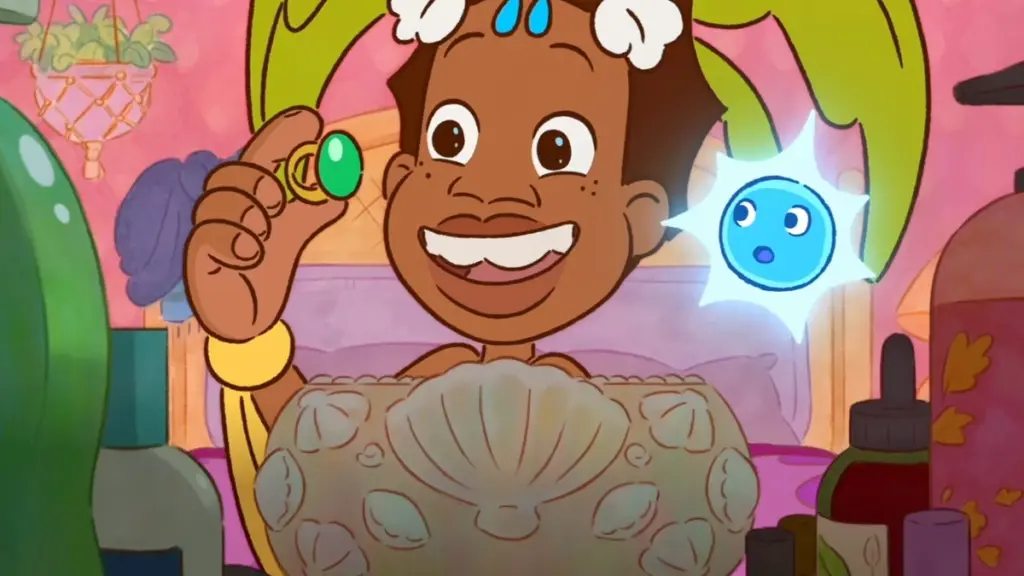
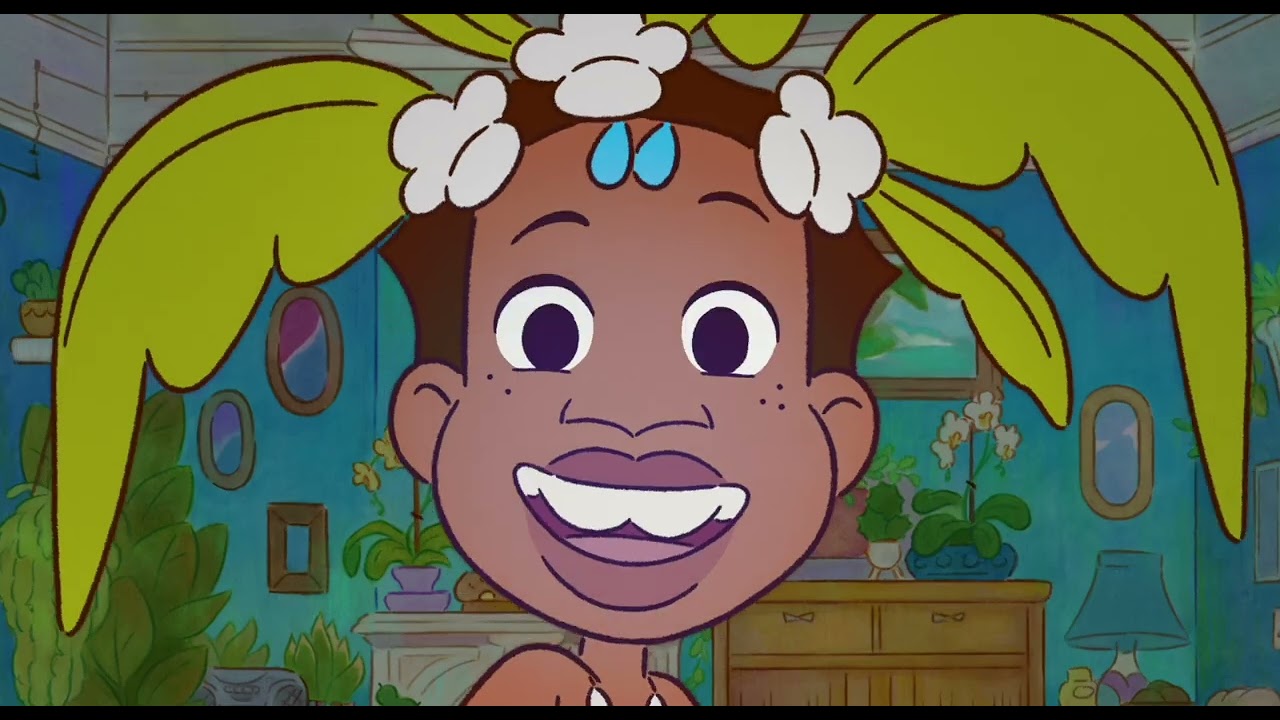
We look to be ourselves as loudly as possible, but fear being shut down by the world. Julián encounters resistance to his personality from outside his bubble for the first time and grows in a deeply satisfying way. His design is a fine example of Cartoon Saloon’s ability to express depth through simplicity. Julián’s teeth show little detail, though they are clearly wonky. His baby teeth are punctuated by his adult teeth, making his smile endearingly outsized for his face. Julián’s features are also gloriously childlike, capturing the phase where some parts are more developed than others. He sincerely feels like a kid, not an adult made smaller and airbrushed.
Sophisticated, Not Clean
Cartoon Saloon are experts at making things feel pristine without being overly clean and sanitized. The line work in each frame of Julián is only slightly rough; gaps appear, as do sections where the pencil seems to have been applied with a bit more pressure. Additionally, the coloring of people, buildings, animals, and plants does not remain completely uniform. The animators are not using the Fill option in MS Paint — this is an intentionally crafted effect that stops the film from feeling so manufactured that it’s no longer alive. 2D animation allows for so much control that blemishes are what breathe life into it. In Julián, the blemishes are all put in the exact right space.
Still, practically everything in Julián sparkles. Its sheer beauty never washes over you. The same characters, sets, and objects are seen repeatedly, but the bumps on your arm continue to rise. A lot of animated movies fall into the trap of throwing so many details at the frame that the audience becomes inured to it. Somehow, Julián keeps you engaged visually without letting up on its vibrant colors.
Imagination vs. Reality
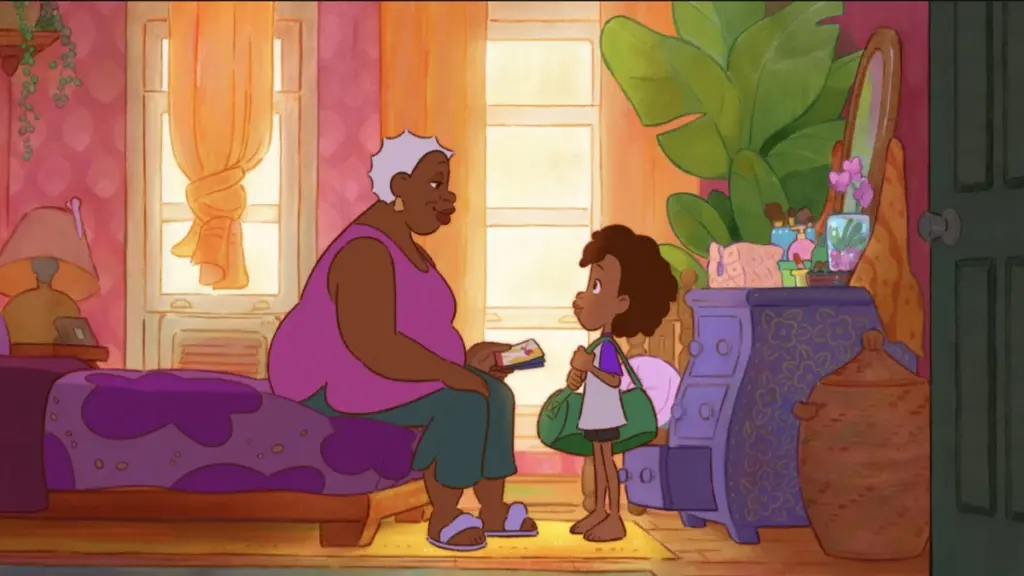
Julián swings from scenes that are almost overwhelmingly detailed to very minimal ones. The first time viewers get a peek inside Julián’s abuela’s house, director Louise Bagnall showcases a truly lived-in home with vibrantly painted walls, plants adorning every corner, dishes that can’t quite fit into a cupboard, and the organized chaos of a jewelry desk. Meanwhile, the frame is often awash with blue, showing nothing much else but Julián floating amongst it. These scenes that take place in his imagination are foundational to the film’s themes.
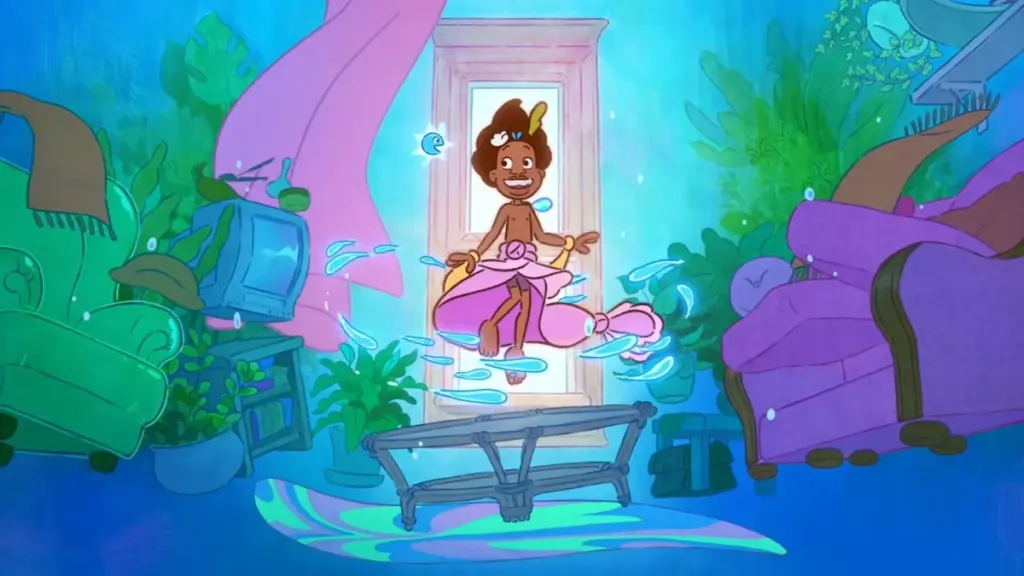
Imagination and memory play a massive role in the lives of the titular character and his grandma, respectively. Julián is perpetually obsessed with the imaginary, who he can be in the future, the person, or mythical being, he wants to turn into. His abuela is stuck in the past, developing a fear of swimming that clashes with Julián’s love for the water. Imagination is freedom, memory is a prison.
The dynamic between Julián and his abuela is the engine of the animated film. Their bond feels true to life; there is something about the innocence of a child that speaks to the worldliness of a grandparent. Even when their ideologies clash, they come to a wholesome understanding. Julián is able to retain the memory of his Dominican culture, and his Abuela recovers the freedom of her imagination.
A Frictionless Story
The neatness with which a lot of the conflict is wrapped up is Julián’s biggest problem. The movie lacks friction — all the tension lasts only a minute or so. Whenever Julián clashes with his grandma, something that you would think happens a lot based on just how different they are, the film quickly snaps back to being hopeful and wholesome almost immediately. The only real friction and conflict come from a group of boys who aren’t even part of the narrative.
Other than that, Julián shines, both the character and the film. The frames literally bleed with passion and love. You can clearly see that the world constructed by director Louise Bagnall is one she poured her entire soul into, and there are few things more rewarding than spending time inside somebody’s passion. Julián is a reminder that there’s no replacement for something handcrafted with love.
★ ★ ★ ★ ☆
‘Julián’ premiered at the 2026 Annecy International Animation Film Festival!