



Twenty-four years before we came to know Haymitch Abernathy as Katniss Everdeen’s disillusioned mentor, he was just another District 12 teenager, spending his birthdays each year lined up in the Justice Building’s cobbled plaza, awaiting the annual reaping. The seeds of Haymitch’s journey toward becoming a victor were sown before the first Hunger Games film debuted in 2012; more specifically, fans began to see it expanded upon in Suzanne Collins’ second book, 2009’s Catching Fire. Ultimately, it took the better part of two decades for his story to take full form. By the time the latest novel in the franchise, Sunrise on the Reaping, hit shelves in Spring 2025, a movie adaptation was already well underway at Lionsgate.
The Hunger Games: Sunrise on the Reaping is a prequel that kicks off on the morning of Haymitch’s 16th birthday. Played by Australian newcomer Joseph Zada, Haymitch has an almost unrecognizable vitality compared to Woody Harrelson‘s older, iconic interpretation from the original films. Despite living in a dystopian society, his family’s company, making moonshine in the woods, and roaming the fenced forest with his covey girlfriend Lenore Dove (Whitney Peak) is enough to give him a satisfying life. Even with the games looming and an acute awareness that any reaping day could irrevocably alter the course of not only his life but also his loved ones, Haymitch carries himself with the unburdened confidence of a boy who feels untouchable.
Entering the Second Quarter Quell
As all Quarter Quells do, the 50th Hunger Games comes with a twist. With twice the usual number of tributes selected this year, it is surprisingly not Haymitch’s name that is drawn from a tiny tangerine envelope. Yet, by the time the reaping is broadcast nationwide, it’s as though he was always destined for the arena. Alongside his fellow District 12 tributes, Maysilee Donner (Mckenna Grace), Wyatt Callow (Ben Wang), and Louella McCoy (Molly McCann), Haymitch is ushered through the familiar motions of the games. These rituals have become so deeply ingrained in the fabric of the franchise that every stage now feels like déjà vu, reinforcing the persistent brutality that has become normalized for the citizens of Panem.

With each stride towards the arena, the tributes follow in the footsteps of those who came before them, and unknowingly cast a shadow over those yet to come. Each Hunger Games film boasts a colossal ensemble, but by bridging a significant gap in the franchise’s timeline, Sunrise on the Reaping carries the added responsibility of recontextualizing a handful of characters fans already know and love. Returning director Francis Lawrence assembles a mixture of fresh and familiar faces for this task.
A Star is Born in Joseph Zada
There are far too many performances to dissect individually; however, it is unsurprising that Joseph Zada emerges as the film’s undisputed star. A near-perfect choice for Haymitch, he brings an unmistakable Appalachian warmth to the character, one that gradually gives way to resilient, even ferocious determination as his world begins to crumble.

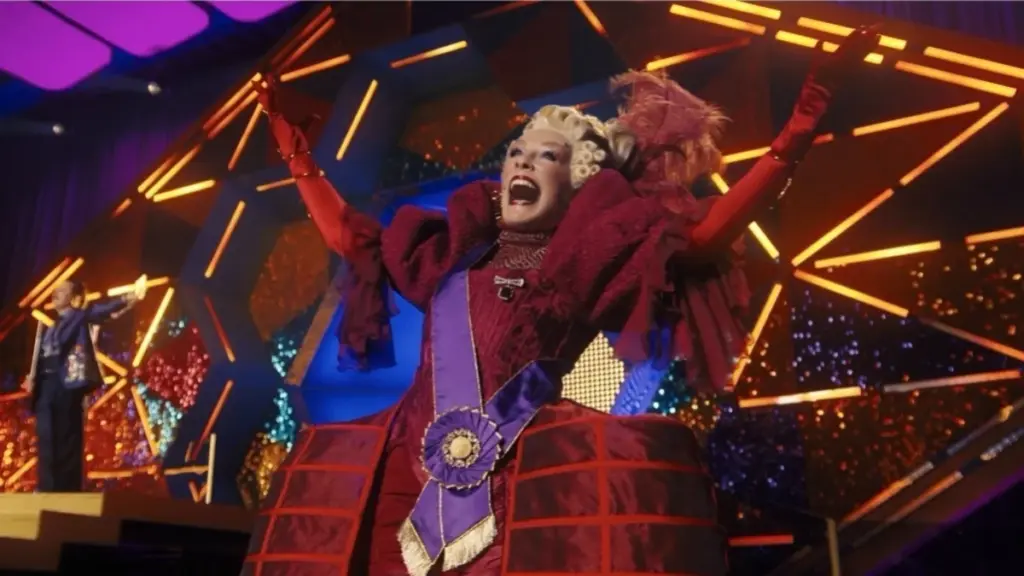
The other most notable rendition of a familiar character is Jesse Plemons’ Plutarch Heavensbee, a performance so consistent with Phillip Seymour Hoffman’s that it’s almost uncanny. Among the new characters, perhaps no one was better suited to play Capitol escort Drusilla Sickle than the great Glenn Close, who is genuinely menacing and eerie as she captures the sinister theatricality of the games.
The Book’s Beautiful Epilogue is Left Undercooked
Much like The Ballad of Songbirds and Snakes, Sunrise on the Reaping feels sanitized in its violence. It’s as if the grit and abrasive edges of Suzanne Collins’ writing, which elevated and characterized earlier Hunger Games movies, have been sanded down in favor of something slightly more palatable. That being said, Sunrise on the Reaping remains exceedingly faithful to the novel’s sequence of events, perhaps more so than any of its predecessors, and often down to the most minute details. The only real exception to this is the script’s fleeting epilogue, which is particularly butchered in its translation to the screen in terms of length and substance.
Though spanning barely two pages, the book’s epilogue is among its most poetic passages, offering readers their first glimpse into the lives of Katniss, Peeta Mellark, and Haymitch after the events of Mockingjay. It is a tender moment that celebrates the prospect of newfound peace while acknowledging the unfathomable loss Haymitch has endured. Until this point, he has kept that trauma bottled up and hidden from his new chosen family.
In the movie, however, this closing moment feels immensely cheap. It’s reduced to what resembles a last-minute attempt at fan service, complete with a trio of hideous wigs, rather than an integral thread woven into the vast tapestry of this story. What translates on the page as calculated and poignant comes across as nothing more than an obligatory nod on the screen.
A Worthy Addition to The Hunger Games’ Poignant Legacy
Thanks to its distinct, colorful retro aesthetic, gut-wrenching narrative, and impressive ensemble, Sunrise on the Reaping marks another strong entry in the series. While it lacks some of the rugged spirit that is characteristic of the source material and previous movies, it retains the ideological conviction and intricate world-building that have long defined Panem. Reinforcing the enduring parallels between Haymitch and Katniss’ journeys, Sunrise on the Reaping ultimately reminds audiences that, even in the most harrowing times, there is always something worth persevering for. If not for ourselves, then for those who come after us, in the hope that they might one day know a life beyond the cycles of violence and oppression that came before them.
★ ★ ★ ½
‘The Hunger Games: Sunrise on the Reaping’ hits theaters on November 20!

Release Date: November 20, 2026.
Directed by Francis Lawrence.
Screenplay by Billy Ray & Michael Lesslie.
Based on The Hunger Games: Sunrise on the Reaping by Suzanne Collins.
Produced by Nina Jacobson, Brad Simpson, & Francis Lawrence.
Executive Producers: Meredith Wieck, Cameron MacConomy, Scott O’Brien, & Mika Saito.
Main Cast: Joseph Zada, Mckenna Grace, Whitney Peak, Ben Wang, Jesse Plemons, Elle Fanning, Kieran Culkin, Ralph Fiennes, Glenn Close, Billy Porter, Maya Hawke, Kelvin Harrison Jr., Lili Taylor, Iris Apatow, Edvin Ryding, Kara Tointon, Smylie Bradwell, Scot Greenan, Grace Ackary, Jeffrey Hallman, Melody Chikakane Brown, Jefferson White, Molly McCann, Iona Bell, Percy Daggs IV, Jhaleil Swaby, Laura Marcus, Sky Frances, Rada Rae, Tatyana Muzondo, Alina Reid, Salimou Thiam, John Doeble, Kaine Buffonge.
Cinematographer: Jo Willems.
Composer: James Newton Howard.
Editor: Mark Yoshikawa.
Production Company: Color Force.
Distributor: Lionsgate.
Runtime: 158 minutes.
Rated PG-13.