

Actor Glen Powell has become a new favorite among Hollywood’s leading men. Since hitting the big time with a charismatic standout performance as Hangman in 2022’s megahit Top Gun: Maverick, Powell has solidified his star power with Devotion, another aerial-focused film, Anyone but You, the recent rom-com sensation opposite actress Sydney Sweeney, and upcoming leading roles in Netflix and Richard Linklater’s Hit Man and the summer blockbuster Twisters. But for The Blue Angels — a brand new documentary from Amazon MGM Studios and IMAX about the Navy’s elite flight demonstration squadron of the same name — Glen Powell stepped behind the camera as a producer, one with a decent amount of flight experience of his own.
With the help of star Tom Cruise and the crew of Top Gun: Maverick, Glen Powell reignited his childhood love for aviation, obtained his pilot’s license, and made invaluable contacts with the U.S. Navy, all of which factored into The Blue Angels documentary film coming to fruition. Directed by Paul Crowder, the documentary puts audiences up in the air right alongside the real Blue Angels squadron with stunning IMAX footage, soaring through the skies at hundreds of miles per hour. It’s impossible not to be wowed by the death-defying maneuvers that the group performs on a regular basis. However, the doc also pulls back the curtain to give a revealing, in-depth look at how the world’s premier jet team perfects their extraordinary teamwork.
From the careful selection process to the intense training to the demanding eight-month show season, viewers get a real understanding of the kind of work ethic and trust that’s required from each Blue Angels pilot in order to master their aerial stunts and precision flying. Above all else, though, The Blue Angels is a fitting tribute to the outstanding men and women of the Navy and Marine Corps who have kept the squadron’s legacy alive with their pride and passion. We sat down with producer Glen Powell to dive into The Blue Angels documentary and his love for flying. Powell discusses how the Blue Angels have inspired him personally, the film’s aerial shots and immersive footage, and how bringing J.J. Abrams onboard helped create a more theatrical experience for the documentary.
Exclusive Interview with Glen Powell for The Blue Angels
You’ve had an interest in aviation since you were a kid, and you’re now a licensed pilot yourself. What was it like to actually fly in these kinds of jets, meet these pilots, and learn their stories?
Glen Powell: What happened to me after Top Gun: Maverick and Devotion was that I never looked at the sky the same way again. Anytime a plane flies over, you wonder what it is, who’s flying it, and where it’s going. It’s also really impossible to be around Tom Cruise and not fall in love with aviation. That experience was one of the most incredible in my entire life. I got to live on naval bases and be around the best pilots in the world. When you’re around the best of the best, it’s an infectious thing that happens.

When Brian Ferguson, who is the liaison between Top Gun the institution and Top Gun the movie, reached out and said Boss Wooldridge, who’s one of the most legendary bosses in Blue Angels history, is “looking to put a documentary together, would you want to talk to him?” I said, absolutely! It really hit me, while I was talking to him, that because I had sort of been among this community for so long, I knew all the right players to make this documentary. I could put together the right team, so to speak. In addition to Kevin LaRosa and Michael FitzMaurice, who were the aerial coordinators on Top Gun: Maverick, I knew all the players in the Navy to really have their trust.
My contacts in the Navy knew that I would be looking after them and their legacy, that I would be doing service to them. That trust is not easily earned. With this documentary, we have unprecedented access to briefing rooms and proximity to planes that no audience has ever had before. When we brought on J.J. Abrams, who is obviously one of the most iconic filmmakers of all time, it really cracked open this doc in a way that is just going to be so thrilling for audiences. So yeah, I really caught the aviation bug and I’ve really doubled down on it. I feel so lucky to be a part of the Naval community, and I think audiences will catch the same bug once they see this doc.
You’ve worked as a producer on a couple of other projects before The Blue Angels. What do you think are the biggest differences between those movies and documentaries like this?
Glen Powell: At the end of the day, it’s really about how to make audiences go on a ride. To make something that is theatrical visually, and that’s where, obviously, these IMAX cameras come in, but also emotional. I think the really cool part about this documentary is you are really getting a sense that what these planes are doing is absolutely extraordinary. It’s incredible. It almost feels like it defies physics.
But then you’re with the pilots and seeing the human aspect of all the training that goes into flying that plane to pull these things off. For me, whether you’re making documentaries or whether you’re making narrative films, it’s the same thing. The human aspect is what makes it universal. The human aspect is what we gravitate towards. It’s not just awe, but it’s also emotion. That’s something that I try to keep consistent in anything I do.
Was it always the idea to film The Blue Angels with IMAX cameras?
Glen Powell: That was always the intention. Boss Wooldridge really wanted to do a documentary during what was a very special time in Blue Angels history. For me, what really cracked it open was my experience on Top Gun: Maverick and Devotion. I had seen how the technology had evolved to a point where you could put IMAX cameras on these planes and not affect airworthiness. You could really put audiences in that proximity. When I flew with the Blue Angels at an air show, the thing that blew my mind was that these planes are 18 inches apart in the sky, and I was in the center of that hive.
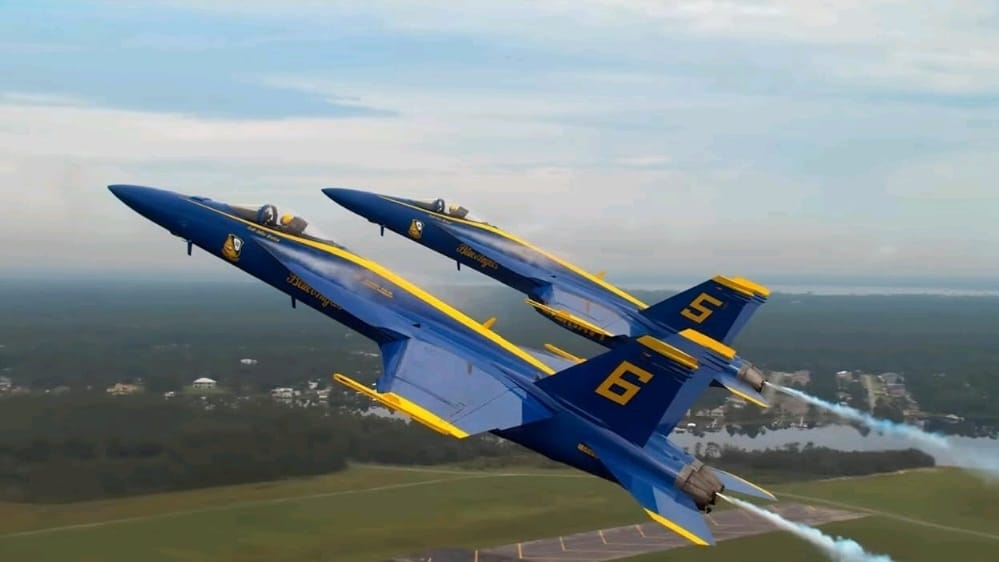
I couldn’t believe that perspective from inside the cockpit. It was like, “I don’t know how to describe this to people. But I hope I get to show someone what this is like at some point.” The fact that we get to do that with these IMAX cameras, that’s what got me really excited. When you sit and watch this documentary in IMAX, you can’t help but be in awe of what these guys do every day. When you watch the Blue Angels at an air show, you’re always watching from the ground. There are maneuvers that are like 50 feet above the ground, just below the speed of sound. Everybody in the audience, child to adult, it doesn’t matter where you are; it’s impossible not to have your mind blown by what these pilots are doing.
But now, with this movie, it’s like being up there and watching the maneuvers that they’re doing up close. They do this thing called “chair flying,” where they go into the briefing room and they all close their eyes. They all hold the throttle on their left and the stick on their right and go through the entire flight. They’re basically singing a cadence through the entire flight. We actually capture it in the documentary. It’s incredible to watch because you see the magic of what it is to be a Blue Angel. They can literally fly this show with their eyes closed. It’s just so impressive.
What kind of music helps get you in that high-speed flying zone?
Glen Powell: That’s a really great question. I always rely on my pilots for that. Every pilot sort of has their own mix. It’s always so funny how when they’re flying, they’re singing their own mix. There’s that cadence when they’re talking and pulling certain maneuvers. It’s almost like a chant or a song. The Blue Angels have their own soundtrack — they’re like a supersonic acapella group up there. It’s wild.
The Blue Angels is now streaming on Prime Video!
Release Date: May 23, 2024 (Prime Video).
Directed by Paul Crowder.
Executive Produced by Emerson Davis, Bill O’Dowd, Rob Stone, John Turner, & Greg Wooldridge.
Produced by Glen Powell, J.J. Abrams, Hannah Minghella, Mark Monroe, Sean Stuart, & Glen Zipper.
Cinematographers: Lance Benson, Michael FitzMaurice, & Jessica Young.
Composer: James Everingham & Stewart Mitchell.
Production Companies: Zipper Bros Films, Bad Robot, IMAX, Dolphin Entertainment, Barnstorm Productions, & Sutter Road Picture Company.
Distributor: Amazon Studios.
Runtime: 94 minutes.
Rated G.