

Many have long believed that certain works of art are “unadaptable,” meaning the qualities that made them unique would not translate well (or at all) in another medium. But now that we live in a world where art, especially cinema, is constantly mining other existing properties to adapt, it seems like such a hurdle isn’t as daunting anymore. The works of Beat Generation author William S. Burroughs used to be considered unadaptable in this way. Anyone who’s cracked open a Burroughs novel can see why — his prose is a nearly impenetrable stream of consciousness, pitched somewhere between poetry and encryption, and even if he was more of a forthright writer, his books tackle some fairly taboo topics.
Filmmaker David Cronenberg was the first to crack the Burroughs code with his audacious big-screen adaptation of Naked Lunch in 1991, a movie that found a back door into Burroughs’ alternative reality of “Interzone” through some of his real-life encounters. Now, 33 years after Naked Lunch, director Luca Guadagnino and screenwriter Justin Kuritzkes have mustered up the chutzpah for a new Burroughs adaptation, bringing his 1985 unfinished (put published) novella Queer to the screen.
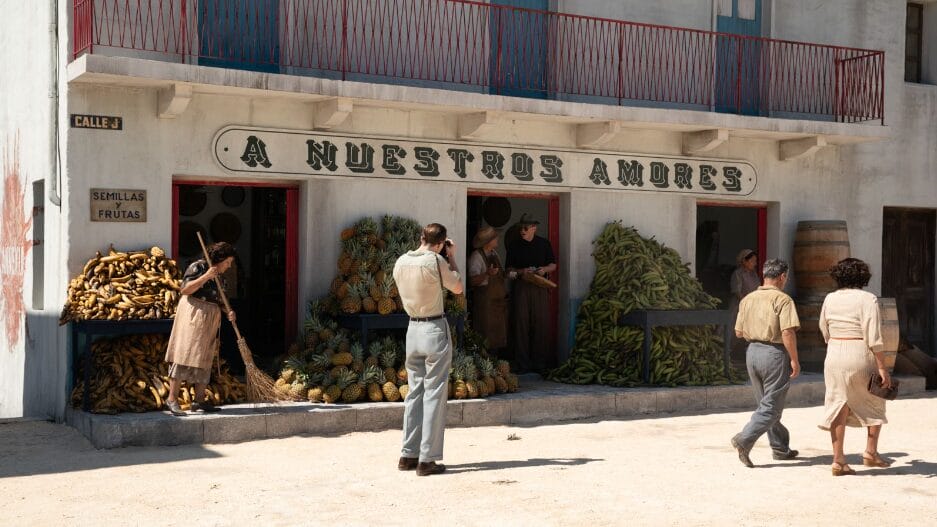
Luca Guadagnino and Justin Kuritzkes, who together brought Challengers to screens earlier this year, are helped in large part by both Cronenberg’s Naked Lunch and Burroughs’ life. Unlike the sprawling Naked Lunch, Queer the novel is a semi-autobiographical story of a man having a somewhat unrequited love affair in 1950s Mexico City. This relatively simpler premise allows Guadagnino and Kuritzkes to give their movie adaptation a much more manageable structure and identity. However, this is no mere translation of the book; Guadagnino’s film is a heady, sometimes hilarious, frequently horny, yet ultimately haunting amalgam of the novel and Burroughs’ own life, telling an aching tale of star-crossed lovers doomed to never quite fully connect.

Split into three chapters and an epilogue, Queer follows William Lee (played by the great Daniel Craig), an American expatriate living in Mexico City sometime in the 1950s. Through some set dressing and dialogue, it’s assumed that Lee was once an author. He might still be, were it not for clearly preferring his dalliances in Mexico as part of a homosexual subculture, filling his days with bloviating about life with friends like Joe (Jason Schwartzman) and his nights with random hook-ups. When Lee spots Eugene Allerton (Drew Starkey of Outer Banks fame), a discharged American Navy serviceman, on one fateful night, he becomes infatuated, following the man from place to place in hopes of sussing out his sexuality.
Eventually, the two men come together, though not in a fashion that’s as permanent or committed as Lee would hope. Thus, the lovesick older man concocts an impromptu trip to South America with Eugene, which involves their quest for a plant used in ayahuasca that, according to some dubious research by Lee, could give a person telepathy when ingested. Given the story’s central age gap romance between an older gentleman and a younger man, much will be made about its relationship to Luca Guadagnino’s Call Me by Your Name, and indeed, Queer contains a good portion of that film’s swooning, idyllic bittersweetness.
In fact, much of Queer involves Lee constantly attempting to peer into Eugene’s soul, trying to figure out if there’s genuine affection beneath his ambiguous demeanor or if their dalliance is merely a lustful experiment for him. Call Me by Your Name’s sexuality is quite frank, but Queer pushes things even further, including a particular visual element during one sex scene that anyone who is or has been with a man will identify with. In a way, the movie slightly feels like a rejoinder to critics of Guadagnino and Kuritzkes’ Challengers, which was taken to task for being not as sexually explicit as some hoped.
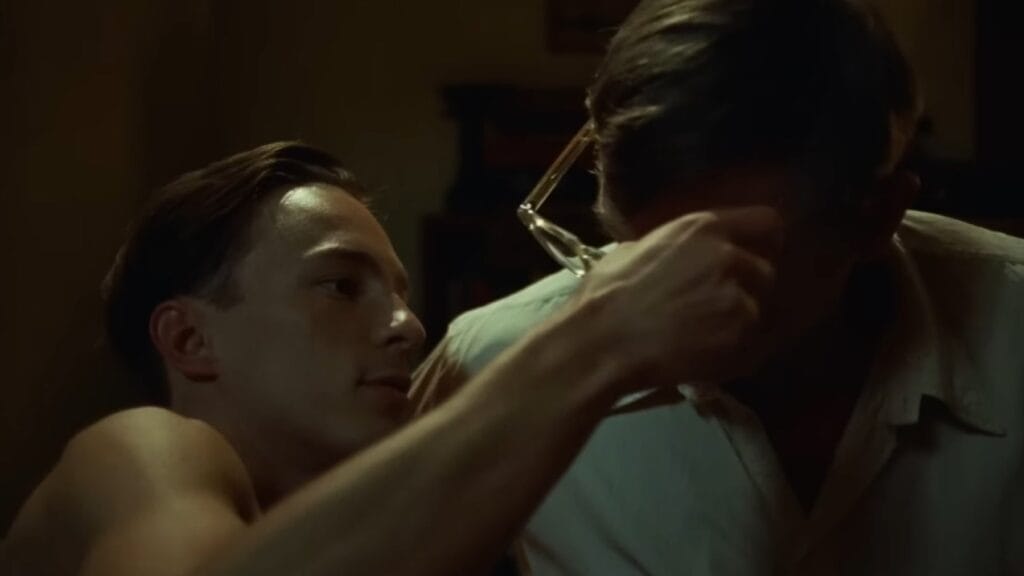
In Challengers, the tennis was the stand-in for sex. But in Queer, the sex is an externalization of the two men’s inner feelings. Eugene never once identifies himself as queer or homosexual, while Lee, who publicly identifies as a gay man, is shown to struggle with that self-image within his private thoughts to great frustration. These private thoughts will likely enrapture or confound viewers, for Luca Guadagnino uses the more fanciful and drug-related aspects of Burroughs’ life and literary works to delve into the surrealism that he’s employed in prior films like The Protagonists and his remake of Suspiria.
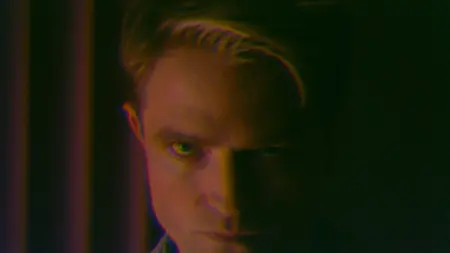
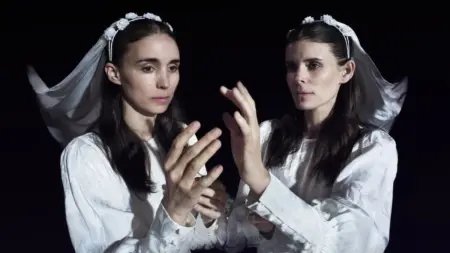
Queer indulges in lengthy sequences of Salvador Dali and Luis Buñuel-like imagery that attempts to visualize the conflicting emotions swimming around in Lee’s head. These thoughts and fantasies don’t merely concern Lee and Eugene, either; they extend to the rest of his life. These include other elements drawn from Burroughs’ own life, including his wife, Joan (Ronia Ava), and the fateful “William Tell routine” game that took her life, as alluded to here and as depicted in Cronenberg’s Naked Lunch.
Concurrent with this bleeding between real life and “reel” life is the movie’s soundtrack, which defiantly eschews 1950s period-accurate needle drops in favor of anachronistic tunes by Nirvana, New Order, and others. Additionally, Queer marks Oscar-winners Trent Reznor and Atticus Ross‘ third scoring collaboration with Luca Guadagnino, coming after Bones and All and Challengers. The duo provided Challengers with such a blisteringly propulsive score but goes into a more pensive mode here, creating a sonic landscape that, again, echoes more of Lee’s mind than it does his environment.
Luca Guadagnino’s Queer, then, is a character study about a man whose own identity escapes him, let alone the identity of others. It’s a movie that feels simultaneously personal and detached, with Guadagnino finding kinship in Lee’s emotions while trying to dissect William S. Burroughs, the man. Yet, for a film adaptation of an unfinished novel, it also feels remarkably appropriate and honest. A phrase that crops up several times during the narrative is “I’m not queer, I’m disembodied,” which seems to indicate that one’s identity, one’s soul, is more than mere labels of sexuality or even their physical self.
We may never truly know other people, and we may not ever fully know ourselves, but it’s the attempt to do so that allows us brief moments of transcendence, where we are able to merge our consciousness with others. Director Luca Guadagnino and writer Justin Kuritzkes have done that with William S. Burroughs, and through Queer, they’ve done that with us.
Queer hits select theaters in Los Angeles and New York on November 27 and then expands nationwide on December 13!
Release Date: November 27, 2024.
Directed by Luca Guadagnino.
Screenplay by Justin Kuritzkes.
Based on Queer by William S. Burroughs.
Produced by Luca Guadagnino & Lorenzo Mieli.
Executive Producers: James Grauerholz, Justin Kuritzkes, Emanuela Matranga, Elena Recchia, Peter Spears, & Christian Vesper.
Main Cast: Daniel Craig, Drew Starkey, Lesley Manville, Jason Schwartzman, Henry Zaga, Omar Apollo, Drew Droege, Ariel Schulman, David Lowery, Colin Bates, Ronia Ava, Simon Rizzoni, Michaël Borremans, Andra Ursuța, & Lisandro Alonso.
Cinematographer: Sayombhu Mukdeeprom.
Composers: Trent Reznor & Atticus Ross.
Production Companies: Frenesy Film Company, The Apartment Pictures, & Fremantle North America.
Distributor: A24.
Runtime: 138 minutes.
Rated R.