


As If the Sun Itself Had Fallen Upon the City: ‘A River of Corpses’
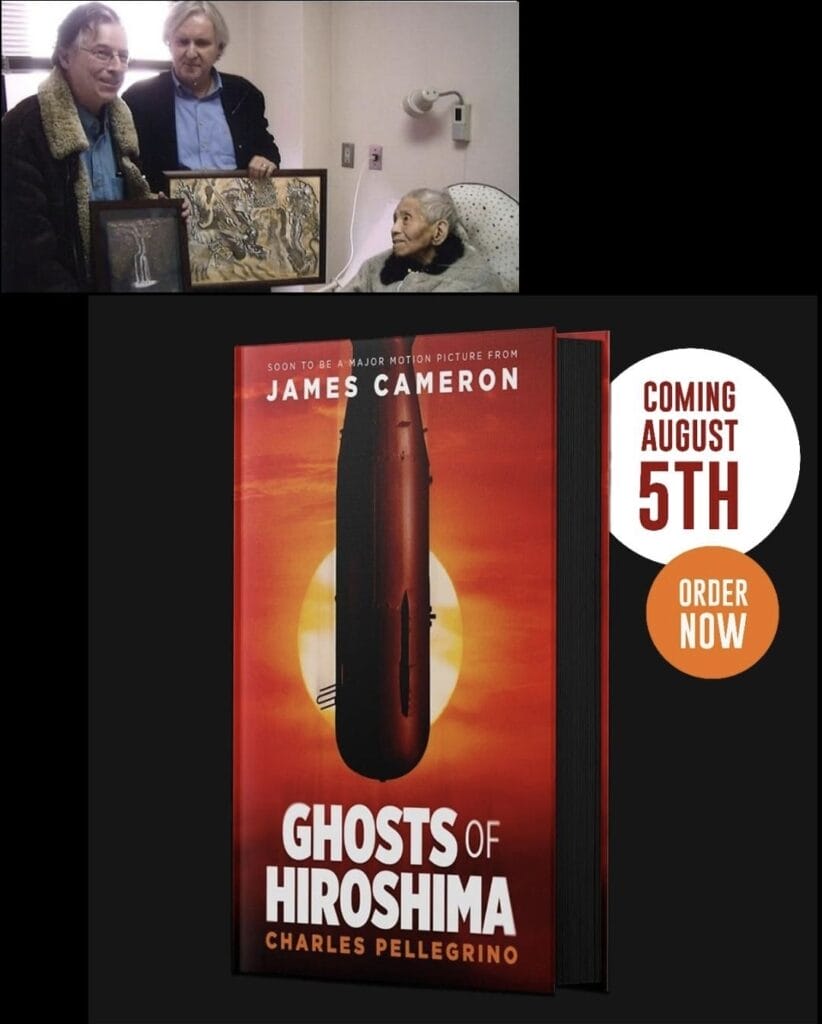
Three-time Academy Award-winning filmmaker James Cameron is set to direct, write, and produce a movie adaptation of the non-fiction book Ghosts of Hiroshima by author Charles Pellegrino, which will be released on August 5, 2025. Based on a harrowing true story, Ghosts of Hiroshima is expected to be Cameron’s first non-Avatar film in 30 years. Yesterday, Cameron tweeted the following from his Twitter/X account:
“Not since Titanic have I found a powerful, heartbreaking and inspiring real life story as found in Ghosts of Hiroshima by Charles Pellegrino. This is an amazing book and a film I am excited to direct.”
Ghosts of Hiroshima has been James Cameron’s passion project for many years. He traveled to Japan to interview many survivors, including Tsutomu Yamaguchi, who survived both the bombing of Hiroshima and Nagasaki.
Based on years of forensic archaeology combined with interviews of more than two hundred survivors and their families, Ghosts of Hiroshima is a you-are-there account of ordinary human beings thrust into extraordinary events, including the men who dropped the two atomic bombs and the dozen “double-survivors” who miraculously lived through both. Pellegrino is the New York Times bestselling author of Her Name, Titanic, and was a technical advisor on Cameron’s films Titanic and the Avatar pentalogy.
Exclusive Excerpt from Charles Pellegrino’s Ghosts of Hiroshima
Following our debut of the book’s second trailer last week (viewable at the bottom of the page), DiscussingFilm can now share an exclusive excerpt from Ghosts of Hiroshima ahead of its August 5 release. After sinking their teeth into this special preview of, readers can go ahead and preorder the book on Amazon.
The following excerpt is adapted and condensed from Ghosts of Hiroshima by Charles Pellegrino to be published by Blackstone Publishing and The Story Factory. Copyright © 2025 by Charles Pellegrino. Printed by permission.
The ground roared and quivered, snapped and leaped, tossing Tsutomu Yamaguchi out of the ditch in which he took shelter—tossed him some four or five feet into the air. In later years, he would be unable to tell for certain whether it was the ground shock or the air blast or some convergence of both that had coughed him out of the ditch and made him airborne. At the very moment he seemed on the verge of falling back again onto the potato field, the fireball imploded over the city and rose at stupendous speed, creating a vacuum effect that levitated him for what would be recalled as an impossibly long time on a cushion of air and thick dust, and he guessed that at no point was he any more than six feet above the ground. Through one of the clear-air openings in the sea of dust, Yamaguchi glimpsed distant rows of houses warping out of shape and flying toward him in pieces. He felt like a mere leaf, tossed on a lake of rushing black fog. Then, abruptly, he and all the larger pieces of the houses (including whole rooms full of furniture in mid-flight) dropped to the ground. Smaller pieces continued flying toward the city center without him—and, miraculously, without ever having struck him along the way.
After Yamaguchi regained his composure, he realized he had been dropped into a new ditch, some unknown number of paces from the one into which he had dived. Sitting up and looking around while checking for fractured bones, he beheld a blizzard of burning paper and shreds of smoldering clothing falling out of the sky. It appeared to him that the contents of an entire office building had been hoisted into the heavens, then ripped up, blown apart, scorched, and strewn about. He could not find the sun—or, at least, not the real sun he had known. The blue sky appeared to have been erased and darkness prevailed, making Yamaguchi feel as if he were in the depths of the ocean. Pieces of buildings were still in flight. “I could hear the sound of flying roof tiles shattering in the air,” he would write later. “Objects falling, and the noise of all manner of destruction. It was impossible to identify each noise or its cause.”
Sitting in a mud pool, Yamaguchi became suddenly aware that one whole side of his body was intensely hot. The exposed skin on his left arm had been literally roasted brownish-black. Even then, before he knew anything about atomic bombs, the engineer began to suspect he had just survived a heat ray of some sort; and he realized that his white shirt and his light-colored pants had reflected the rays and spared him much. Just ahead of the flash, he had seen a woman in a black monpe running in fright from the planes, running toward the center of the field. Running upright, she had exposed her entire body to the full fury of the flash, while clothed in the all-absorbing equivalent of India ink. Yamaguchi glanced around in every direction, but he never did see a trace of her again.
When the noise and the black dust subsided and Mr. Yamaguchi looked up, he saw a pillar of fire and ash reaching into the stratosphere: “Like a giant tornado enclosed within a volcanic plume, but the base of it did not move. Only the top of the monster seemed active, growing higher and wider.”
When this cloud falls to the earth, Yamaguchi told himself, every living thing will die. He realized that even if he survived the cloud, which soon splashed him with oily yellow mist, the B-29s might return. Suddenly, all the burning of his body went away, to be replaced at once by the image of his young wife and child alone at home. He contrived a plan then to find a train or an automobile that was still working, or a horse that was still alive, and by any means necessary find a way out of Hiroshima.
Home was Nagasaki.
###
A soldier had assured Yamaguchi that as a high-ranking naval engineer, he would get a priority seat on the train. The shipbuilder had long ago ceased really caring about military priorities or the war effort. All he wanted was to get home to his wife and his infant son.
Though flash burns on his arms and hands throbbed and stabbed at him, he did not appreciate, yet, how improbable it was for him to have survived at all. The flash burns had been inflicted by little more than the mere visible spectrum of light. It could have been much worse. The air itself had protected him from DNA-scrambling X-rays, gamma rays, and a spray of neutrons. Within the mile-and-a-half of sea-level air that separated him from the detonation point, the atmosphere alone was the equivalent of ten or eleven feet of water. A ten-foot shield of water was the best radiation protection of all, better even than a wall of lead. Except for a pebble that had shotgunned into an arm, none of the other explosive shrapnel had touched him, in a blast radius where few other people had walked away.
Yamaguchi had to cross two rivers on his way to the train station. The narrower of them no longer had a bridge, but in the shallows nearby, islands of floating bodies were piling up against rocks and concrete supports, a natural dam that could now be crossed like a bridge. Even when he tried to keep his mind focused on nothing except the recollected faces of his wife and child, crossing that dam—over spillways lined with shirts and shoes—pained him severely. From deep within, a poem began to form in Yamaguchi’s mind:
And the river flowed as a raft of corpses…
###
On the morning of August 9, as the second atomic strike force approached Nagasaki, Yamaguchi was already at work. Although still feeling pain from his burns and barely able to drag himself out of bed even with his wife Hisako’s help, he remained obedient to an order to present a full report about Hiroshima at the headquarters of the Mitsubishi industrial combine. “And besides,” he told Hisako, “if I can warn them about how it happened, I may be able to save lives.”
His Mitsubishi section chief was still trying to explain how he did not believe an atomic bomb could possibly exist when the second distinctive atomic flash concluded the argument. At a distance just 10,200 feet downriver of the hypocenter, the heat that burst into the room was so great that this time, Yamaguchi believed himself gone.
During the critical first second, Yamaguchi’s warnings were instantly recalled, and his listeners dived under tables and behind door frames. In the end, the section chief did exactly what Yamaguchi had said he should do if he saw the bright flash. Given the intensity of the shock wave bearing down on them, obedience to the engineer’s instructions alone would not have been enough if not for the mysterious shock cocoon effect that seemed to accompany all explosive events. Like the nose of a Von Braun rocket cutting through supersonic wind, a single steel-reinforced concrete stairwell behind the office where Yamaguchi stood was able to chop through the blast wave. The rest of the building flew apart around Yamaguchi’s shock cocoon, and in those other rooms beyond him some three hundred people died. Only one office, behind the bomb-facing stairwell, survived. In that office, window glass flew harmlessly over the men on the floor, and a mahogany desk became flying wooden daggers; but these men, and no one else, walked away from the building. Even the ground-level lake of instantly superheated air seemed only to have eddied around the outside of the office before retreating backward toward the hypocenter and following a fireball into the heavens.
Yamaguchi became aware that his burns from Hiroshima were now fully exposed to the increasingly abrasive and random gusts of smoke. Though the blast wave had bounced and diverged as it burst through the Mitsubishi office block, the gale that came with it had blown off all his bandages, and mahogany thorns had penetrated his skin. The young engineer merely shrugged at another strange horror and looked out from the top of the ruins, trying to find home.
Fighting off nausea, chills, and new wounds, he began to walk.
Tsutomu Yamaguchi discovered that one side of his house was a curiously intact box, filled with raked table and chair parts, and balcony splinters—all of it sheathed in a veneer of black carbon. The rest was ruin. Yamaguchi searched the area and dug frantically for his family, and eventually he came upon a very young child, deceased and no longer identifiable.
Yamaguchi soon found Hisako (his wife) and little Katsutoshi (his child) alive. He also found an answer to what had happened at home. After he left for work on the morning of the second bomb, Hisako had stepped out to visit a local medicine dealer who knew something about treating burns, taking Katsutoshi with her. Hisako’s mission to find a remedy for her husband led her to a Mitsubishi tunnel-shelter ahead of scheduled work detail. Hisako sought out the coolest, deepest part of the tunnel in which to preserve the white skin cream she had bought to treat her husband’s burns. And this was how she and Katsutoshi came to be safely underground when the bomb detonated.
“Sometimes by God’s will,” Tsutomu Yamaguchi liked to believe, “and maybe sometimes, we are alive just by sheer dumb luck.”
In Hiroshima there is a “Tree of Hope,” which survived the first atomic bomb and which is prophesied to continue growing until the day humans banish nuclear weapons from the Earth. One day, the tree will be forgotten, either because human civilization has changed its way of thinking and eliminated nuclear weapons, and the tree becomes just another tree, or because nuclear weapons have eliminated us, and there is no one left to water it.
Ghosts of Hiroshima releases on August 5!