

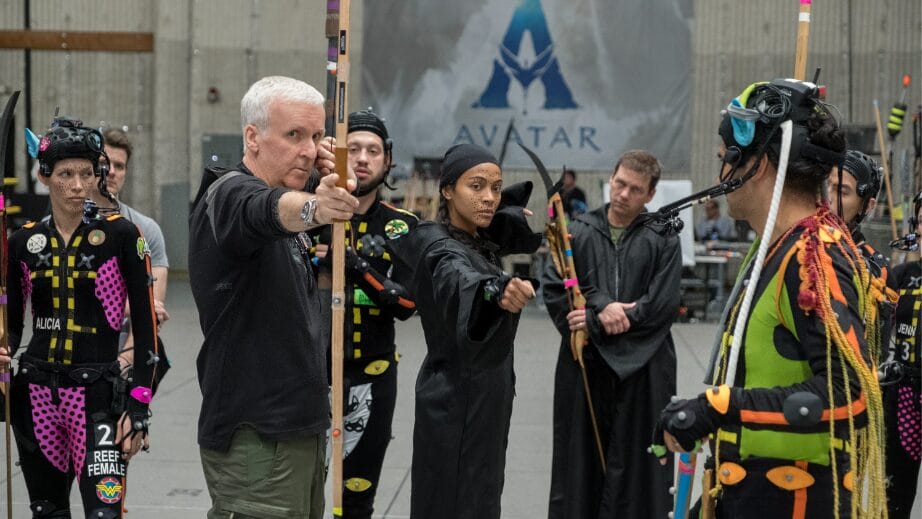
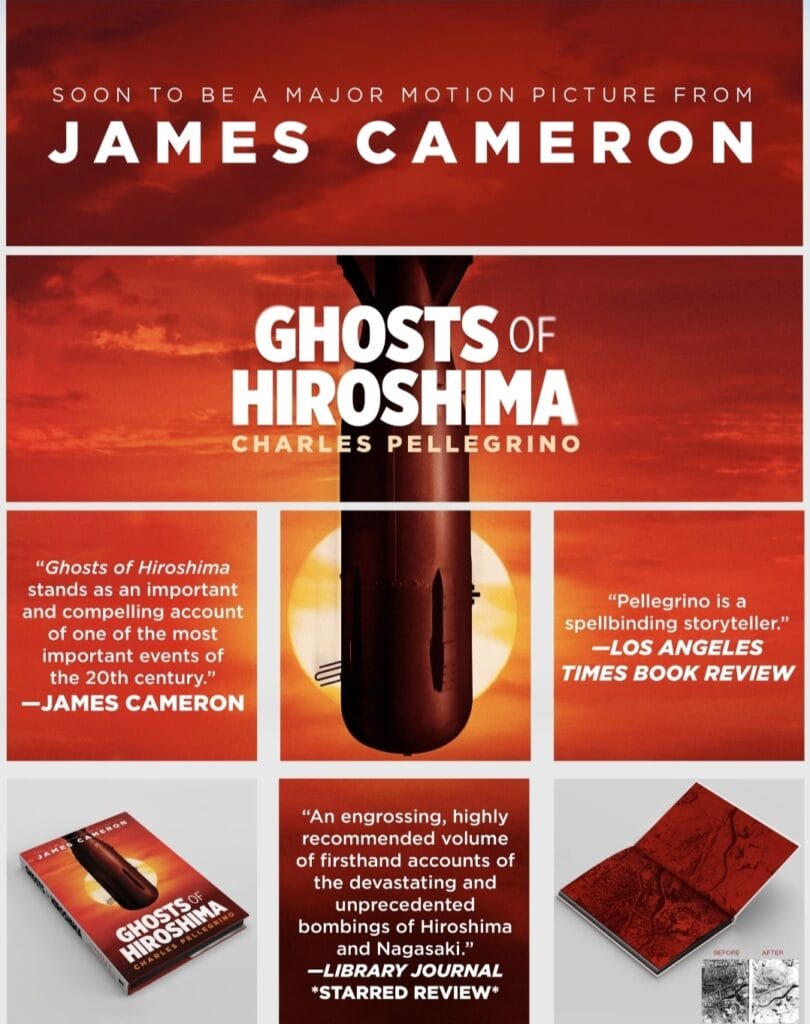
Now that Charles Pellegrino’s Ghosts of Hiroshima is out everywhere, writer-director James Cameron is urging everyone to read the book (purchasable on Amazon). The New York Times bestselling author of Her Name, Titanic and To Hell and Back: The Last Train From Hiroshima has created a haunting yet necessary remembrance of those who survived the 1945 atomic bombings in Hiroshima and Nagasaki, Japan. Based on years of forensic archaeology and interviews with more than 200 survivors, Ghosts of Hiroshima is a vivid, you-are-there account of ordinary human beings thrust into extraordinary events. Cameron and Pellegrino have worked closely together since Titanic (1997), with the author/historian serving as a scientific consultant on that film and 2009’s Avatar.
In addition to its major historical relevance, documenting the stories of numerous atomic bomb survivors who were almost forgotten by society, all eyes are on Ghosts of Hiroshima due to James Cameron’s promise to adapt it into his next feature film. After this year’s Avatar: Fire and Ash, the three-time Academy Award-winning filmmaker will be permitted a four-year break until the release of Avatar 4 (scheduled for December 2029). Oh, and he still plans to direct that and 2031’s Avatar 5 as well. Ghosts of Hiroshima, though, is a unique passion project that has arguably been longer in the making than the Avatar franchise.
On the eve of the 80th anniversary of the atomic bombings earlier this week, we at DiscussingFilm sat down with Oscar-winning director James Cameron to discuss the timely importance of Ghosts of Hiroshima. In the first part of our exclusive interview, Cameron dove into the colossal challenges that await in this upcoming movie adaptation. In this second part, the filmmaker delves into his personal connection to the project and the miraculous stories of real “double bomb” survivors Tsutomu Yamaguchi and Kenshi Hirata, who will both be featured in his Ghosts of Hiroshima film. Want to learn more about what will be Cameron’s first non-Avatar movie in 30 years? DiscussingFilm has got you covered.
Exclusive Interview with Filmmaker James Cameron for Ghosts of Hiroshima
It’s not every day that a new book release gets this kind of attention, since your name is in huge bold letters at the top, promising that Ghosts of Hiroshima will soon be a feature film adaptation…
James Cameron: I questioned that, my name being in a bigger print than the author’s. It’s a way of selling the book, linking it to something that I’ve committed myself to. I wasn’t closely editing the book with Charlie. It’s his creation. However, I have read every draft over the last couple of years. He knows that it’s a story that has fascinated me since I was young, since probably high school, when I read the John Hersey book [on Hiroshima], quite a slim volume by the way. It’s a firsthand account of what he saw when he went in after the bombings in 1945.
You can see that over time, I have been cathartically working through the images evoked in that book, like in The Terminator and Terminator 2: Judgment Day. More specifically, seeing the aftermath and bomb blast effects in Terminator 2 with Linda Hamilton getting flash incinerated and then hit by the blast wave. So, yeah, this stuff has been on my mind for a long time. I just hope that people will read [Ghosts of Hiroshima] because we’re certainly in as much peril right now as we were at the peak of the Cold War.
Courtesy of Disney
Historically, the Cuban Missile Crisis was probably our closest scrape with a full-on nuclear war. Since then, there have been several close calls. I think the world went through this collective sigh of relief when the Soviet Union collapsed, but there are still 12,000 warheads out there, fully ready to go in nine countries. Lately, there has been a lot of saber-rattling and posturing between authoritarian governments, with Trump talking about deploying boomer-class subs off the Russian coastline, which is not healthy. It’s an escalation toward a situation of heightened tension where a simple mistake could actually lead to a full-scale nuclear exchange. The fact that we’re still in this precarious place as a civilization is unfathomable.
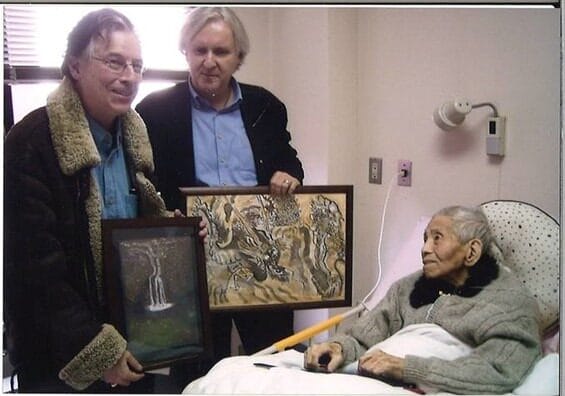
On the topic of your promise to adapt Ghosts of Hiroshima into your next film, you made that same commitment to the real Tsutomu Yamaguchi in person. You got to meet him on his deathbed shortly before he passed away in 2010. You’ve described that experience as a sort of passing of the baton, where he essentially told you, “I have done as much as I can do” to keep this story alive. I have to ask, did you know that you were going to make such a heavy promise beforehand, and what motivated you to seek him out in the first place?
James Cameron: I wanted him to tell me his story his way. He was one of the few survivors who were adults at the time of the event. I went through a similar process with Titanic, but by the time I came into the world of trying to tell that story, most of the survivors of the wreck were dead. The few who remained were infants or too young at the time to remember. Thus, having the chance to talk to someone who was in young adulthood at both Hiroshima and Nagasaki, and remembered it quite distinctly, was invaluable.
Plus, Tsutomu was an engineer, so he had a very analytical mind. As a double bomb survivor, he didn’t have so much blunt trauma that he couldn’t actually remember the event. Now, I didn’t know in advance that meeting him would lead to this heavy commitment. But that’s okay; life takes you where it takes you. It made sense to me in the moment to make that promise to him, because I knew it was something in my heart that I had already decided to do.
So, what was the exact point or moment in your life that brought you to the mindset of needing to adapt this historical tragedy?
James Cameron: I don’t think I’ve shared this story yet… I was going to Japan to promote Terminator 2: Judgment Day, which is about nuclear war. I decided to arrive a couple of days early for National Atomic Bomb Memorial Day on August 6th. The studio needed me there on the 10th, I think, to promote the Japanese release of T2, although I had told them I was going ahead of time. They said, “Let’s do some additional press,” and I replied, “No, this is a private pilgrimage.” I visited Ground Zero in Hiroshima and the Peace Museum. There were many things I knew about in advance, but I never had the chance to visit in person until then.
On August 6th, they do a ceremony there that starts about an hour before sunset. People gather at the banks of the river at Ground Zero — it’s all been rebuilt, so the river banks are made of stone walls and look more like a canal. It goes right through the center of the city. On a barge, a Shinto priest lights a paper lantern that sits on two cross sticks, a basic little raft, and then sets it in the water. Then, an acolyte hits a big temple drum that makes a loud, gong-like boom, and that’s it. That’s the only sound, and it echoes out.
There were probably 200,000 people watching in utter silence. No kids crying, no one moving around, no one laughing, no one talking. Dead silence. The priest puts one lantern in the water, lights it, and then boom, puts another one in, boom. This ceremony lasts for about two and a half hours. When it’s done, what you see is a river of light going off into the distance in commemoration of 120,000 souls that died in one day at that spot. It’s one of the most powerful things I’ve ever witnessed in my life. That’s when I decided that I needed to make this film.
Yamaguchi’s story is one of amazing resilience and fate. As Charles Pellegrino quotes him in the book, Yamaguchi says that sometimes we are alive by “God’s will,” and other times by “Sheer dumb luck.” The fact that he survived the blast less than 2 miles away from the hypocenter in Hiroshima, then traversed to Nagasaki on one of the last operating trains, only to clock into work three days later at the Mitsubishi Heavy Industries offices, still wounded from skin burns, and survive there again, is unbelievable. Additionally, how his wife and infant child survived the bomb in Nagasaki is twice as astonishing.
James Cameron: Right? She was buying some kind of burn cream and wound up away from her home, which was destroyed in the blast. The interesting thing about Yamaguchi’s story is the moment when he’s trying to explain to his supervisor [in Nagasaki] that Hiroshima was entirely destroyed by a single bomb. The supervisor was saying, “That’s not even possible. You’re an engineer, you know better than that,” and was yelling at him. He responded, “All I can say is if you see a really bright, silent flash, don’t look at it, get down.”
As he was saying that to everyone in the room [at the Mitsubishi Heavy Industries building], he was standing up to his supervisor, and then there was a second, really bright, silent flash. All the people who listened to him got down, and they were the few survivors out of hundreds of people in the entire complex. It was only the small group in that room that survived. When you think about it, that’s an incredible moment.
Despite the remarkable nature of his story, many people in the US have surprisingly never heard of Yamaguchi’s name. There was a huge stigma for survivors in Japan post-WWII, with the disgraced societal label of “Hibakusha” forcing these people into hiding. Author Charles Pellegrino spent numerous years simply trying to find these people in plain sight to document their stories for Ghosts of Hiroshima. Aside from this, do you believe there is a Western bias that has prevented many of us here from learning about these survivors?
James Cameron: The survivors wouldn’t come forward. They weren’t proud of it and didn’t want the attention. Early on, after the war, there was a stigma attached to anybody who was hibakusha, an atomic bomb survivor, because they saw that as the fall of Imperial Japan, with the Emperor being forced to capitulate. There was this associated guilt over having essentially lost the war. As the years passed by, I think there was also an improbability factor. “No, you didn’t survive two atomic bombs.” It was a hard case to make. People just held on to their pain privately and slowly went about their lives.
Yamaguchi was amazing because he eventually came forward and realized that he had something to say. He had that sense of mission, which sometimes emerges from survivor’s guilt. “I must have been left here alive for a reason, to bear witness.” Later in life, he traveled extensively and would share his story with anyone who would listen, often to peace activists. His message was very simple: “I’ve survived an atomic bomb, not once but twice, and I can forgive the people who dropped those bombs.” He reassured his audience, “If I can forgive that, then you can forgive anything.” What he was trying to implant is the idea that we must break the cycle of blame.
Too many horrific events throughout history have occurred due to past sins. You have to break the cycle of trauma. It doesn’t justify the actions you commit against other people now. In the film that I’m going to make, I’m not going to get into those debates at all. “Were the bombings justified? Did the Japanese deserve it after their atrocities against American prisoners of war?” Those questions are not the purpose of Charlie’s book and of my film. I want my movie to serve as a reminder of the stark reality of what these weapons do to other people. You can forget a lot in 80 years culturally. However, this is one lesson we cannot afford to forget.
I would be remiss not to bring up other double survivors that you have teased will also be featured in your Ghosts of Hiroshima movie adaptation. Kenshi Hirata is one such name who survived the first bomb miraculously, thanks to a sort of premonition from his soon-to-be-deceased wife of only 10 days telling him to duck and cover. His story finds him returning home to Hiroshima after surviving the blast, recovering the last of his wife’s remains, and then bringing them to her family in Nagasaki in a small metal bowl shortly before the second bomb goes off.
James Cameron: It’s a heart-wrenching story — really gets me every time I read it. On that note, my film must ultimately succeed on the basis of evoking that anyone you target, anyone you think you can justify using a weapon against, is a human being. They are on this earth playing by the same rules we are; the need for love, the need for family, the need to be cared for. Also, their flaws and aggressions, whatever they may be, at the end of the day, they are people just like us. Hopefully, this film can make that statement and show people the horrors of what it is to use these weapons.
In 1945, there were three nuclear weapons in the world. One was used as the Trinity test at Los Alamos. The other two were dropped on human targets. Today, we have 12,000 nuclear weapons. It’s a fraction of what it was at the peak in the 80s. When I made the first Terminator, we had over 60,000. The world was completely insane at the time. Somehow, though, we are currently reaching a new level of insanity and hysteria, with a lot of saber-rattling and brinkmanship. That can only happen because I think we have utterly lost the plot — we have lost the memory.
You mentioned a Western bias earlier. Sure, there’s a Western bias against Hiroshima. It remains a hot-button issue for people years later. It triggers all these nationalistic and patriotic notions that put people into a state of denial. I’m sure my film will re-invoke all of those controversies, but I don’t care about any of that. Rather than even having an argument, I want to show you what it was like. You’re just there. You’re a witness to history, you’re a witness to what happened.
Finally, I have to say that Ghosts of Hiroshima feels like a true testament to preserving history that was almost lost or forgotten. In the current digital age, you can witness atrocities and war crimes on your phone, such as the ones occurring in Gaza, from firsthand reports, and still have people deny images that are as clear as day. That, in and of itself, has led to a cultural desensitization to images of war, as they are now ubiquitous on the internet. Have you considered how our societal perspectives on war and history have evolved over the recent decades?
James Cameron: There’s a fluidity to our modern reality. People often discuss being in a “post-truth” world, but we have always lived in a post-truth era. The winners of wars are the ones who dictate the history of that war, of that time period. That’s always been the case. It’s just incredibly heightened today, and anything can be dismissed or condemned as false news. History is greatly documented, yet there are Holocaust and Hiroshima deniers. These events happened, there’s no denying that, and [Ghosts of Hiroshima] is a well-documented piece of work.
I would go as far as to say that there’s an ongoing patriotic backlash against anyone trying to tell a story about Hiroshima. Like we said, in the United States, there’s a Western bias that’s highly critical. Everything that is written about Hiroshima gets ripped apart and has to be defended like a PhD thesis. So, in a funny way, that makes the histories that do emerge and do get published 100% vetted — these written works are one of the things that you can most trust that’s out there to read.
The biggest danger at present is that people are turning away from actual reading. There’s nothing like reading an account and projecting it in your mind, because our minds are capable of creating imagery all day long. I think that can break through the desensitization of merely looking at a bitmap of pixels on your phone and not being able to process it as real, as opposed to something that we conjure in our mind from a written description. The power of the written word, that’s what we’re talking about here. I defy anyone to read [Ghosts of Hiroshima] and not have a powerful, empathetic reaction to the victims, the survivors, and their families.
Charles Pellegrino’s Ghosts of Hiroshima is now on sale from Blackstone Publishing and The Story Factory!