

Director Scott Derrickson and screenwriter C. Robert Cargill’s The Black Phone is one of the most definitive horror films of the 2020s. Compact, layered, and, crucially, very scary, The Black Phone represents a career high for the Sinister and Doctor Strange duo, making a sequel feel like an extremely risky endeavor. Then, audiences got their first taste of Black Phone 2 (2025) with its initial teaser. With a bone-chilling, snowy aesthetic and the ingenious twist of bringing back Ethan Hawke’s modern horror icon, The Grabber, as a ghost, it seemed as if Derrickson and Cargill were ready to best themselves. As it turns out, that is not the case.
Black Phone 2 may not be among the weakest horror movies released this year, and certainly not the worst from Blumhouse, but it is notably disappointing when compared to its beloved predecessor. Some elements allow it to squeak by as a solid horror sequel, namely Madeleine McGraw’s powerfully tortured performance and a truly inspired visual direction from Derrickson. Yet, those strengths are significantly diluted by a confused story and an overall messy tone. Black Phone 2, to put it simply, doesn’t entirely justify itself as a natural continuation of the first film.
An Inspired, Frozen Summer Camp Location
Four years after the first movie, 17-year-old Finney (Mason Thames) is withdrawn from those close to him. His younger, 15-year-old sister, Gwen (Madeleine McGraw), begins experiencing visions of dead children at Alpine Lake, a Christian summer camp. Convinced that she needs to get to the bottom of this, Gwen drags her older brother and Ernesto (Miguel Mora), the brother of one of The Grabber’s previous victims, Robin, to the camp. They intend to join the winter camp counselor training as a cover, but it soon becomes clear that The Grabber has a sordid history with Alpine Lake. If that’s not already enough, he’s now reaching out from beyond the grave to torment Finn and Gwen once again.
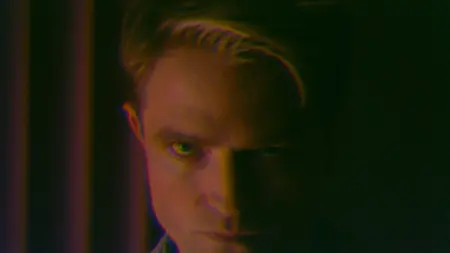
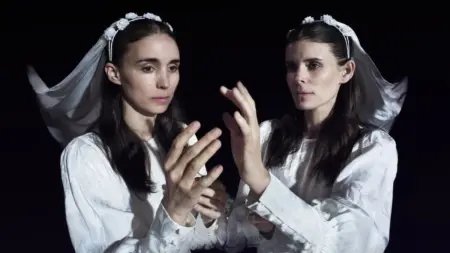
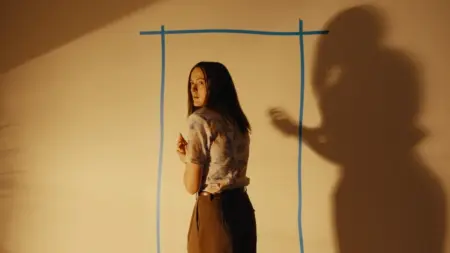
Alpine Lake makes for a stunning locale. Backed by an eerie score from Atticus Derrickson, the camp’s lonely, mountainous backdrop, with a steady supply of flurry snow surrounding a frozen lake at its center, looks unquestionably gorgeous under the eye of cinematographer Pär M. Ekberg. Moreover, it’s cunning to build on the claustrophobia of the first film with an isolated camp that prompts a fear of the unknown. Of course, a key part of Black Phone 2 is Gwen’s ability to commune with spirits through her dreams in a sort of astral plane. These sequences, as well as flashbacks, are shot on Super 8 film stock that creates a downright unnerving feeling.
The Grabber is Largely Underwhelming in Black Phone 2
Black Phone 2 surpasses the visuals of the first installment, undoubtedly. However, the issues with this sequel stem from the cast of characters at Alpine Lake. Miguel Mora, who returns from the first movie, has a likable screen presence. That doesn’t take away the fact that he doesn’t have anything to do here, though. Mason Thames (How to Train Your Dragon) tries his best to do something with Finney, yet the script doesn’t allow him any range beyond a surface-level examination of residual grief. The portrayal of his “marijuana addiction” is incredibly out of touch as well, and it would be hard for any actor to sell that.
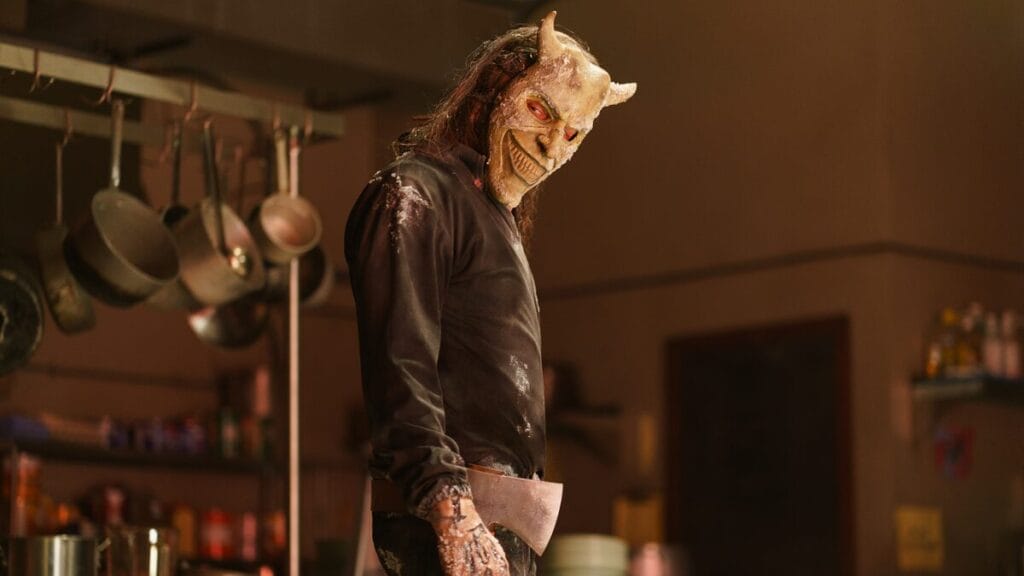
Demián Bichir is a welcome addition as the kindly camp supervisor Armando, at least, providing a nice bit of warmth. Moving on, whoever decided to turn Finney and Gwen’s abusive father, Terrence (Jeremy Davies), into a pseudo-comic relief character was seriously misguided. Worst of all is The Grabber himself. In the first film, The Grabber was portrayed as a deeply sick man, an enigma whose personality shifted depending on which mask he wore. The closer the audience got to understanding him, the more they would be faced with an unknowable void.
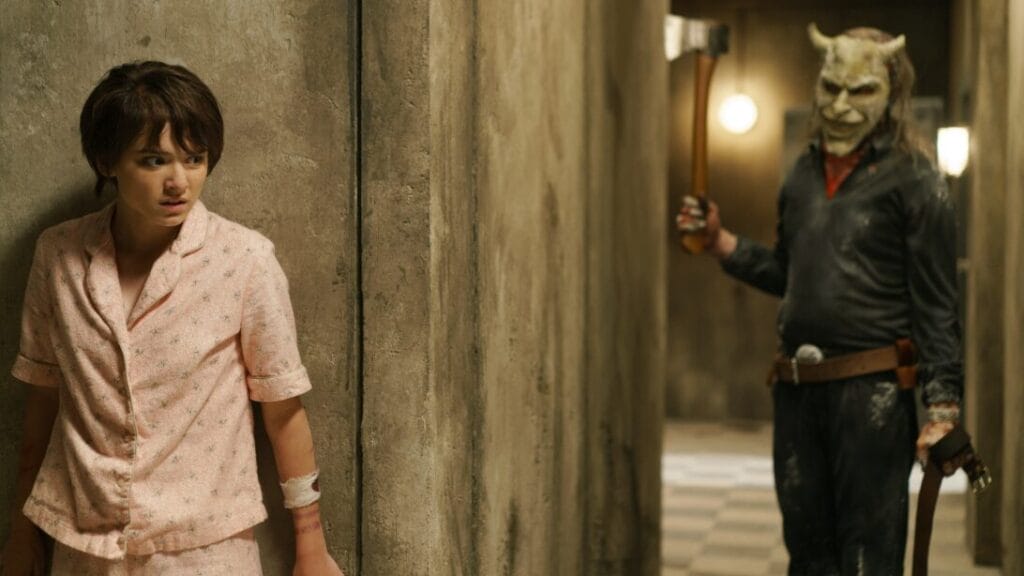
In Black Phone 2, he’s essentially Freddy Krueger without the quips. That’s hardly an exaggeration; if it weren’t for the suit and mask, there would be no separating The Grabber from any other generic supernatural horror villain. All of his quirks are replaced with a single-minded thirst for vengeance.
Horrifying Visuals Can’t Make Up For a Muddled Script
Ethan Hawke (FX’s The Lowdown) tries his best in Black Phone 2. However, when the screenplay reduces his character to something this uninspired, there’s not much that can be done. This sequel boasts numerous fascinating ideas, like dreams serving as a form of communication with spirits, darkness surrounding a Christian institution, and the villain undergoing a supernatural transformation. Ultimately, the biggest problem is that the narrative constantly bends over backwards to try to fit these pieces into the established world of The Black Phone. It’s shocking to hear that the idea for Black Phone 2 came from Joe Hill, who wrote the original short story on which this franchise is based.
Courtesy of Universal
Frankly, the pervasive feeling is that Black Phone 2 is constantly trying to prove its own need for existence rather than telling a bold new horror story. There are too many flashbacks, retcons, and even an element that facilitates communication between two points in time, making it hard to become invested in the present plot. It’s been a long time since any horror sequel has spent most of its energy on contrivance instead of having fun with some clearly great ideas. The 114-minute runtime struggles to contain the amount of painstaking elaboration on things that didn’t need to be explained, while key aspects — like The Grabber and the kids that Gwen is looking for — fall by the wayside.
Madeleine McGraw is Supersonic
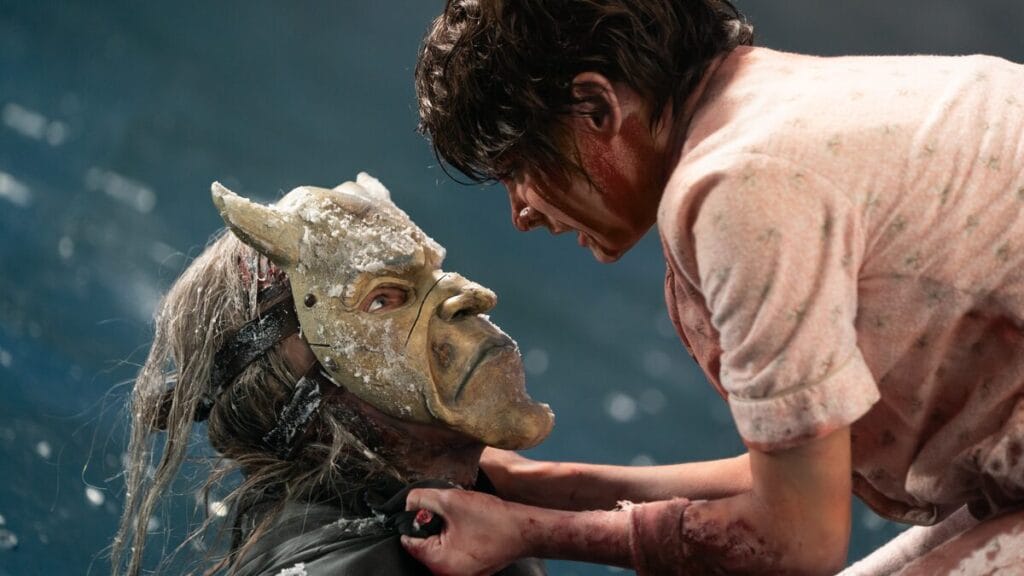
Madeleine McGraw saves Black Phone 2, pushing it into riveting territory. As a teenager dealing with multiple layers of grief and learning to come to terms with her burgeoning powers, McGraw takes the character of Gwen further than what little is on the page. She’s charming, vulnerable, and a powerful protector, all at once. Whether it’s a guttural, terrified scream or a steely gaze towards her tormenter, all of the emotion, all of the thematic tissue, all of the story worth telling comes from her. She even elevates Black Phone 2 to nearly stratospheric heights at certain moments. But what she really deserved was a sequel that rose to her level of commitment.
Courtesy of Universal
There are far worse horror sequels than Black Phone 2. At the same time, though, few horror sequels of recent memory are this messy. Both can be true. Black Phone 2 has the right ideas, but they are conveyed in a convoluted manner. The major leap needed to go from the simplistic narrative of the first movie to the more expansive one of the sequel isn’t given proper follow-through. Madeleine McGraw’s supersonic work, the well-considered iconography, and strong concepts keep Black Phone 2 from disaster. The problem? It should have been so much better.
Black Phone 2 premiered at Fantastic Fest 2025 and hits theaters on October 17!

Release Date: October 17, 2025.
Directed by Scott Derrickson.
Screenplay by Scott Derrickson & C. Robert Cargill.
Based on characters created by Joe Hill.
Produced by Jason Blum, Scott Derrickson, & C. Robert Cargill.
Executive Producers: Joe Hill, Daniel Bekerman, Jason Blumenfeld, Adam Hendricks, Maggie Levin, & Ryan Turek.
Main Cast: Mason Thames, Madeleine McGraw, Ethan Hawke, Demián Bichir, Miguel Mora, Jeremy Davies, Arianna Rivas, Anna Lore, Graham Abbey, & Maev Beaty.
Cinematographer: Pär M. Ekberg.
Composer: Atticus Derrick son.
Production Companies: Blumhouse Productions & Crooked Highway.
Distributor: Universal Pictures.
Runtime: 114 minutes.
Rated R.