

It’s been a long road back to the Grid. Disney’s Tron franchise has always represented the cutting edge of technology and imagination. Steven Lisberger’s 1982 original film pioneered digital effects, paving the way for Joseph Kosinski’s Tron: Legacy (2010) to redefine that aesthetic for a new generation. Now, with Tron: Ares (2025), Oscar-winning actor and producer Jared Leto (Requiem for a Dream, Morbius) and director Joachim Rønning (Young Woman and the Sea, Maleficent: Mistress of Evil) are pushing the franchise’s iconography even further into the future.
The third and latest Tron film merges tactile spectacle with the philosophical ideas that have made the series endure. Leto, who’s been attached to the project for nearly a decade, says his biggest mission was simply to make sure the movie existed at all. “For me, as a super fan of Tron, I guess my first job was to try to make sure the film happened,” he told us during an exclusive interview. “Over the years, as we developed a script, we leaned in and made sure that it was filled with not only surprise and delight, but also heart and humor. To make something satisfying for someone like me — a Tron super nerd.”
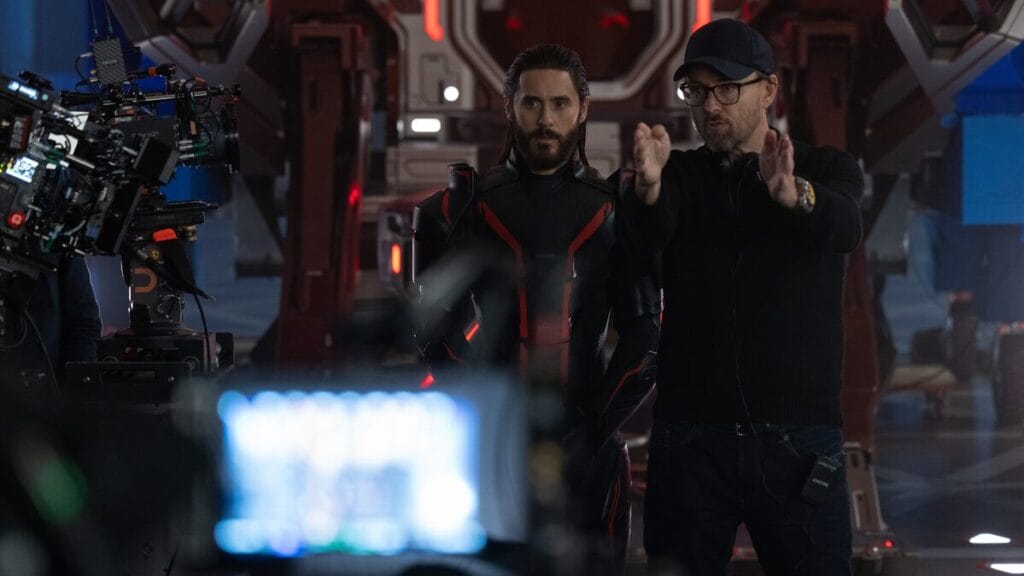
Courtesy of Disney
The Pressure of Taking on Tron’s Literal Legacy
Joachim Rønning, a lifelong admirer of the series himself, tells us that he found the prospect of helming the next Tron sequel both thrilling and daunting. “I didn’t really catch it when it came out, but it grew on me a couple of years after that,” he recalls. In fact, he goes as far as to credit Leto as “the keeper of the flame,“ since the singer-actor played a significant role in figuring out how to incorporate classic callbacks and Tron easter eggs in the film’s plot.
Joaquim Rønning: “Having Jared kind of guide this, being the keeper of the flame. I must call him that, in the sense of knowing the universe and coming up with these ideas of how to bring back some of the original stuff, like going back to the ’80s Grid. But for me, I just love the first film and Kosinski’s. I think they are masterpieces, and I put a lot of pressure on myself to take Ares to the next level.”
Leto jokes that Rønning’s commitment came at a cost. “He hasn’t slept in three years,” he quips, to which the Norwegian filmmaker laughed and replied, “Not too far from the truth.” Their chemistry speaks to the collaborative nature of Tron: Ares, which marks the franchise’s return to the big screen after 15 years. Between its cutting-edge technology and expanded mythology, its director and lead star view their sequel as both a continuation and a reinvention of Tron’s visual identity.
Incorporating Nine Inch Nails Into the Grid
Music has always been the pulse of Tron, from Wendy Carlos’ groundbreaking electronic score to Daft Punk’s era-defining soundtrack for Legacy. This time, Rønning turned to another powerhouse: Nine Inch Nails. “Music is such a big part of the Tron franchise,” the director explains. “It was such an amazing process to be able to get Nine Inch Nails to do it, and I knew that they were going to make the music when we were shooting. So, I used [their older songs] as inspiration — really going more industrial and grittier with this movie.” That industrial edge also mirrors the film’s central clash between the digital and physical worlds, “the two different worlds colliding,” as Rønning puts it.
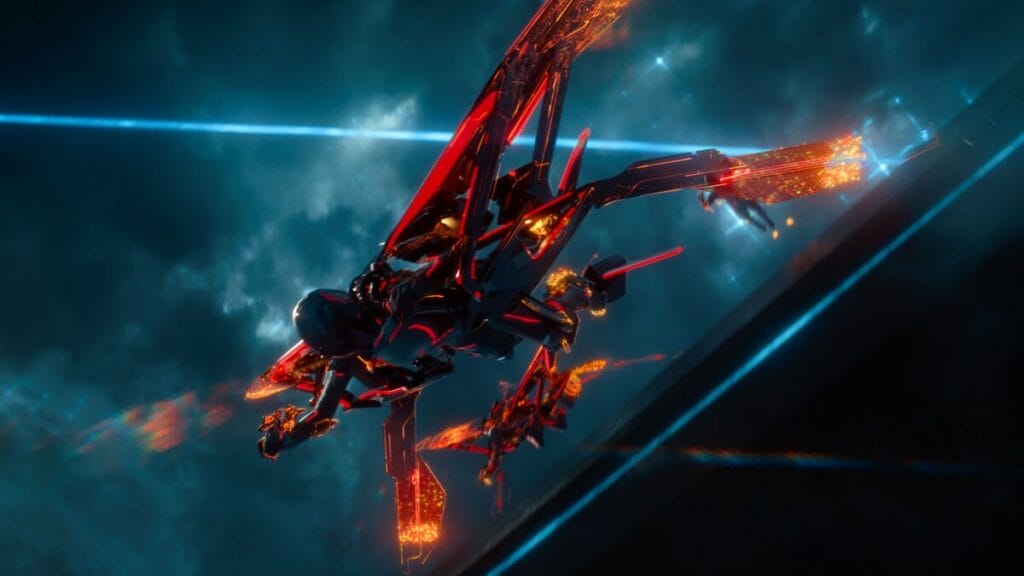
Years after the events of Tron: Legacy, a highly sophisticated AI program named Ares (Leto) is sent out into the human world on a dangerous mission that threatens to blur the boundary between user and code. As the digital warrior grapples with his autonomy and freedom of choice, the arrogant CEO of Dillinger Systems, Julian Dillinger (Evan Peters), and the optimistic ENCOM CEO, Eve Kim (Greta Lee), race to find the Permanence Code. It is said that the legendary Kevin Flynn (Jeff Bridges) left behind a vital key that could allow programs like Ares to exist in reality permanently. Thus, cyberspace begins to merge with human existence in ways that can never be undone.
Building Real-Life Light Cycles
Four decades after the first movie pulled audiences into the infinite possibilities of digital worlds, Tron: Ares is pulling them back in. Only now, the Grid has never felt more alive. With Rønning guiding the way, the series that once redefined computer-generated imagery, or CGI, is ready to do it again for a whole new era of users. The narrative at hand revolves around the collision between the virtual and the tangible, and this extends to the visuals as well.

As Rønning tells us, his team was able to build practical, life-sized light cycles, giant neon-drenched sets, and much more. This immersion was then enhanced by the VFX wizards at Industrial Light & Magic (ILM), who seamlessly blended these incredible props within the digital playground of the story. Believe it or not, practical light cycles have never been utilized in the Tron series until now.
Joachim Rønning: “It’s important that we believe it when they are in the real world. When they are in the Grid, you have more freedom in creating an environment that’s technically and artistically a little easier to make believable. However, in the real world, everything needs to have a texture to it, needs to be tangible. You need to be able to touch it. With this kind of budget, we were able to build some of these large sets and real light cycles, among other things. And with the amazing help of Industrial Light & Magic, it all came together.”
Tron: Ares hits theaters on October 10!

Release Date: October 10, 2025.
Directed by Joachim Rønning.
Screenplay by Jesse Wigutow.
Story by Jesse Wigutow & David DiGilio.
Based on characters created by Steven Lisberger & Bonnie MacBird.
Produced by Jared Leto, Sean Bailey, Steven Lisberger, Emma Ludbrook, Jeffrey Silver, & Justin Springer.
Executive Producers: Russell Allen, Joseph Kosinski, Trent Reznor, & Atticus Ross.
Main Cast: Jared Leto, Greta Lee, Evan Peters, Jodie Turner-Smith, Hasan Minhaj, Arturo Castro, Gillian Anderson, Jeff Bridges, Cameron Monaghan, & Sarah Desjardins.
Cinematographer: Jeff Cronenweth.
Composers: Nine Inch Nails.
Production Companies: Walt Disney Pictures & Sean Bailey Productions.
Distributor: Walt Disney Studios Motion Pictures.
Runtime: 119 minutes.
Rated PG-13.