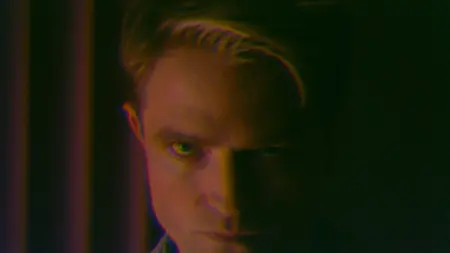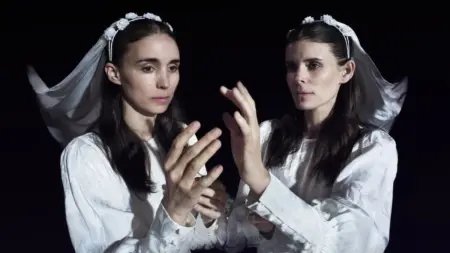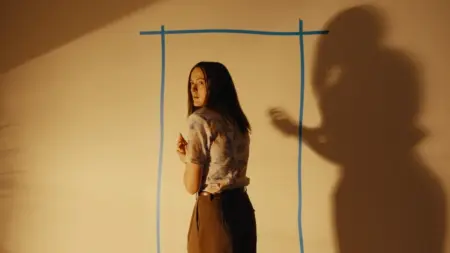


There’s something inherently unsettling about being asked to sit in the dark and listen. To trust what you hear instead of what you see. To let distorted, ambiguous sounds and negative space guide your fear rather than the familiar grammar of jump scares or visual shock. Undertone (2025), the feature debut from innovative writer-director Ian Tuason, understands this on a molecular level. It’s a horror movie that not only uses audio as a tool, but also builds its entire identity around the act of listening itself. This is listening as investigation, as obsession, as faith, and ultimately as surrender.
Tuason’s film, which played at Fantasia 2025 and Sundance 2026, follows Evy Babic (Nina Kiri). The skeptical paranormal podcaster spends her nights combing through eerie audio files sent to her show while caring for her comatose mother (Michèle Duquet) in the childhood home where she grew up. As Evy and her remote co-host, Justin (Adam DiMarco), dissect recordings allegedly linked to a pregnant couple experiencing supernatural disturbances, the boundaries between those audio files and Evy’s own reality begin to erode. The eerie voices creep closer, the strange sounds grow oddly deliberate, and what initially plays like a puzzle to be solved slowly mutates into something much more intimate and invasive.
Analog Horror in the Modern Age
What makes Undertone immediately striking is its commitment to the idea that what we don’t see is often far more horrifying than what we do. Horror has always thrived in negative space. However, Tuason is among the few filmmakers who clearly know how to weaponize it. Cinematographer Graham Beasly has the camera drifting slowly through hallways and lingering on doorways. He frames dark corners with an almost cruel patience, daring the viewer to imagine what might be lurking just out of shot. These slow, panning movements are both stylistic flourishes and acts of provocation. Undertone is asking you to fill in the gaps, then punishing you for doing so.
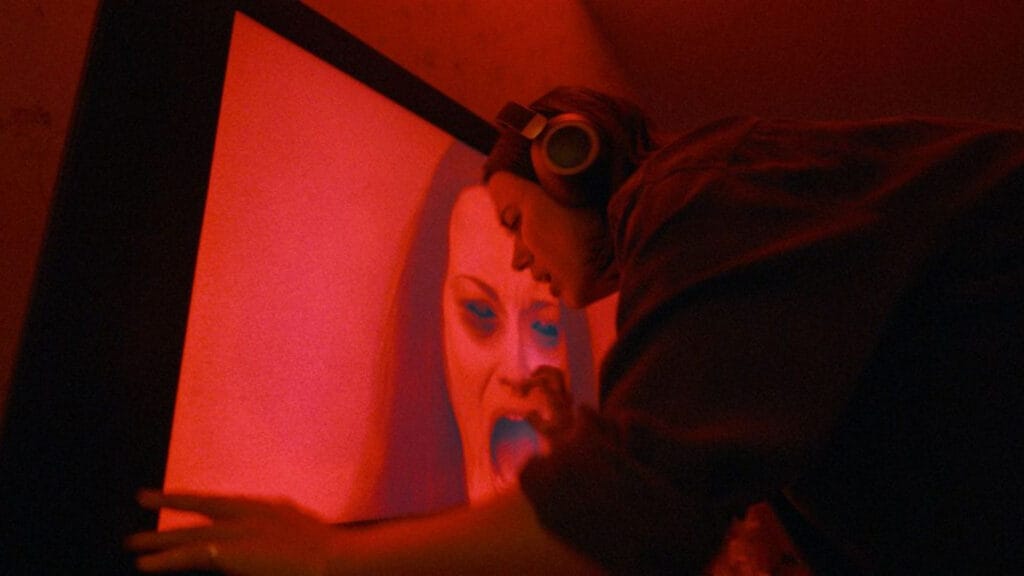
That approach recalls the nerve-shredding minimalism of the original Paranormal Activity (2007) and Skinamarink (2022), where the real horror lived in waiting for something, or anything, to happen. The suffocating, demonic, and domestic dread of Hereditary (2018) also comes to mind. But Undertone distinguishes itself by shifting that anxiety predominantly into the auditory realm. Sound here is not merely atmospheric dressing; it’s the engine of terror. Directional audio cues, whispered voices, reversed nursery rhymes, and distant, creeping noises all play tricks on your brain. Similar to the audio-focused work of Austrian filmmaker Johannes Grenzfurthner (Razzennest, Solvent), there are moments where you genuinely feel like something is behind you, or barely out of reach, even though the screen remains defiantly still.
Nina Kiri Delivers an Astounding Leading Performance
The effect is overstimulating in the best way. By the time Undertone reaches its final stretch, the film becomes a masterclass in sensory escalation. It piles sound upon sound and tension upon tension until the experience is too overwhelming. It’s horror that attacks the imagination directly, bypassing the need for explicit imagery and instead letting your mind do all the damage. At its best, Undertone elicits unavoidable stress and panic from within, like you’re eavesdropping on something you were never meant to hear.
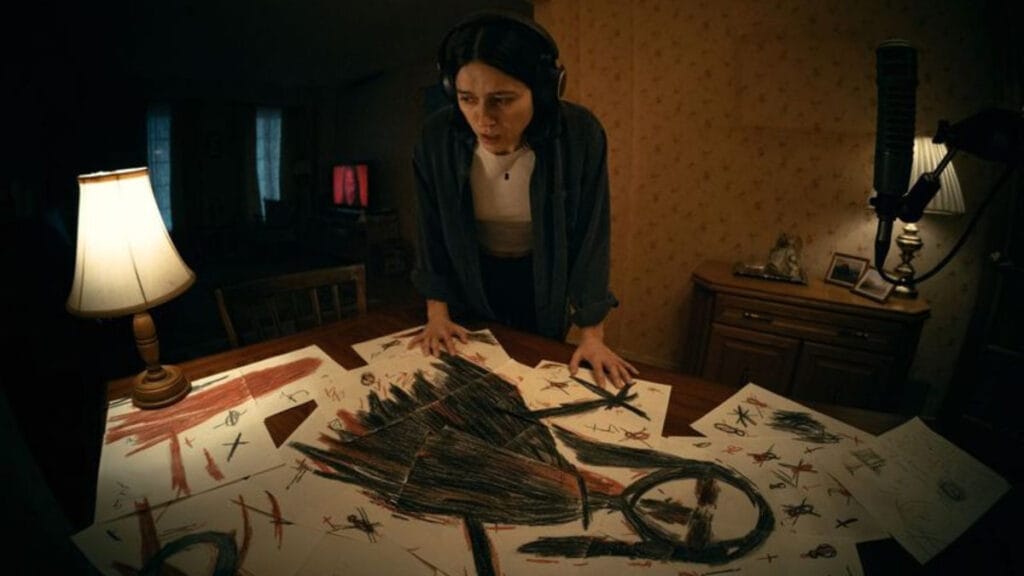
At the center of all is Nina Kiri (The Handmaid’s Tale), delivering a remarkable near-one-woman performance that anchors the film emotionally as well as narratively. Evy is exhausted and defensive. She’s a woman clinging to skepticism, not because it’s comforting, but because belief seems like one more burden she can’t afford to carry. Kiri plays her with a raw, unvarnished vulnerability, capturing the quiet desperation of someone trying to keep control as every external and internal support system collapses. As Evy’s faith (in herself, in logic, in the boundaries between reality and imagination) begins to fracture, Kiri charts that unraveling with frightening precision — all while reacting to whatever she’s currently listening to.
The Emotional Undertones of Undertone
Equally impressive is Michèle Duquet as Evy’s mother, a largely comatose presence who nonetheless becomes one of the film’s most haunting figures. It’s a thankless and underrated performance in the truest sense: built entirely out of breathwork, subtle physical movement, and an uncanny stillness that feels charged with intent. There’s something incredibly unsettling about Mama’s presence, even when she’s doing nothing at all. Her body becomes another piece of negative space, another site where the audience is invited and compelled to project their own meaning, fear, and guilt.
That guilt is central to Undertone’s emotional core. The movie’s supernatural horrors are inseparable from its exploration of caregiving, grief, and inherited belief systems. Evy’s strained relationship with her religious mother, combined with the revelation of her own pregnancy, creates a thematic knot that Ian Tuason’s script tightens relentlessly. Motherhood here is not idealized; it’s fraught, exhausting, and terrifying. Faith is not presented as salvation so much as an unresolved inheritance; like it’s something passed down, whether you want it or not, lingering long after the believer is gone.
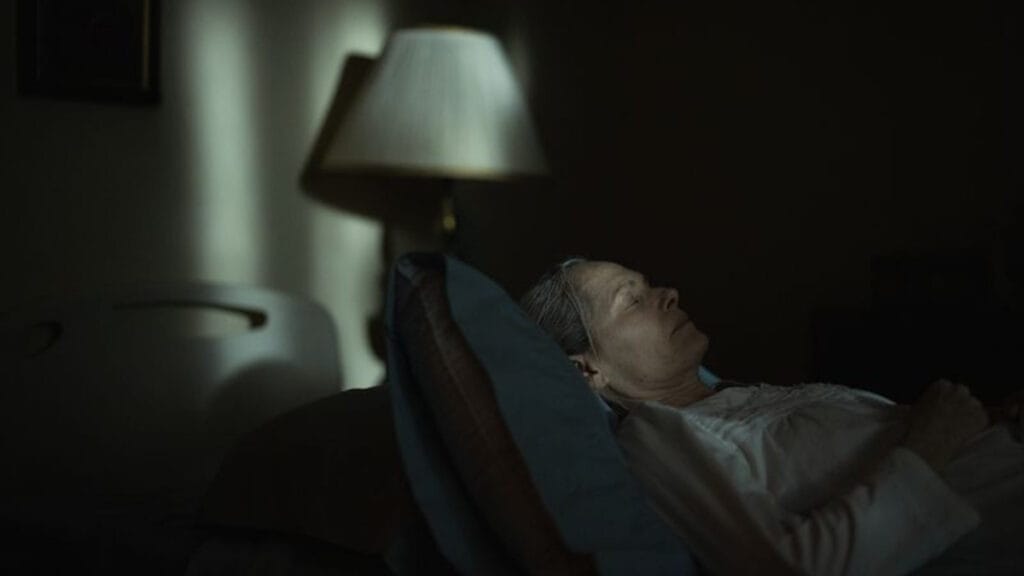
Religious imagery is woven throughout Undertone with chilling restraint. Catholic iconography, childhood drawings, and nursery rhymes all bleed into the plot in ways that feel both deeply personal and cosmically malicious. There’s a sense that something ancient and indifferent is pressing its weight against Evy’s life at the exact moment she’s least equipped to resist it. The result is a horror film that feels genuinely cursed. As if the act of listening itself might invite consequences. There are scenes where a strange, almost superstitious discomfort takes hold, like you shouldn’t be hearing these sounds at all.
A Truly Singular Vision of Original Horror
Knowing the extremely personal origins of Undertone only enhances its impact. Shot inside Ian Tuason’s actual childhood home and shaped by his real experiences caregiving for his dying parents, the film carries an authenticity that’s impossible to fake. Every creative decision is intentional, born out of lived experience rather than genre obligation. This is a horror movie haunted by its maker in the most literal sense. It’s a story where grief, guilt, and imagination collapse into one another until they are indistinguishable.
By the time Undertone reaches its final moments, it’s clear that Tuason has delivered something truly singular. It’s a fully formed directorial debut that is unafraid to alienate viewers who demand easy answers or conventional scares. This is a film that rewards patience, close attention, and repeat viewings. If you tap into its unique wavelength, Undertone is a work that lingers long after the sound cuts out, leaving you alone with whatever your mind conjures next. Undertone doesn’t just ask you to listen. It dares you to believe what you hear and to reckon with what that belief might cost you.
★ ★ ★ ★ ☆
Undertone hits theaters on March 13!
Release Date: March 13, 2025.
Directed by Ian Tuason.
Written by Ian Tuason.
Produced by Dan Slater & Cody Calahan.
Executive Producers: Ian Tuason, Al Akdari, Chad Archibald, Melodie Austria, Charles Ben, Thomas W. Choong, Anthony Eu, Daril Fannin, Rod Hafezi, Douglas Lee, Roy Lee, Brit MacRae, Stuart Manashil, Luke Maxwell, Ben Ross, Will Rowbotham, Steven Schneider, David Sproat, & Matthew Sterling.
Main Cast: Nina Kiri, Adam DiMarco, Michèle Duquet, Keana Lyn Bastidas, Jeff Yung, Sarah Beaudin, & Brian Quintero.
Cinematographer: Graham Beasley.
Composer: Shanika Lewis-Waddell.
Editor: Sonny Atkins.
Production Companies: Black Fawn Films, Slaterverse Pictures, Spooky Pictures, DimensionGate, KINO Studios, & Feel Everything.
Distributor: A24.
Runtime: 94 minutes.
Rated R.`