

When you think of a movie star, George Clooney is a name that will undoubtedly spring to mind. Having spent five years on the long-running television series ER and led the Ocean’s franchise, Clooney is one of the most recognizable figures in Hollywood. Lately, however, he has taken a slight step back from acting, quite literally, by taking on more projects as a director. Clooney made his feature directorial debut over two decades ago with 2002’s Confessions of a Dangerous Mind. Since then, the Oscar-winner has helmed Good Night, and Good Luck, The Monuments Men, The Midnight Sky. George Clooney’s latest, The Boys in the Boat, is a sports drama about the University of Washington rowing team that took home the Olympic gold medal in 1936.
George Clooney’s The Boys in the Boat is adapted from the 2013 New York Times best-selling novel of the same name by Daniel James Brown. Screenwriter Mark L. Smith returns to collaborate with Clooney after writing The Midnight Sky. Smith previously wrote The Revenant with Alejandro G. Iñárritu and his next project is the highly anticipated sequel Twisters, which releases later this year. The story of The Boys in the Boat is set against the height of the Great Depression and the rise of Nazi Germany, as the 1936 Summer Olympics were held in Berlin. Both the book and movie adaptations focus on the inspirational true story of Joe Rantz, an American rower who was abandoned by his family as a teenager and overcame all obstacles to achieve his dreams of becoming a professional athlete.
Callum Turner takes on the role of Joe Rantz and leads the main group of underdogs in The Boys in the Boat. Turner is perhaps best known for playing Newt Scamander’s brother, Theseus, in the Fantastic Beasts franchise as well as starring opposite Anya Taylor-Joy in 2020’s Emma. He is next set to take the spotlight in the upcoming AppleTV+ miniseries Masters of the Air alongside Austin Butler and Barry Keoghan.
We sat down with director George Clooney and star Callum Turner to dive into the challenges that came with making The Boys in the Boat, which include learning to row to an Olympic standard and shooting nearly entirely practical race sequences. Moreover, Clooney shares his thoughts on why moviegoers have always gravitated towards underdog stories.
Exclusive Interview with Director George Clooney and star Callum Turner for The Boys in the Boat
George, you were already attached to the project throughout the screenwriting process, meaning the book was your first point of contact with this story. What were your first impressions of it? And Callum, what were your first impressions of the script?
George Clooney: I love [The Boys in the Boat] book. It’s a tricky thing when you hear about a book before you read it and it’s a bestseller. It’s always a bit of a concern that you’re not going to like it as much. I read it and then I got it on tape, like an Audible on tape type of thing, and I just found it to be this really beautiful story. It kind of already feels like a movie when you hear it. It’s a long book, so the screenplay had to condense it down. But from the very beginning, it felt really cinematic.
Callum Turner: Well, George was going to be directing, so that was my main pull because I have always wanted to work with him. If it was a film about the moon, I would be there. When I read the script, I was taken aback by Joe’s story and what these guys achieved. The idea of him being abandoned by his family when he was 13 years old and making the decision to not let that define him and to be determined to achieve the things that he did, really took me aback. I just fell in love with him and wanted to play him.
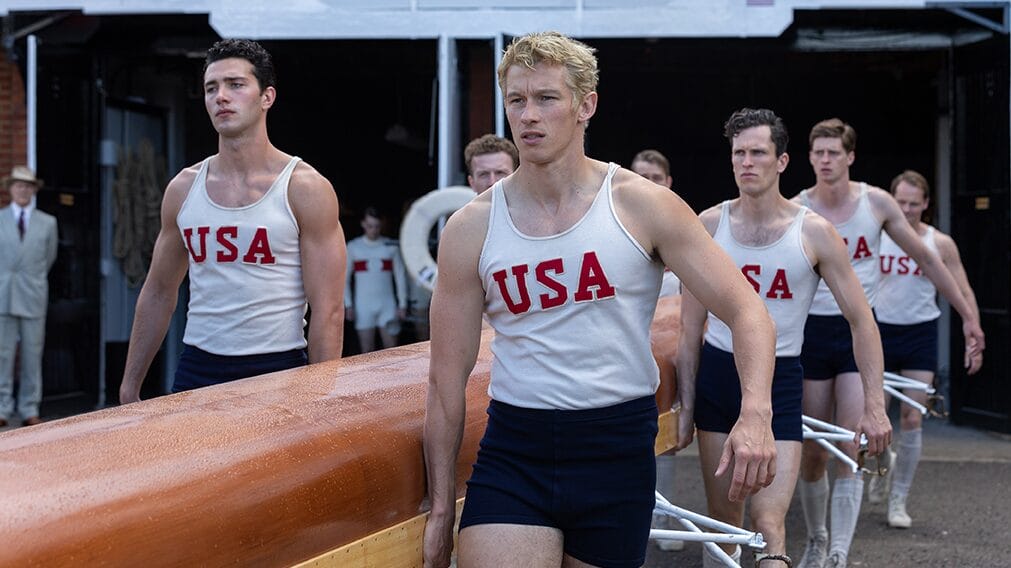
You just mentioned that your character Joe is the core of this story. George, how did you go about the casting process and when did you know that Callum was right for the role?
George Clooney: I was aware of Callum, I’d seen him in a few things. Grant Heslov and I, my producing partner for four years, started looking at who would be right to do it. I always make jokes that he was our 15th choice, but the truth is that he was our first and only choice. We were really lucky that he wanted to and was available to do it. So, casting him was easy but casting the other guys was tricky because you had to get athletic guys. Casting Joe was the key, and if you got that right, then everything else was covered.
Callum, was rowing a completely new skill that you had to learn?
Callum Turner: Absolutely. Not just for me but for everyone else in the boat. It was an excruciating process. It was five months of training but George and Grant set us up to succeed. They gave us the best facilities in England with trainers who have won gold at the Olympics as well as nutritionists. We really felt like a professional sports team.
George Clooney: Have you talked to Terry [O’Neill] since we finished the movie?
Callum Turner: No, I haven’t.
George Clooney: l’d like to hear what he thinks.
Callum Turner: I did see an interview though and he seemed pretty happy.
George Clooney: We’ve been running into some Olympic rowers lately. Yesterday, we did an interview with two of them and they gave us a thumbs up. Then last night after a screening, a guy came over and said he was an Olympic rower and told us, “That was the first time I’ve seen rowing done right.” That makes you feel good because that was a big part of it.
Callum Turner: To have the community you’re portraying support the film is special.
That whole process must have been physically intense, right?
George Clooney: I was fine!
Callum Turner: I knew you were asking him.
George Clooney: You know, every once in a while I get a little cramp, just getting in and out of the motorized boat, but I was fine! I had a masseur there and he kept me in shape. They set me up to succeed.
Callum Turner: He’s really determined. (They both laugh)
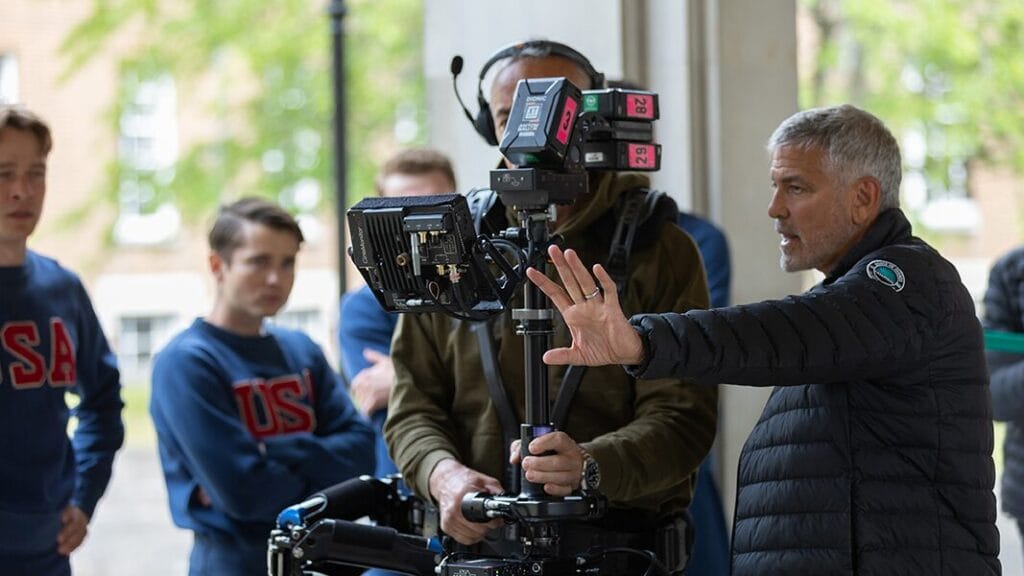
Did you give rowing a go George?
George Clooney: What are you crazy?
Callum Turner: You know what he did, he had a basketball hoop outside his trailer. He dunked on us. He schooled us.
George Clooney: I needed to have something that I could do. He [Callum] is like the shortest guy on the team, some of those guys were huge!
Callum Turner: That’s true. It’s nice to work with actors who are that tall because I’m usually the tall one.
How did you balance your performance with the rowing? Were you not exhausted all the time?
Callum Turner: We all were but what George does is provide a space where we work quickly. He shoots fast and efficiently. Normally by three o’clock, we were wrapped.
George Clooney: We were wrapped, but then we sent him off to row some more.
Callum Turner: George would be there with his glass of red wine like…
George Clooney: Have a nice row boys!
Callum Turner: There was a lot of just going back to the hotel room, sitting in a bath, and watching Rowing for Gold over again.
George, one of the first things they taught me during my time at film school was to avoid shooting near water because of how tricky it can be, but obviously with this story that’s not an option. What kind of challenges came with shooting the rowing sequences?
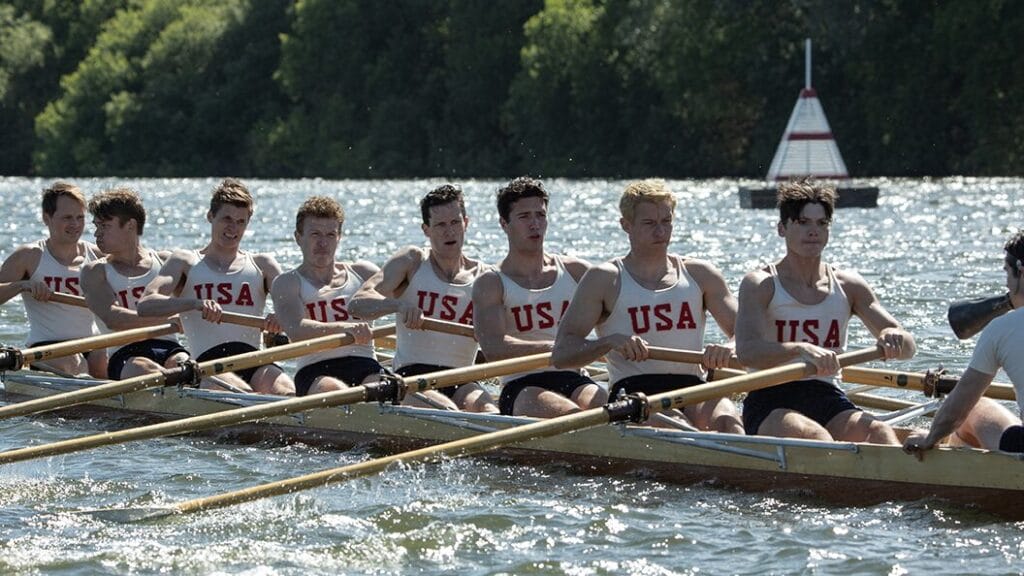
George Clooney: It’s funny, we were talking about this yesterday, I did The Perfect Storm nearly 25 years ago and I just forgot. When I read the book, I was like, “Yeah, this will be great!” But then I thought, “What am I thinking?!” It was tricky. We did a couple of tank shots, but most of it was practical and on the water directly, and boy I tell you, that was a workout trying to figure it out. The wind blows and getting everybody to go in the same direction at the same time is a headache.
They also all have to perform. These guys are trying to do, and eventually by the last few weeks, we’re going for sections at the same pace that the Olympic rowers are going, which is forty-six strokes. That’s what the boys in the boat won doing in 1936, and that’s flying! They got there for sections, but you can’t do that with them all day. So, you can only shoot a few sequences, and then you have to stop and shoot something else.
Callum Turner: I guess to your point earlier, we were actually in such good physical condition that we were able to somehow maintain that.
Like so many others, I love an underdog sports story. What do you think it is about that very specific genre that we’re drawn to as audiences?
George Clooney: I love that scene where the coach gives them money. That I don’t know, it’s a funny thing. We do like an underdog story. It’ll even go back to films like Casablanca, which is an underdog story. We were just talking about films we love and if you think about it, All the President’s Men is an underdog story because those two reporters weren’t supposed to be the guys. There’s something about the idea of you not being meant to being somewhere but getting there anyway, that I have always liked.
I feel like for us, the advantage was that this was a true story, because if it wasn’t it would feel formulaic, right? Did the kid really get sick? Did the other coach really give them money? All those things happened, so it being true helped a lot. Isn’t that a good scene? The actor was really terrific, he worked for a couple of days. He walked in, and he just had this great open smile.
Callum Turner: I suppose that they have a great rivalry too. When he puts his arm on Joel [Edgerton], it’s so good.
I think that’s what makes it so special, when the wife, Hazel, also says thank you less subtly than the men in the room.
George Clooney: That is kind of a perfect example with these sports films. The guys can’t emote much, right, because they don’t. Particularly, they didn’t back then. So, when the guy comes in and gives him the money, and you see everybody look at each other and just nod their heads, but then the wife goes “Oh my god!” and hugs him, then all of a sudden everything breaks loose and you’re able to understand how high the stakes were without having to have their say “Gosh, this is so big of you.”
I just talked to Joel Edgerton about a similar thing with coach Ulbrickson where it feels as though he is quietly a paternal person. Besides the passion of rowing, he very much wants these boys to succeed because of the difficult socio-economic conditions of the time.
Callum Turner: I love his performance because it’s just so matter of fact and almost stern all the way through, and then when he does say something that he means like, “I’m proud of you,” it really hits.
George Clooney: The first shot with Joel was where he is first introduced on the dock and he comes out and is like “You’re all going to hate it!” The studio saw the dailies and said he wasn’t very likable but I was like, “He’ll get there, don’t worry.” It’s a funny thing, you know, actors and certainly studios, when they’re looking at dailies, they want every scene to solve every problem, all the time. You have to say, “No, there’s a journey here.” So, when he finally gives us the “I’m proud of you,” which is not much in the scheme of things, it feels like a lot.
To wrap things up, do you have any favorite memories from set that you can share?
Callum Turner: I would say, I know I already said that George had a basketball net. That was a really nice moment, all of us playing basketball together.
Sounds like a fun unit base to me!
Callum Turner: It really was.
George Clooney: There was a moment at the very end, the guys had wrapped, but they still had the row back and they took a long, slow row back. We all met up on the dock and it really felt like the end of a sports season. It felt special. I think everybody knew that they weren’t going to have that experience again and it was really emotional.