

Legendary filmmaker Quentin Tarantino personally introduces the definitive examination of his entire oeuvre with the Quentin Tarantino Library, written by Jay Glennie. Never before has a major filmmaker allowed ten 500+ page coffee table books to be written for each of his films. In the first book of this series, The Making of Once Upon a Time in Hollywood, Glennie pulls back the curtain on the visionary writer/director/producer’s ninth movie, with unprecedented access to the filmmaker, cast, and crew. This epic tome is a stunning deep dive and a must-have book for all film aficionados and Tarantino fans.
The Making of Quentin Tarantino’s Once Upon a Time in Hollywood is set to release on October 28 and is now available for order on Amazon and Barnes & Noble. Up next in this series will be the “making of” coffee table books for Inglourious Basterds (2009) and Django Unchained (2012), both of which are currently scheduled for release in 2026. However, for now, Tarantino has gifted respected journalist and author Jay Glennie the never-before-told tales of Once Upon a Time… in Hollywood. The book features hundreds of behind-the-scenes photographs, along with production memos, concept art, and costume and production design sketches.
Examining the Untold History of Quentin Tarantino’s Once Upon a Time in Hollywood
Jay Glennie’s book also gorgeously flaunts reproductions of letters, studio documents, and film ephemera that can be found nowhere else. Additionally, the author conducted new exclusive interviews with key cast and crew members, including Oscar-winning actors Leonardo DiCaprio and Brad Pitt, Oscar nominee Margot Robbie. The brilliant supporting cast, including recent Oscar-winner Mikey Madison, Margaret Qualley, Oscar nominee Austin Butler, Lena Dunham, Kurt Russell, Dakota Fanning, Emile Hirsch, Damian Lewis, Maya Hawke, and Sydney Sweeney, were interviewed for this epic recollection as well.
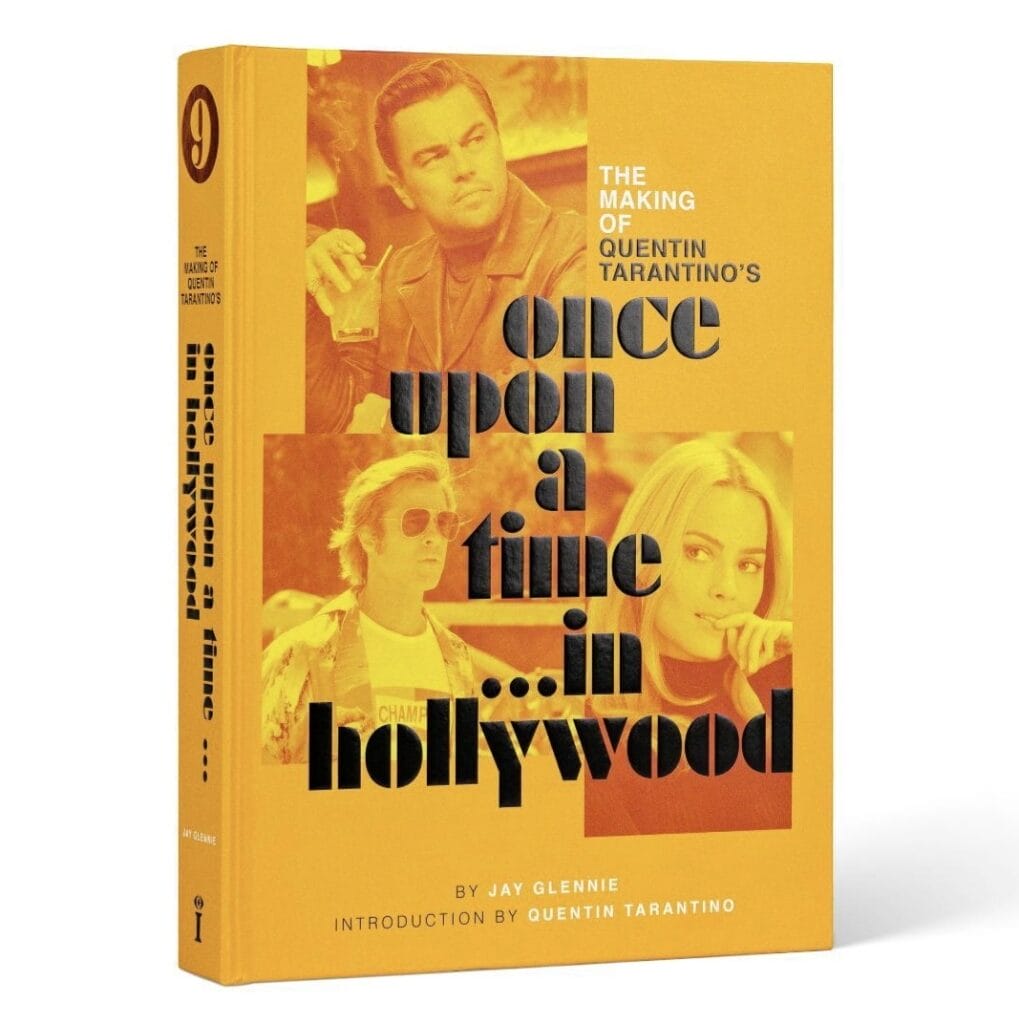
DiscussingFilm can now exclusively debut an excerpt from The Making of Quentin Tarantino’s Once Upon a Time in Hollywood. In the section below, Tarantino recalls the casting process for DiCaprio and Pitt as the film’s two leads, Rick Dalton and Cliff Booth. The respective actors also share their experience and reactions to reading Tarantino’s script for the first time, and how they initially joined the monumental project. This is the official record of how Once Upon a Time in Hollywood was achieved — from inception to the world premiere and on to 10 Academy Award nominations, resulting in 2 Oscar wins.
“Finding Rick Dalton, and Building a Crew“
From Jay Glennie’s The Making of Quentin Tarantino’s Once Upon a Time… in Hollywood
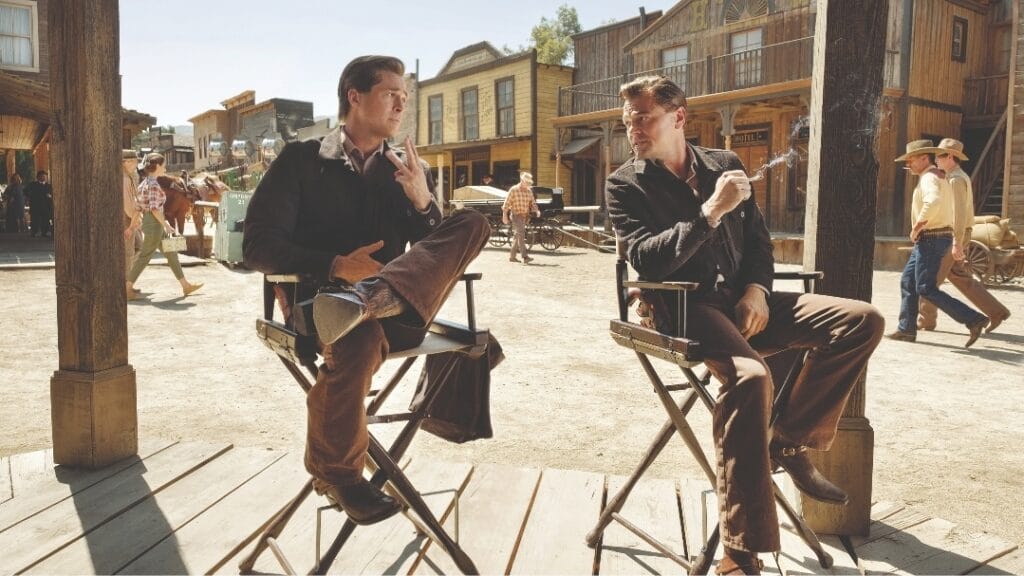
Here’s the thing: The trick was, I had to cast Rick first,” Tarantino explains. “Rick was the lead, and when I cast him, it would become obvious who should play Cliff.”
This was the conundrum—an exciting choice, but a conundrum nevertheless for Quentin. He had an idea for a really interesting pairing. There were three actors he felt had the cojones to pull off the friendship between actor and stuntman, but they had to chime like Newman and Redford had in Butch Cassidy and the Sundance Kid and The Sting.
Quentin had designs on two actors: Leonardo DiCaprio and Brad Pitt, two extraordinary leads. Go big, or go home. He had worked with both. The experiences had been joyful. The work had been fun. The question Quentin asked himself was, if you cannot enjoy your work, why were they doing this? Making movies is fun—we love making movies, right?! No, he couldn’t imagine Inglourious Basterds without Pitt or Django Unchained without DiCaprio. Calls went out to Bryan Lourd and DiCaprio’s agent, Rick Yorn.
…
“So Brad came down to the house to read it,” Quentin says. “Now, I first thought of Brad for Rick, but he liked Cliff more, but he was like, ‘Quentin, whichever way you decide to go, I’ll do either one.’”
Pitt says he immediately picked up on “the friendship between Cliff and Rick. You know, we all have those friendships who have helped us in the down time. Look, there was much in there that was beyond my understanding—we’re talking layers deep—but I was there to serve Quentin.”
Quentin was on hand to serve Brad prior to any reading taking place. He wanted to make his house guest comfortable and made a pitcher of iced tea, “with plenty of sugar,” Pitt says, “QT likes his iced tea with plenty of sugar.”
Before handing over the script, however, Tarantino laid into some background to the characters Brad was about to be introduced to.
“It was astonishing,” Pitt adds. “It must have been an hour. Quentin is pretty verbose, as you know, but this level of detail was astonishing. I also loved the period it was set in. It was great fun. Considering the subject matter, it was really warmhearted—but, hey, so is the guy who penned it.”
But Quentin had to get Rick Dalton down first—whoever is Rick will determine, undeniably, who is the best Cliff Booth. Rick and Cliff, they’re a pair. They have to be a pair. And for Rick, Tarantino had his sights set on Leonardo DiCaprio.
“Look, Leo is one of, if not the finest, actor of his generation, period,” Tarantino explains. “He’s just so naturally gifted. We know each other. We’re friends. He trusts me. That’s important—trust. Both Leo and Brad trust me, and consequently, I trust them both. So Leo comes over to my house, and he reads the script.”
Leo went over to Chez Tarantino.
“Sure, for Quentin, you travel,” Leo says with a laugh. “There was coffee and beer. I think I had a beer and I took my seat in his backyard and I read this script with a handwritten cover. There was one copy, and Quentin’s scripts have their own vernacular, unique to him. Some pages were not typed, and in their place there were handwritten pages—in Quentin’s own handwriting, of course. He was constantly checking in on you, looking to see where you were in the script and if you were laughing at the right places. He wanted that instant reaction. He’s remarkable. There is nobody like Quentin.
“I loved it, right off the bat,” he adds. “I’m a huge fan of movie about our industry, so that caught my interest right away. You then had this relationship between the two guys, which I thought really clicked. It was a work that could have only come from somebody like Quentin, somebody who has infinite knowledge of this world.
And boy, does he know film. He was able to capture the behind-the-scenes of Hollywood in that era and to create this amalgamation of a character that is a character on-screen but also flashes back and forth to his cinematic roles that also help tell his story.
Ultimately, he had written a great love story. I loved it as a piece of writing. As I said, I just loved it.
“Quentin is a cinephile, a true cinephile,” DiCaprio enthuses.
“You know what? It takes sacrifice to be a cinephile. In a lot of ways, a cinephile will cut off from social circles and sit at home in a screening room and watch things on loop to get inspired to learn more. That is Quentin. Quentin thinks Google-searching something is cheating. You know, if you’re a real cinephile, you really have a deep knowledge of your art. Then you’ll know who the editor of The Crowd was, or you know who the cinematographer was on a particular Kurosawa movie. You have to go into the archives of your own brain, and Google-searching is cheating. Again, that is Quentin.
“So reading the script, which I felt was a love story between these two working-class guys, you knew that it was digging deep in Hollywood history because it has come from Quentin, one of the great cinephiles of our time,” he adds.
First reading done, and its author was quick to see what his potential star thought.
“I remember that I told Quentin that it was like Nick Carraway and Gatsby, the whole inside and outside thing with these two guys, these working-class outsiders,” DiCaprio adds. “I loved that it was tipping its hat to all those that make movies that don’t always get their fair and their due respect or success but are, you know, are a staple, the backbone of our industry. It was his love letter to Hollywood. It was so cool that was done in the late sixties, a time of huge change in the movie industry and also politically across the country as a whole. He was referencing all these actors who have sort of disappeared historically and aren’t in the mainstream zeitgeist for their contributions but had done significant and great work.
Quentin was going to honor the outsiders of our industry. I told him I loved what he had done.”
Once Upon a Time . . . in Hollywood had already inserted its claws, and Leo found himself backing up and trying to gain an understanding as to who Rick Dalton was, and what he was going through in this pivotal time in his life as he tried to transition from TV star to movie star. There was no crossover in those days—you were either one or the other—and Rick desperately wanted to have a slice, a huge slice, of what his contemporary Steve McQueen had. He wanted a movie career. Goddamn it, Rick Dalton wanted to be a movie star! But to bring this to the screen, DiCaprio needed to find out who Rick Dalton was, mine more detail that was not present in what he had just read. Luckily, he had Dalton’s Geppetto sitting in front of him.
“Quentin, I need to understand what he is going through in his life,” DiCaprio recalls asking Tarantino. “What the hell is going on?”
No problem. Quentin queued up some shows he felt would give further insights into Rick Dalton. Tarantino knew Rick Dalton backward and forward. He had him down. He gave Leo a few chapters of The Films of Rick Dalton to read. It was easier to show examples in order to highlight where Rick was and where he wanted to advance to, and where he might ultimately end up.
“OK, I watched a couple of things,” DiCaprio remembers. “I put on some Wanted: Dead or Alive.” So now, Leo is not a Steve McQueen fan per se. He was, like, “Jesus Christ, you’ve got to try a little harder than this guy.” McQueen is just not his type of actor. Robert De Niro is his type of actor. Al Pacino is his type of actor. But Leo loved Wanted: Dead or Alive, and he liked McQueen in it. He was, like, “OK, I get it now”—he’s pretty good in that.”
It had been a fruitful few hours. Quentin knew that he had Rick Dalton in his house. Jumping out from the page and sitting, living, and breathing in his house was Rick Dalton.
But Leo needed more time. Sure, he loved what he had read—fuck, it was Quentin Tarantino—but he had to find the character, the true essence of the man, and that took time. No problem. Quentin knew not to stir the pot too much as it cooked, but he also knew that he could throw in some fresh ingredients.
“I start to send Leo DVDs of shows,” he recalls. “I had him watch a bunch of different episodes of Wanted: Dead or Alive, and then I wrote out a whole thing: Watch this disc, episode 3, and then watch disc 2, episode 4, and then I kinda wrote out the story and the good elements and who else to look out for and whatever. And so Leo watched about four episodes, and he’s, like, ‘Oh, I like him more now. They were good shows. I get the sense of Bounty Law now—they’re actually cool half-an-hour shows. They’d be cool.’
“I had figured out everything Rick had done,” Tarantino says. “I said to Leo that Rick is not going to be in The Magnificent Seven—that’s Steve McQueen. But Rick could be in the third sequel, The Guns of the Magnificent Seven—that’s the kinda movie that Rick could have done. I show him The Guns of the Magnificent Seven, and I go, ‘So you’re this guy—you’re the Monte Markham character.’ So he watched the DVD I gave him, and he goes, ‘Yeah, I like that guy. He was cool. That’s a cool little character. Yeah, I can see Rick as that guy. I can totally see Rick as that guy. It would be a fun movie to see Rick in.’”
…
So Rick and Cliff are out there—Tarantino knows that Rick and Cliff are out there—and he can relax, just a little.
Excerpt © 2025 Insight Editions.
Provided courtesy of Insight Editions & The Story Factory, from Jay Glennie’s The Making of Once Upon a Time… in Hollywood (publishing October 28, 2025)