


It’s been five years since James Wan’s Aquaman became the highest-grossing DC film of all time, surpassing $1 billion at the global box office. After taking a well-earned hiatus by dipping his toes back into horror with the gnarly and twisted Malignant, Wan is now back with a massive sequel that is also serving as the final installment in the DC Extended Universe (DCEU) timeline. Since James Gunn and Peter Safran are already deep into rebooting the franchise as the new DCU, Aquaman and the Lost Kingdom could very well be Wan’s last DC movie. But at least he goes out with a bang because this sequel still has a lot to offer even though Warner Bros. Discovery decided the upcoming franchise reboot after it was already shot.
Writer David Leslie Johnson-McGoldrick returns to pen the sequel’s screenplay with James Wan, Thomas Pa’a Sibbett, and main star Jason Momoa receiving story credit. Johnson-McGoldrick can be seen as one of Wan’s go-to collaborators at his Atomic Monster production house as he’s written multiple Conjuring films as well. Aquaman and the Lost Kingdom kicks off in the freezing depths of Antarctica, where David Kane (Yahya Abdul-Mateen II) and his team discover the power of the mythic Black Trident. Kane quickly sees this mysterious weapon as the key to making a comeback as Black Manta and getting revenge on Arthur Curry (Momoa) for his father’s death as seen in the first movie.
Black Manta doesn’t plan on stopping there, as he too seeks to destroy all of Atlantis and then plunge the entire world into a new global meltdown. However, this comes at a dangerous cost as an unknown dark force emerges from the Black Trident’s uncontrollable ancient power. When the Earth starts to feel the devastating effects of this extreme global warming, Aquaman is forced to forge an unlikely alliance with the only person who can lead him to Black Manta, his imprisoned brother Orm (Patrick Wilson). What ensues is a rollicking action-adventure between the current and former King of Atlantis that not only has its fair share of laughs but also a heartfelt conclusion to Aquaman’s arc across the DCEU.
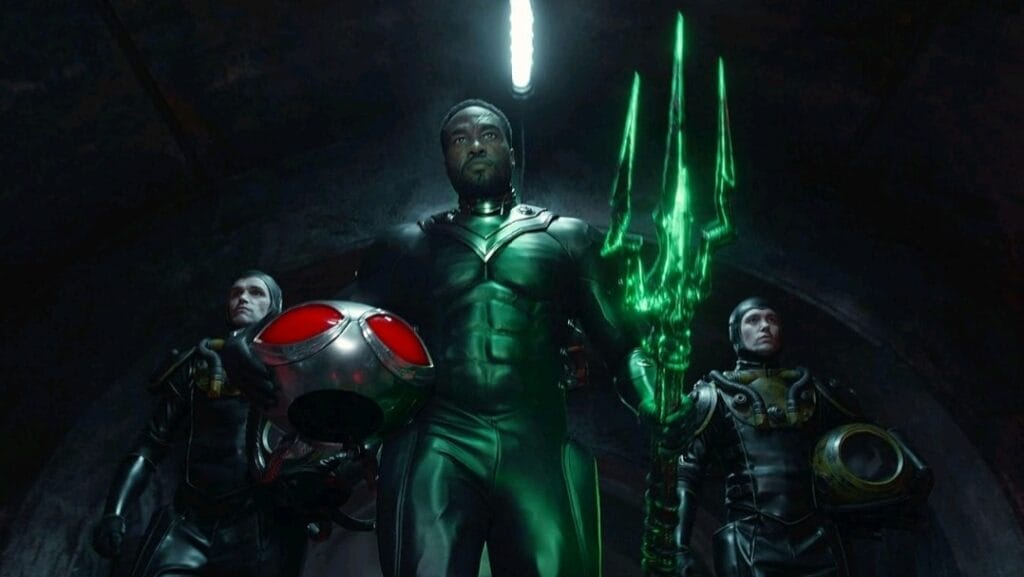
Although it’s a shame that Aquaman and the Lost Kingdom was unknowingly burdened with closing out the DCEU, writer-director James Wan gets to have his final say with the titular hero at the end of the day. How Wan ties up Aquaman’s journey is quite admirable. The sequel catches up with Arthur as both the new King of Atlantis and a new father right from the beginning. Much of the film is about Aquaman struggling to balance his royal duties with his life at home with Queen Mera (Amber Heard) and their infant son Arthur Jr. It’s not until he works to heal his broken relationship with his brother Orm that he’s able to figure out what it truly means to have the responsibility of a superhero and how to use his position for good.
Aquaman and the Lost Kingdom is admittedly nothing innovative or radical as a comic book film, but James Wan delivers even more of the colorful spectacle and epic scale that made 2018’s Aquaman such a hit. It’s a solid blockbuster that has the same amount of often dodgy VFX as the first film paired with cinematographer Don Burgess‘ imaginative visuals. That being said, Wan delivers something a little more dark – similar to Sam Raimi’s Doctor Strange in the Multiverse of Madness. Whereas the first movie only really had the Trench sequence that showed off Wan’s horror chops, there are now way more terrifying beasts and ocean enemies with visually inspired creature designs that Arthur must face. There is even an army of zombie-like monsters brought to life with fantastic practical costumes and make-up. It all makes for a very entertaining blend of action, adventure, and horror.
The sequel doubles down on the flashy action, the camera is always in motion and cuts for dramatic effect. Every shot makes an impression, and it would certainly be tough to sleep through something on this scale. Yet, it must be said that while the visual world-building is impressive, it sometimes remains confusing due to the endless amounts of glossy CGI. The underwater sets lack realism compared to the many scenes on land, which was a problem also seen in the first film that sadly wasn’t improved upon. Even if the underwater fight scenes do pack a heavy punch, Atlantis just doesn’t feel very tangible at all. It’s easy to imagine the poor VFX pulling audiences out of the movie in these instances.
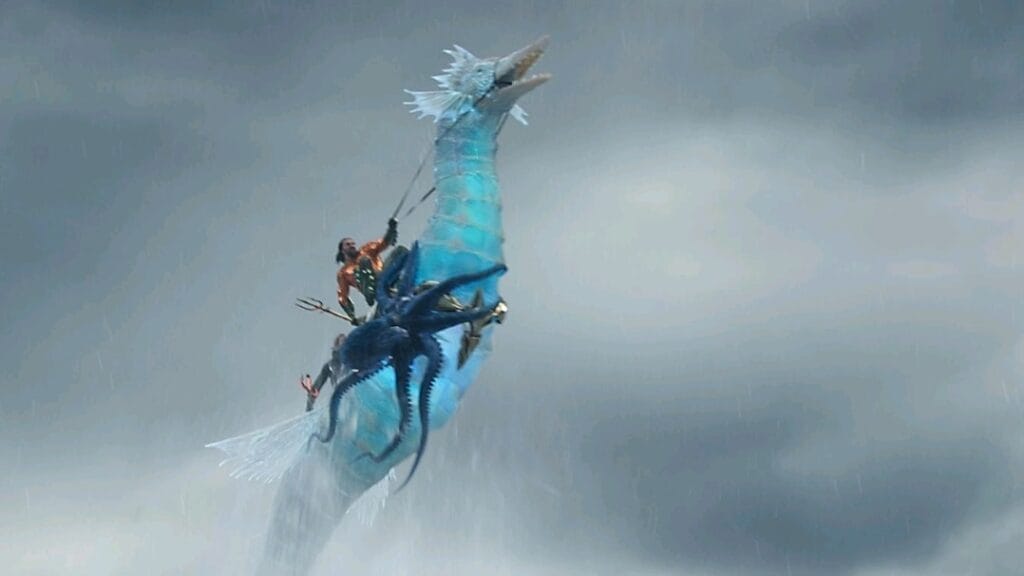
Jason Momoa does a stand-up job as Aquaman once again, delivering some of his best work as the character. The focus on Aquaman’s human side makes his performance stand out more, although he doesn’t go the whole film without whooping and screaming as he does best. This is all good fun but when it goes on for too much the humor starts to wear thin. Patrick Wilson’s charisma makes a much-welcomed return, playing the second biggest role in the movie alongside Yahya Abdul-Mateen II whose lingering stares are enough to strike fear into the viewer. He is a genuinely scary villain in the times when he’s not delivering fun banter during his numerous brawls with Aquaman.
Randall Park returns as the marine biologist Dr. Stephen Shin, this time in a much bigger capacity than his cameo-like role from the first movie. He provides fine comedic relief and a great up-close perspective of what it’s like working under a malevolent force building toward the destruction of the planet. Amber Heard leaves a memorable mark as Mera despite getting less screen time, starring in some of the film’s key battle scenes, as does Nicole Kidman’s Atlanna. Willem Dafoe’s Vulko is sorely missed on the other hand. Dolph Lundgren’s King Nereus somewhat takes over as Arthur’s mentor but can’t fill up the entire gap left behind by Dafoe’s absence. Meanwhile, Temuera Morrison plays a critical role in Aquaman’s arc as his father Tom Curry. Their private father and son sit-downs, wherein they both sip on beers and open up about their lives, help ground the stakes at hand.
Aquaman and the Lost Kingdom leans heavily into its climate change message. It’s the film’s main threat but with a comic book-style twist. The root cause of the climate catastrophe at hand is this ancient source of fuel that was outlawed generations back after the Atlanteans realized the sheer amount of damage it could cause to Earth. Obviously, it is very self-reflective and it’s easy for audiences to engage with the very real threat of climate change. But the plot never overcomplicates things, stating the destruction that it could cause very plainly and echoing its real-life warnings. Some people will appreciate this while others will see this as perhaps too forced or preachy for a blockbuster. However, it fits perfectly for a superhero like Aquaman.
James Wan’s bombastic Aquaman sequel marks the end of an era. As the final chapter for Jason Momoa’s take on the iconic DC character, Aquaman and the Lost Kingdom does a solid job of wrapping up his overarching story that spread across multiple movies. As the last entry in the DCEU, this sadly doesn’t fully put a neat bow on the end of the franchise, yet how could it when this wasn’t in Wan’s original plan? This is all about Aquaman and no other major DC connections are mentioned. Even if this works as a standalone piece, it leaves an underwhelming feeling in fans that can only be blamed on the studio’s management of the DC franchise.
Nonetheless, coming after Shazam! Fury of the Gods, The Flash, and Blue Beetle, Aquaman and the Lost Kingdom still stands as a well-oiled blockbuster that delivers something unique when compared to other recent DC movies. The sequel’s bombastic thrills, many good laughs, and heart can’t be taken away – regardless of the upcoming franchise reboot.