

Initially released as a timed Xbox and PC exclusive, Indiana Jones and the Great Circle was one of last year’s biggest gaming surprises. Published by Bethesda Softworks and developed by subsidiary MachineGames, The Great Circle earned unanimous acclaim, quickly becoming one of the best-reviewed video games of 2024. This week, the game finally became available on PlayStation 5 consoles, bringing a thrilling new adventure from our beloved professor/archeologist to a wider audience.
Set after the events of Raiders of the Lost Ark, the game follows Indiana Jones (Troy Baker, who takes over for Harrison Ford) in pursuit of a globe-trotting mystery involving “The Great Circle,” a series of legendary treasures that form a perfect geographical circle around the globe. Aided by a plucky journalist named Gina Lombardi (Alessandra Mastronardi), the duo find themselves in a race against time as the Nazi party’s Emerich Voss (Marios Gavrilis) attempt to harness the circle’s power to the dismay of an an ancient guardian, Locus (Tony Todd).
We reviewed the PC version of The Great Circle back in December and called it a “modern, inspired take” on an Indiana Jones tale that “feels like a natural evolution of the franchise’s spirit.” If you’re a diehard Indy devotee who was left unsatisfied with 2023’s Dial of Destiny, this game is for you. If you’re a casual fan who wants to engage in a genuinely well-designed mixture of exploration and action/adventure gameplay, this game will definitely also appeal to you.
To help celebrate the PS5 release of Indiana Jones and the Great Circle, we sat down with Axel Torvenius, the creative director of the game, and Craig Derrick, an executive producer at Lucasfilm Games, to discuss the enormous challenges the game faced during its development. We dive deep into the making of The Great Circle, from how MachineGames modernized a cinema icon to casting Troy Baker in the role of Indiana Jones. Additionally, we break down how an in-house cinematographer was brought in to recreate the aesthetics and swashbuckling thrills that Steven Spielberg and George Lucas established in the famed movie franchise for a video game.
Exclusive Interview with Creative Director Alex Torvenius and Executive Producer Craig Derrick for Indiana Jones and the Great Circle
Many adventure games are directly inspired by the Indiana Jones franchise, such as Uncharted. So, there was already an established mold to follow. But you instead took a different path to deliver a fresh take on the iconic swashbuckler. Were there ever any concerns that this project was headed in the wrong direction?
Axel Torvenius: No, not really. It might sound a bit weird, but we knew very early on what we had our minds’ eyes and hearts focused on. We were always aware of all the other fantastic adventure games inspired by Indiana Jones, though it was never a concern to us what they were doing.
We did our homework, fleshing out what the core pillars of Indiana Jones as a character are and the themes of these movies. Then, we extrapolated from it and tried to form something new based on that — something that would still feel like Indiana Jones but be an interesting game in its own right. In the early stages of production, we never felt any hesitancy; it felt right from the beginning. However, saying that it felt right absolutely does not mean that it was easy.
Initially, there was considerable skepticism towards Troy Baker’s casting, but his performance as Indiana Jones has now been widely praised. Was Baker’s take on Indy always clear, or was it a more collaborative effort?
Craig Derrick: From the beginning, Troy understood the assignment and that it was a daunting one. He’s spoken about this, too. Troy wasn’t sure if he wanted to take on the role because of how difficult it might be. He wanted to make this character feel like Indiana Jones, like Harrison Ford, but not have his performance come across as an impression. At the same time, he wanted to do something with it in his own way.

Craig Derrick: Troy is an extraordinarily talented actor, and he definitely was engaging with the character and with us as collaborators. He possesses a strong ability to bring layers to a character’s voice, including humor, confidence, and swagger. But he brought a vulnerability and a world weariness to Indy as well, which is something really at the heart of the character. That’s the power of an extremely confident performer. You know, Troy has the industry status that he has for a reason.
He worked with many of the other actors in the cast, some of whom had little to no experience in this type of motion capture. On set, I watched him help mentor and coach others. So, it wasn’t only about capturing the performance of Indiana Jones. He was also a true collaborator with his cast. It was pretty amazing to see; he’s a true professional.
I loved this game’s take on Indiana Jones because it emphasizes him as a humanist. He’s interested in archaeology because he believes it’s about preserving culture and sharing it with the world. What inspired this take on Indy, and how did you ensure it felt true to the character?
Craig Derrick: Yeah, I mean, we’re telling such a long story, right? From the perspective of a game narrative, you can play 30-40 hours in this game and still not discover everything. To get that right, you have to have an amazing main story. However, it’s all those other secondary elements that follow. You’re actually the first person to bring it up to me as a highlight of the game, and in that sense, that truly was why we did it. How do you center a character who’s exceptionally familiar with the other cultures of the world and show players that they could show respect for the cultures represented in the game, too?
The team conducted incredible research that made you, as the player, feel like this recipe or piece of culture might be just as interesting to Indy as discovering the next secret passage around the corner. We discussed all the various languages that Indiana Jones knows and how Troy could perform dialogue in those languages, delivering it with a certain demeanor, calmness, and secure confidence. You could sense that Troy, through Indy, was being absolutely respectful while trying to be as authentic as possible to the language. So, yes, it was critically important to have all that in this game.
That’s so interesting; you were asking if people would respond to it, and I totally did. I’ve always seen him as a nerd as much as an action hero. You guys nailed that part.
Craig Derrick: Absolutely. We haven’t made an Indiana Jones game in a long time, and we’re all fans. Many of those elements originated from the team. We asked, “How do we make you feel a part of the culture?” This is not necessarily Indy’s first time in these countries. He has allies everywhere, and in Sukhothai, he’s very respectful of the religion and aware of the mythology. He establishes a connection with the characters in that region early on, simply on the basis of mutual respect. It was crucial to the character and for us, as game makers and developers, to get that right. So, thank you for bringing it up!
You guys worked with cinematographer Kyle Klutz on this video game. From what I know, not many game studios hire cinematographers, so I want to ask what it was like working with Kyle?
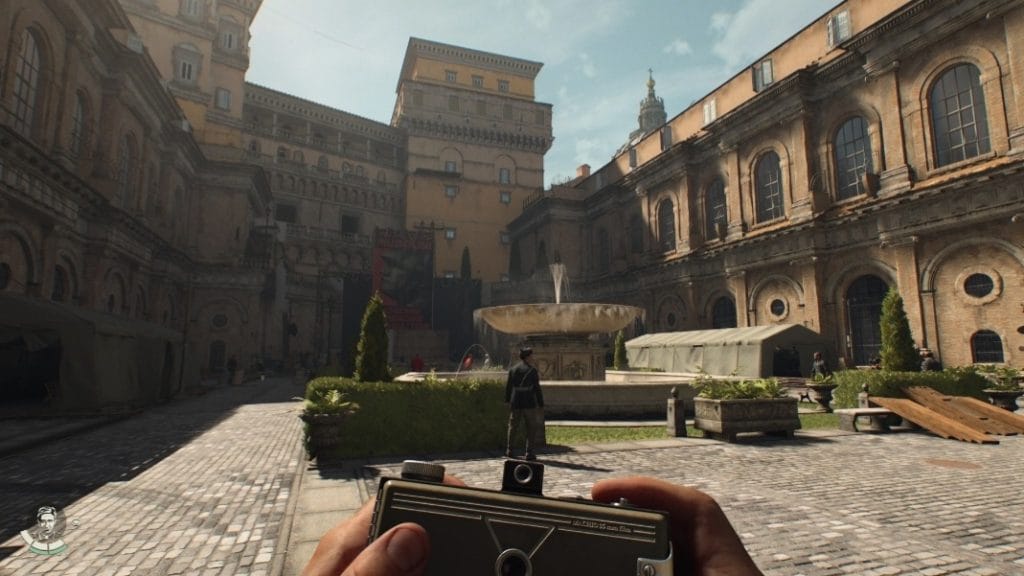
Axel Torvenius: First off, I think Kyle has received too little recognition in this project. He played a key role in the motion capture studio, ensuring that we accurately translated the camera pans, composition, and general cinematography. Kyle helped us early on with nailing that and transferring it instantly into the engine, even in the first rough takes. Obviously, we ensured that our camera movements and cinematography were planned on storyboards and then refined in animatics. However, having him on set, being pushed around on a big dolly, working as if it were an actual movie set, was invaluable. We had never done that before.
Typically, we have been working with a virtual camera, which allows you to move around and adjust things as you prefer later on. In the case of this game, allowing ourselves to trust the process of sticking to the design that we had on paper, fleshing out the compositions of the camera, and seeing that happening in real-time, even though everyone was wearing these weird motion capture suits, helped so much because it set the tone and style so distinctly from the get-go, especially in the cutscenes. Kyle’s input and feedback throughout the sessions, as well as the labor of his craft, were priceless.
I’m a huge Spielberg fan, and Indiana Jones and the Great Circle works double time to honor the “Spielbergian” visual quirks of the movies. That’s already incredibly challenging for filmmakers to replicate. But, as game developers, I imagine it’s even harder?
Axel Torvenius: We had a cinematic director, Markus Söderqvist, and he has been scrutinizing the movies, back and forth. It always helps to have endless references for how things are framed in these films, with the specific types of angles and scale. With this knowledge, we were able to establish rules early on. You knew how these events would play out in a Spielberg film from day one. Identifying what type of cinematography is and isn’t present in Spielberg’s films was beneficial.

Craig Derrick: What a daunting, impossible task it was to capture the Spielbergian look and feel of a classic Indiana Jones adventure. We didn’t do ourselves any favors by deciding that we were going to open the game with a faithful recreation of the prologue from Raiders of the Lost Ark. What were we thinking? (laughs) Truly, the answer, I think, was that we aren’t Spielberg. We will never be able to meet the master in that way. Axel knows that too well. He did so much research on compositional studies to try to recreate that “Spielbergian” feeling.
Additionally, we examined film stock. We looked at film grain and lenses as we studied how Spielberg frames establishing wide shots. How do we do these kinds of close-ups? How do we shoot chase scenes, etc.? It was a combination of both technical implementation and realizing what the unachievable, impossible ask was. Could we capture something in the style or essence of a Spielberg Indiana Jones movie? We hoped we could. We felt like we could get it right both technically and artistically, yet we were never satisfied, I think.
Last question, you guys obviously have DLC planned now that Indiana Jones and the Great Circle is available on PS5, so there will be plenty of new players. What do you want to say to those people who are going to be playing the game for the first time?
Axel Torvenius: It’s worth reiterating what we’ve been trying to do with this game since we started development. I was born in ‘79, and many other people in the studio were raised in the ’80s. We grew up with those Spielberg movies, so we instantly started to think, “Oh, yeah, we have to make this a cool throwback to this,” or “You have to have this easter egg.” Then we realized that we can’t make a game only for people who are familiar with Indiana Jones. We are also targeting a large group of gamers and people who may not be familiar with Indiana Jones.
We established this dual focus at the beginning, but it ultimately converged into a single, laser-like focus throughout development. If you are interested in strong, narrative-driven games with a lot of cutscenes and intricate puzzles, and some really bombastic set pieces with heavy action, this would be a game for you, regardless of whether you didn’t know who Indiana Jones is. If you enjoy a good adventure with an engaging story, then this is the game for you. At the same time, we’re ensuring that if you’re a fan of Indiana Jones, then hopefully, this is the ultimate Indiana Jones experience that you can find on Earth today.
Indiana Jones and the Great Circle is now available on PlayStation 5, Xbox Series X/S, and Windows!
Release Date: December 9, 2024 (Windows, Xbox Series X/S) & April 17, 2025 (PlayStation 5).
Developed by MachineGames.
Published by Bethesda Softworks.
Game Director: Jerk Gustafsson
Creative Director: Axel Torvenius.
Lead Writer: Tommy Tordsson Björk.
Producers: John Jennings, Mattias Duclos, & Mariusz Macieja.
Composer: Gordy Haab.