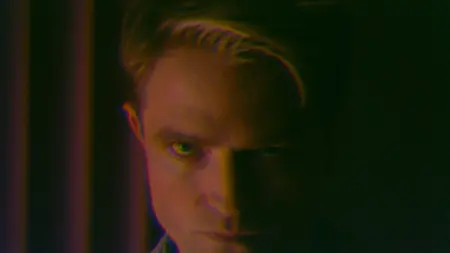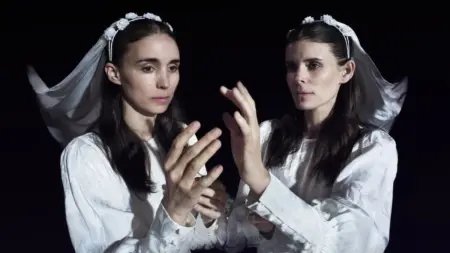


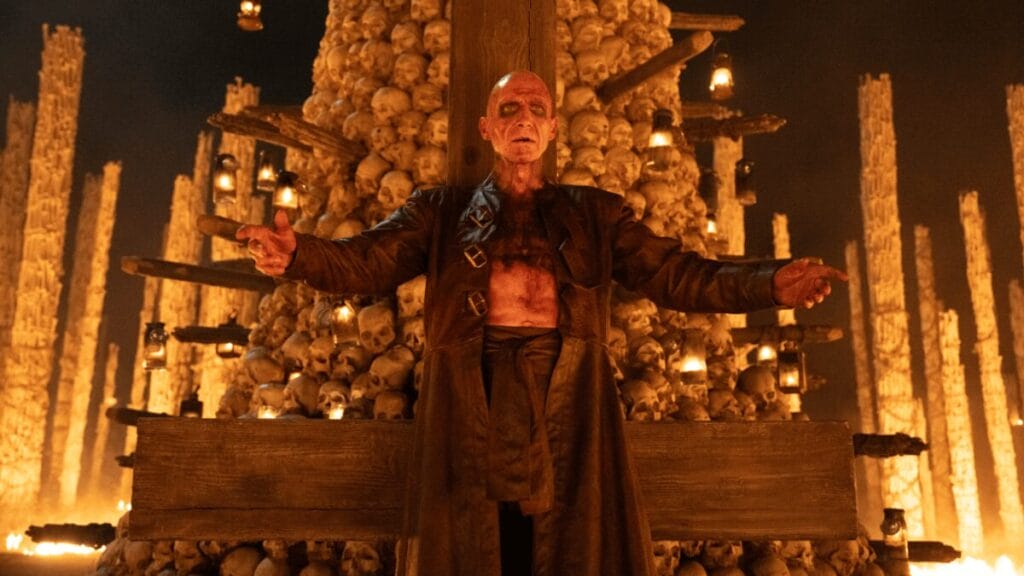
Last year, director Danny Boyle and screenwriter Alex Garland pulled off the near-impossible with 28 Years Later. The legacy sequel introduced several new, fascinating elements while retaining much of the zombie brutality that made the original 28 Days Later (2002) a modern horror classic. Perhaps most impressive was how touching and emotional the film was, as the main “twist” wasn’t horrific but rather quite the opposite. As the young Spike (Alfie Williams) discovered, survivor Dr. Ian Kelson (Ralph Fiennes), who’s spent the last decades in solitude constructing a terrifying-looking temple of human remains in the infected British countryside, was no insane monster. Instead, he proves to be a man of tremendous grace.
As complete as 28 Years Later felt, it was clear from its wild cliffhanger ending that things were not about to stop. Indeed, the franchise’s latest sequel, 28 Years Later: The Bone Temple (2026), began shooting merely weeks after the prior film wrapped, with Danny Boyle’s absence planned from the outset. This means The Bone Temple has a lot to live up to, as it doesn’t have the benefit of a long gap between movies, neither in the real world nor in the narrative. It also has a new director, Nia DaCosta (Hedda, The Marvels), who is only the third filmmaker to helm an installment of the series, after Boyle and Juan Carlos Fresnadillo (2007’s 28 Weeks Later).
Fortunately, The Bone Temple stands strong, brilliantly continuing the 28 Years Later story with unique flair and panache.
28 Years Later: The Bone Temple is a Highly Character-Based Sequel
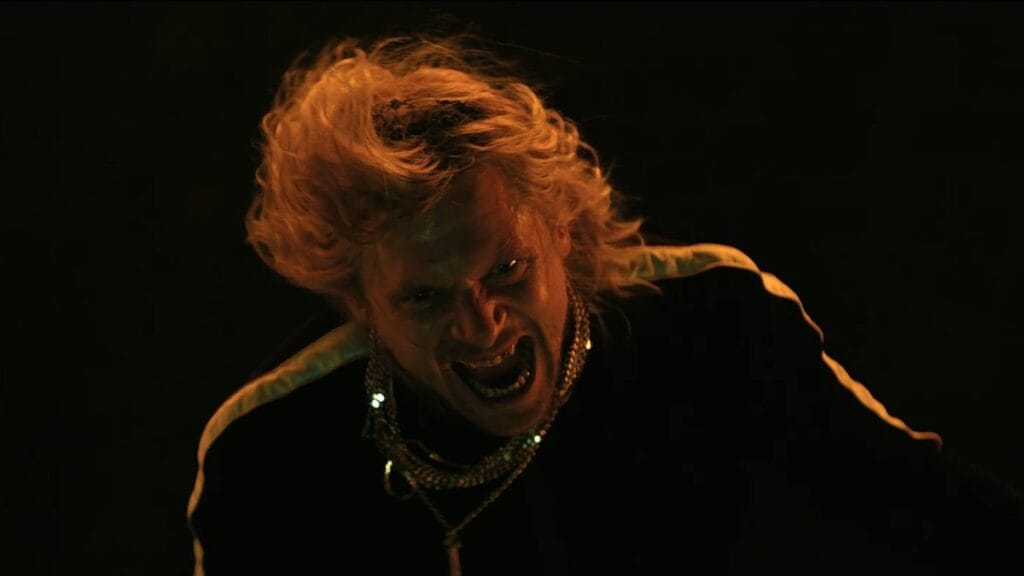
The Bone Temple begins shortly after the end of28 Years Later, picking up with Spike after he’s been taken in by Sir Lord Jimmy Crystal (Jack O’Connell) and his gang of “Jimmys.” The Jimmys are modeled after the notorious English media host and sex pest Jimmy Savile (with a dash of the Teletubbies). Crystal has even adopted a paraphrasing of Savile’s “How’s About That, Then?” as a catchphrase. But the group is more than just post-apocalyptic raiders; they are a Satanic death cult. Crystal insists on a specific number of members as well as the committing of ritualistic killings in order to serve “Old Nick,” aka the Devil, as part of some hackneyed prophecy of armageddon.
Courtesy of Sony
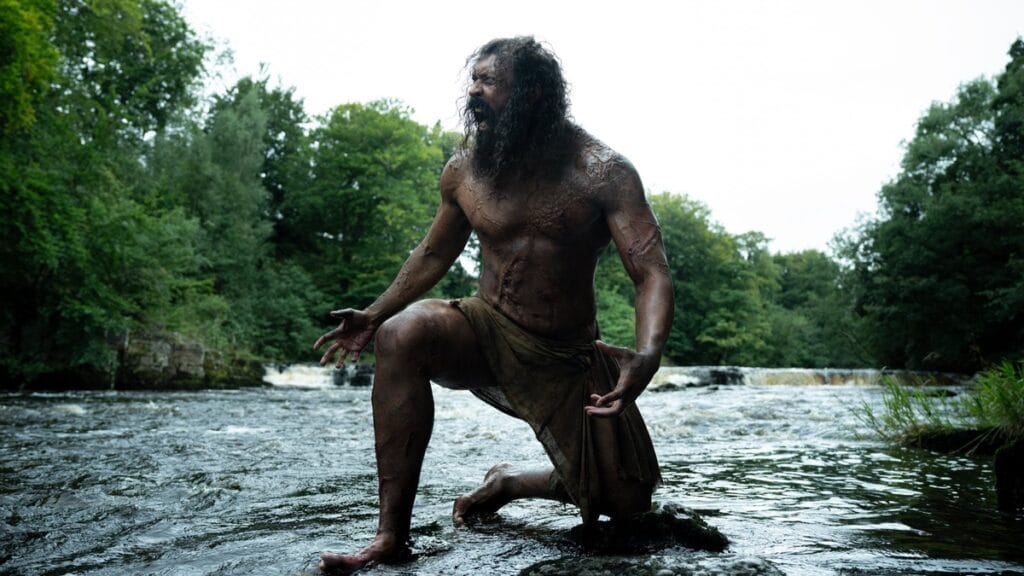
The impressionable Spike is trapped, surrounded by Infected on one side and the insane Jimmys on the other. Meanwhile, Dr. Kelson continually encounters the man he’s named Samson (Chi Lewis-Parry), an Alpha Infected who shows signs of his old human intelligence beneath the Rage Virus. Mixing whatever drugs he has on hand, Kelson experiments with making Samson more docile. When Jimmy Ink (Erin Kellyman) spots Kelson and Samson interacting without violence in the titular bone temple, she believes this must mean Kelson is Old Nick and insists that Crystal introduce the Jimmys to him to fulfill the prophecy.
Although The Bone Temple features a handful of locations, it’s a much more centrally focused movie and is thus very character-based and dialogue-heavy. Director Nia DaCosta and writer Alex Garland use this to their advantage, however, building suspense and tension beyond the franchise’s well-known zombie action.
Alex Garland and Nia DaCosta Make a Bold Pairing
Given that 28 Years Later: The Bone Temple is less concerned with running from (or hunting) the Infected than previous installments, it requires equally exciting ideas and character work to make up for it. This is precisely the case, as Alex Garland has crafted one of his most idiosyncratic scripts to date. Garland has a bold experimental edge, one that can electrify viewers who have similar tastes but can also alienate others just as hard. With The Bone Temple, he strikes a lovely balance by making far-out choices with ample dramatic weight to back them up. Garland allows himself to have fun and even be playful here; it’s perhaps his funniest script yet while remaining quite dark.
Courtesy of Sony
Despite Garland’s screenplay firing on all cylinders, the movie would easily fall apart were Nia DaCosta not up to the task. It’s a very talky film, peppered with highly grotesque violence, which is saying something for a franchise already known for being brutal. This is because most of the violence in The Bone Temple isn’t Infected-on-human or vice versa. It’s actually human-on-human, as the Jimmys do awful things to innocent people. This extremity may leave a bad taste with some audiences. Yet, there is a sense throughout that DaCosta isn’t depicting these atrocities for mere shock value.
DaCosta’s choices may be less brazen in their cinematography and editing than Boyle’s, true. Though her frequent collaborators, including DP Sean Bobbitt, put in work that is sharp and cunning in its own right. Ultimately, DaCosta is a great fit with the material.
There’s No Denying This is a Middle Chapter
The biggest elephant in the room about The Bone Temple is how it can’t ever be fully its own entry. By design, it’s an extension of 28 Years Later, as reflected in its title, and that one was already a legacy sequel to two prior installments in the series. The Bone Temple also ends with a cliffhanger, and it feels like it needs a more immediate resolution than the ending of 28 Years Later. Being the middle chapter of a trilogy where the third movie has only recently been greenlit (with Cillian Murphy returning, no less), it’s hard to say right now whether The Bone Temple’s strengths allow it to exist separate from the films on either side.
Courtesy of Sony
In essence, your reaction to 28 Years Later: The Bone Temple depends a lot on how you view sequels in general. If you take each one on its own, then there is so much to love and be captivated by here that it truly doesn’t matter if the third film sticks the landing or not. If, however, you refuse to judge the 28 Years Later saga without all the pieces in place, then The Bone Temple might seem like a diverting stopgap entry instead. Whatever the case, there’s still a sense of completion to this specific chapter, enough that it needn’t be lumped in with its brethren to be enjoyed.
The Bone Temple Boasts the Best Performances of the Series So Far
The Bone Temple lives or dies with its cast, so I’m happy to say that it contains what are arguably the greatest performances of the entire series so far. Compared to 28 Years Later, Alfie Williams gets less focus here; this is not a “further adventures of Spike” plot that many might be expecting. Nonetheless, his work in the first film allows him to portray Spike being emotionally tortured in a subtler way. Erin Kellyman (Willow) gets to stand out as follower Jimmy Ink, whose skewed worldview is distinct from Crystal’s. Chi Lewis-Parry is the movie’s secret weapon, portraying the best “intelligent zombie” since Sherman Howard’s Bub in George A. Romero’s Day of the Dead 40 years ago.
All that said, this story really belongs to Ralph Fiennes and Jack O’Connell (Sinners). Alex Garland’s screenplay is laden with allusions to religion and mythology, elements that could feel pretentious were it not for Fiennes and O’Connell’s nuanced interpretations. If 28 Years Later was about mourning the passing of society and the old world, The Bone Temple depicts the battle for no less than humanity’s soul going forward. Kelson and Crystal are not God and the Antichrist, but they may as well be. That a horror movie can have that much dramatic weight and still be subversive and irreverent is astonishing. The Bone Temple continues to demonstrate that the 28 Years Later franchise is a monumental achievement in horror.
28 Years Later: The Bone Temple hits theaters on January 16!
Release Date: January 16, 2026.
Directed by Nia DaCosta.
Written by Alex Garland.
Produced by Danny Boyle, Alex Garland, Andrew Macdonald, Peter Rice, & Bernard Bellew.
Executive Producer: Cillian Murphy.
Main Cast: Ralph Fiennes, Jack O’Connell, Alfie Williams, Erin Kellyman, Chi Lewis-Parry, Emma Laird, Louis Ashbourne Serkis, Maura Bird, Ghazi Al Ruffai, & Sam Locke.
Cinematographer: Sean Bobbitt.
Composer: Hildur Guðnadóttir.
Editor: Jake Roberts.
Production Companies: Columbia Pictures, Decibel Films, DNA Films.
Distributor: Sony Pictures Releasing.
Runtime: 109 minutes.
Rated R.