
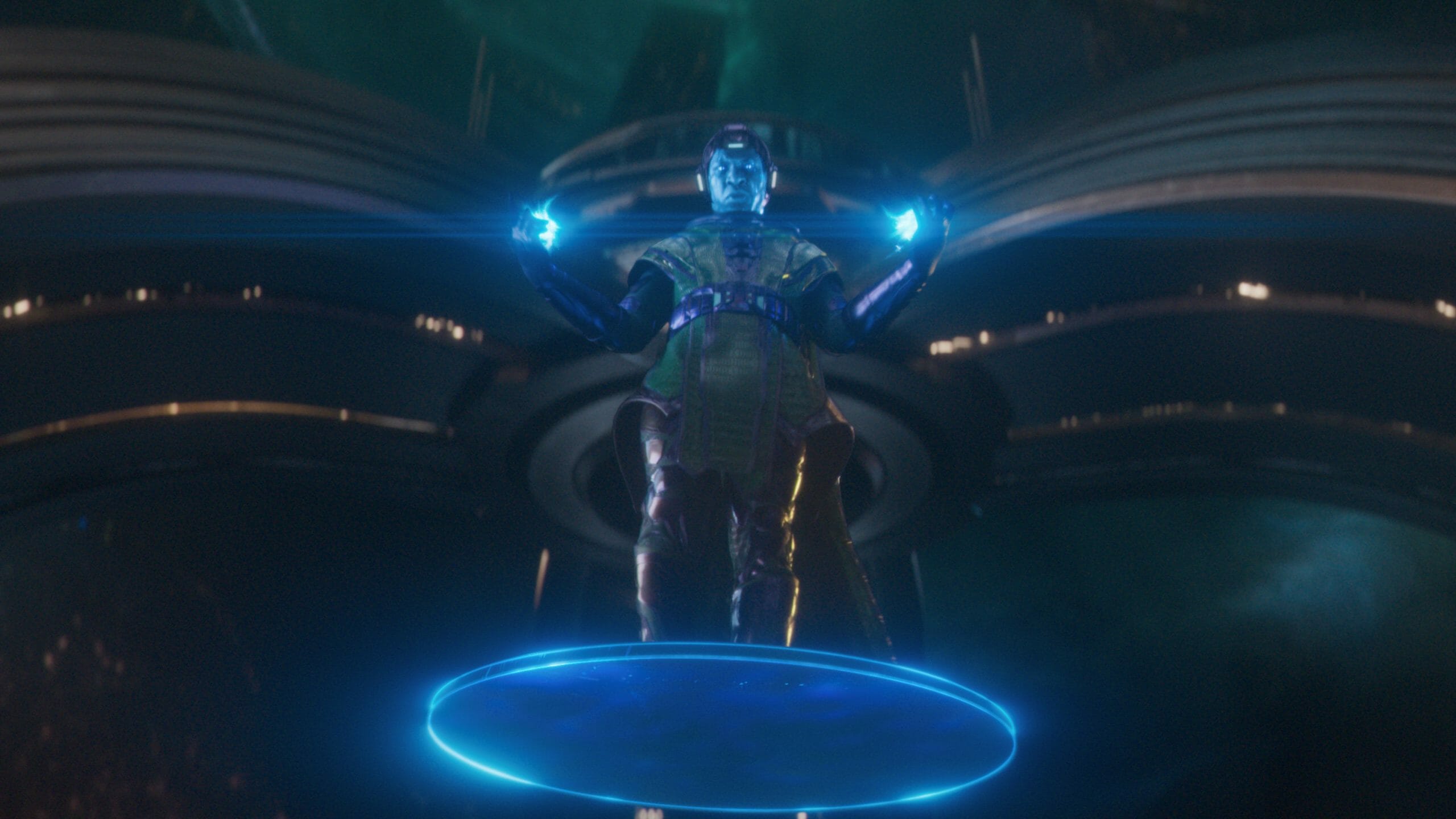

The 31st film from Marvel Studios and the first chapter of Phase 5, Ant-Man and the Wasp: Quantumania, sees our titular bug-themed heroes venture into the Quantum Realm, a minuscule dimension where not everything is as it seems on the surface. During the film’s global press conference, moderated by actor Randall Park, the producers of Ant-Man and the Wasp: Quantumania were asked questions about the new adventure and how the mysterious Quantum realm was crafted.
In terms of what visuals inspired the look of the Quantum Realm, Marvel Studios president Kevin Feige briefly touched on the topic, before proceeding to pass the question over to director Peyton Reed. “A number of things. We looked at everything from electron microscope photography to things like Heavy Metal magazine in the ‘70s and ‘80s, and we wanted to bring in all these elements like this. There’s a little sword and sorcery element, and then there’s a real Mobius element to it,” Reed explains.
Peyton Reed was sure to mention how pivotal the artists behind the threequel were in crafting the visuals of the minuscule dimension. “We just wanted to assemble a team of artists and say, ‘We are creating the Quantum Realm.’ None of the other Marvel movies have really dealt with it, and we wanted to create this very vivid world that has its own internal history and internal logic,” Reed says. The main questions Reed and his team had to find definitive answers to range from “Who are the creatures there? Who are the people there? How do you travel? What are the laws of physics?”
Someone who was crucial in this creative process was production designer Will Htay, who “assembled this insane group of visual artists” according to Peyton Reed. The director’s initial guiding instruction towards this team was “Just bring some of your most fantastic ideas to the table and let’s figure out what it can be.” Reed praises the creative freedom Marvel Studios gave this production since they were the first to really flesh out the Quantum Realm; “We wanted to take these characters that the audience has come to know, and send them on this journey and traverse these very strange lands and just have fun with it. It was a part of the MCU that we were free to create on our own, and it was one of the most exciting things about it.”
Peyton Reed was later asked to cite any specific sci-fi influences for the Quantum Realm. He namedropped classic shows like Flash Gordon and Barbarella to “looking at the covers of old science fiction paperbacks from the ‘60s and ‘70s and into the ‘80s.” Reed went into finer detail on the influence behind these throwback magazines, saying “There are a lot of great artists who would paint the covers for these things and they would be in a newsstand and that cover had to grab you. And a lot of them were creating these really strange worlds, that if you were looking at paperbacks, oh, that one would pull you in. You may not even know what the story is, but that visual worked.”
Reed reiterated prior influences while also diving further; “Again, looking at real-world microphotography, which takes things that are so, so incredibly small. You print them out and they look like landscapes. And it does set your mind thinking.” Reed states that “all of this movie is taking place in your fingernail somewhere” in reference to the Quantum Realm. “It’s this subatomic world, all this stuff is going on in the fabric of spacetime outside of space and time. Janet van Dyne describes it at one point as worlds within worlds, and this sort of idea that there’s this infinite world and worlds down there that are inhabited by creatures and things.”
For Ant-Man and the Wasp: Quantumania, Peyton Reed takes the helm for the third time, having directed all three films in the Ant-Man trilogy. This time, he enlisted the use of Industrial Light & Magic’s StageCraft virtual production technology, or “The Volume”, having used it previously when he directed two episodes of The Mandalorian on Disney+. Reed employed this method specifically for the Quantum Realm. The process involves shooting actors and sets surrounded by large, high-definition LED video walls. These walls display computer-generated backdrops, negating the use of green or blue screens. When shooting, the production team is able to realign the background instantly based on moving camera positions. The entire CG background can be manipulated in real-time. The revolutionary technology has since been used in huge productions such as Thor: Love and Thunder, House of the Dragon, and The Batman.
As director Peyton Reed states, visualizing the Quantum Realm for the MCU was really all about “bringing together this group of artists who had their own crazy things in their portfolios.” The final result on-screen reflects this, as Ant-Man and the Wasp: Quantumania is unlike any other adventure from the Marvel Cinematic Universe visually. Will fan ever get to revisit the Quantum Realm later in the franchise? As always with Marvel, only time will tell.