

In the relatively quaint, pastel-colored town of Clearwater, Florida exists a hospice center called “Suncoast.” Perhaps not infamous in its own right, the establishment became a crossroads for prominent worldwide debate in the late ’90s and early ’00s with one of its comatose residents, Terri Schiavo, and the “right to die” discourse her life situation spurred. At this very same time and place, actress-turned-director Laura Chinn (Florida Girls) centers her semi-autobiographical feature debut, Suncoast.
Suncoast is based on writer-director Laura Chinn’s own experiences growing up in coastal Florida with a terminally ill brother during her formative high school years. The young Nico Parker (The Last of Us) leads the film as teenage Doris. Her brother Max (Cree Kawa) is in a comatose-like state due to a brain tumor, unable to speak, feed himself, or even move at all. Max may be breathing and physically with his family, but the teen hasn’t truly been “with them” in years. His condition is sadly worsening, and keeping him at home is no longer a viable care option. Max is dying, and it’s time for Doris and her mother Kristine (Laura Linney) to make the transition of moving him into a hospice center as they patiently wait for him to pass.
Chinn’s real-life brother was moved into the same hospice center at the crux of the Terri Schiavo protests in the early 2000s. For context, Terri was 26 years old when she suffered cardiac arrest in 1990, which rendered her in a vegetative state and relying solely on life support. In 1998, Terri’s husband and legal guardian, Michael Schiavo, began to fight for her right to pass naturally, as he held that she would not have wanted to exist artificially if there was no hope of recovery. Terri’s family argued he did not have the right to make this decision for her, with the firm belief that she would eventually recover. As she remained in this vegetative state for 15 years, people worldwide debated the right to life vs. the right to die. After her feeding tube was finally removed, Terri passed away in 2005 at the age of 41.
At the beginning of Suncoast, Doris, though to no fault of Max, has lived under the shadow of her brother’s illness for years. She is an afterthought to her distraught mother Kristine who – since watching her son slowly fade away – has become extremely short-tempered, condescending, and miserable. Doris has quietly been on the receiving end of Kristine’s explosive outbursts for some time, but when her mom decides to start spending the nights with Max at Suncoast, she decides to take up typical teenage mischief in an attempt to finally experience a semi-normal high school life.
With a newfound friend group from school, Doris begins to host house parties, buy fake IDs from the local deadbeat, and sneak out drinking with peers. Doris develops bitterness towards Max and her mother as she realizes just how much her youth has been affected and how her relationships have taken a huge toll. This drives a wedge between Doris and her family at quite the inopportune time, specifically when an unlikely companion unexpectedly enters her life and tries to help her see the other side of the picture.

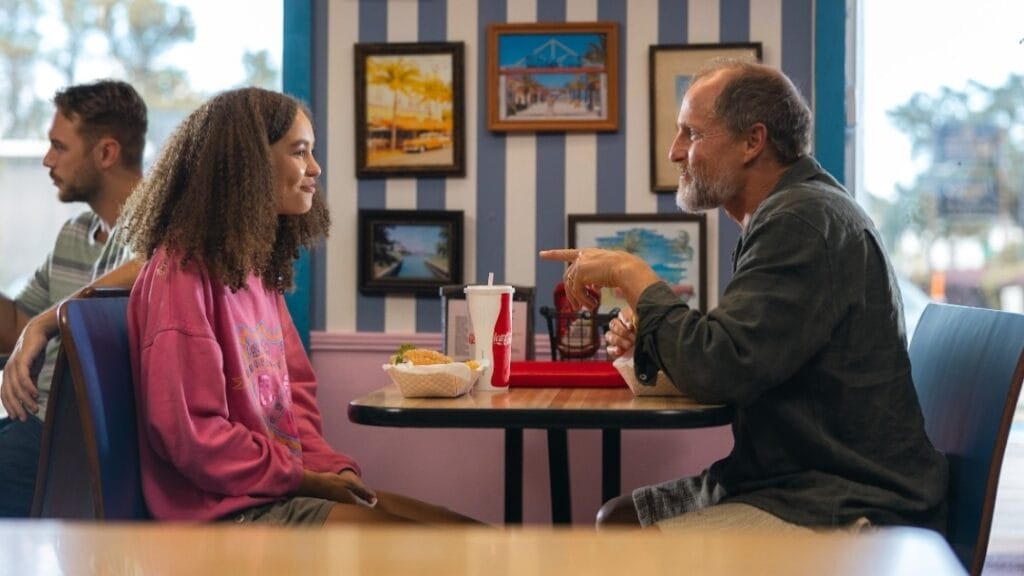
One of the protesters of the “right to die” debate depicted in Suncoast is Paul, an elderly widower played by veteran actor Woody Harrelson. Paul is an eccentric activist in the group that surrounds the hospice daily, shaking signs and shouting their demand to keep Terri Schiavo alive. He crosses paths with Doris, and the two form a bond that would be more wholesome if it didn’t hit nearly every cliche in the “unlikely friendship” trope. The connection the two share is passably endearing, as Paul urges Doris to embrace the time she has left with Max to the fullest so she is ready to cherish his memory when the time comes with fewer regrets. Harrelson’s performance is serviceable, though he doesn’t have much to work with due to the combination of his character feeling underwritten and limited screen time.
Nico Parker as the likable and kind-hearted Doris sells the emotional climax of the film – a tear-jerking monologue that accomplishes exactly what it was written to do: elicit a cacophony of sniffles and sobs from the audience. Laura Linney (Ozark) is commendable as she is unafraid to make Kristine unlikeable, giving a multifaceted portrayal of a mother in the throes of one of the most anguishing processes – grieving the loss of a child. She is unabashedly rude to service workers like the hospice nurse Mia (Keyla Monterroso Mejia) and slips up when the grief counselor Sue (Pam Dougherty) asks if she has any other kids. Kristine, half-listening, says “no” before correcting herself profusely. It’s a Freudian slip and a clever way to showcase the mother’s exhausted, one-track mindset and where her priorities currently lie.
Laura Linney’s Kristine may not be very pleasant, and while underdeveloped in the script, she is perhaps the most interesting due to the weighty material. Though often great, the performances of the rest of the cast are often undermined by the mediocrity of the script at hand. Suncoast barely passes by thanks to its heartfelt story and committed stars, but the movie is dragged down by a basket full of cliches and weak writing. On the other hand, the original score by Este Haim and Christopher Stracey is a standout aspect that accomplishes leaps and bounds in immersion while Bruce Francis Cole’s cinematography beautifully captures colorful coastal Florida. However, these impressive technicalities cannot fully redeem the film.
Suncoast is a bittersweet dramedy that is just overwhelmingly fine. It’s easy to see why large audiences are finding it appealing. After all, despite its weaknesses, the emotional power of its true story cannot be denied. The best aspect of Suncoast is that it gracefully tackles themes of loss, healing, and navigating the toughest family relationships. With an impressive cast and solid technical aspects, Suncoast may seem like another crowd-pleaser in the coming-of-age genre. It’s nearly impossible to get through dry-eyed and sheds light on one of the most landmark medical cases of all time to new viewers. But will it be remembered in the long run? A cliche script makes that seem unlikely.
Release Date: February 9, 2024 on Hulu
Directed by Laura Chinn.
Written by Laura Chinn.
Produced by Jeremy Plager, Francesca Silvestri, Kevin Chinoy, & Oly Obst.
Main Cast: Nico Parker, Laura Linney, Woody Harrelson, Ella Anderson, Daniella Taylor, Amarr, Ariel Martin, Cree Kawa, Pam Dougherty, Matt Walsh, Keyla Monterroso Mejia, Scott MacArthur, & Danielle Henchcliffe.
Cinematographer: Bruce Francis Cole.
Composers: Este Haim & Christopher Stracey.
Production Companies: Freestyle Picture Company & 7 Deuce Entertainment.
Distributor: Searchlight Pictures.
Runtime: 109 minutes.
Rated: R.