

As one of the most anticipated horror offerings of the summer, Longlegs arrives in theaters through Osgood Perkins’ brilliantly calculated direction and indie scream queen Maika Monroe of It Follows and Watcher fame. A chilling, unsettling film that crawls under your skin and stays there long after the credits roll, it’s impact can be credited to the uncomfortable atmosphere crafted by Perkins, Monroe, and Nicolas Cage’s career-best turn as the titular serial killer of the film. NEON has shown their belief by committing to release Perkins’ next films: The Monkey, based off of Stephen Kings short story and produced by James Wan, and Keeper, starring She-Hulk actress Tatiana Maslany.
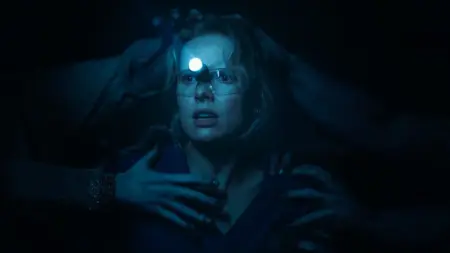
Longlegs follows FBI Agent Lee Harker (Monore) assignment to an unsolved Satanic serial killer case that takes an unexpected turn, revealing evidence of the occult. As Harker goes deeper into the case, she discovers a deadly personal connection to the killer and must stop him before he strikes again. What follows is a inexplicably horrifying, unsettling experience, and a masterclass in blending drama and horror that stands tall as the best horror film of the year.
What went behind the making of the film that has elevated Perkins’ status to one of the most exciting horror filmmakers of his time? Read on to find out.
What was it that inspired you both to pursue careers in directing and acting?
Maika Monroe: Well, I sort of fell into it. I never ever would have dreamt of becoming an actor (laughs)
Osgood Perkins: Why would you?
Maika Monroe: Yeah (laughs) no, no, I did school plays and I was just always quite uncomfortable. I don’t know. It just was never my thing. But I also grew up doing dance and randomly a movie needed background dancers for it and so at the early age of 13, I was like, “sweet, I get a paycheck. I’ll make money”. And so I was like, “I’ll do it”. I show up to set and funnily enough, it was a horror movie. A bad bad horror movie, but I was just in awe of the movie set and movie making and all the fake blood and fake death and I fell in love.
Osgood Perkins: For me, I grew up in the industry with parents who are connected and shining examples of the business and so that was always just part of my environment. Being an actor wasn’t really something that I felt like I wanted to do. It wasn’t something where I felt I had much control over myself. It felt a little bit like I didn’t really know what I was doing or what I was going to do so it didn’t really feel like that was the right thing. At a certain point, you have that moment where you watch a movie and you go “oh I see, someone decides all this, someone deliberately made it so that this happened like this. Oh, I see. There’s an eye that looks at this and positions things and sees this first and sort of has an idea about it”. When that clicked, and for me that came through Beetlejuice, it lights you up and then you start making movies with your friends on the weekends and they’re ridiculous and stupid and you’re having a great time and then you just sort of keep trying.
Osgood, you’ve received a lot of acclaim for your unique vision behind the camera. At this point of your career, what goes behind your creative process from finding that initial inspiration and formulation of an idea to the final product.
Osgood Perkins: It’s really just trying to stay open to to what comes your way. Once you start a project, whether it’s writing or you get into production, you’re turning on the radio and you’re seeing what’s going to come in and you’re going through the dial and seeing what you find. You go to bookstores and you look at random things that you maybe normally wouldn’t. The one thing I don’t do is look at horror movies. That to me that’s not in any way instructive. It’s not interesting to me if I’m making a horror movie to be like “Well, let me watch a bunch of horror movies to see what I should do.” The opposite is true. I’d rather go to a museum and see something that’s very obliquely makes me feel something and trying to incorporate that because if you use strange juxtapositions or you bring in references and comparables that are not immediately obvious, you start to create a much richer tapestry. Going “well, let me look at horror movies in the last five years and figure out a way to be successful” is a very bad way to approach creation.
Maika, what does your creative process look like when it comes to tackling a role?
Maika Monroe: Every character’s a little bit different. For this it was really focusing on everything that came before and in Lee’s childhood, because that’s very informative to who she is now. So I think sort of piecing all that together and breaking down the trauma that she went through and what is suppressed, what maybe there’s a hint of still lingering. Can we bring that to the surface? Where do we want to really push that down? So it was really pretty incredible working working on Lee.
When directing the film, what parts or elements did you find to be the most challenging to tackle compared to your previous work?
Osgood Perkins: You know, when there’s a lot of kind of active action or activity, stuff that needs to be blocked out incorporating stunts or movement or lots of people doing things. Covering action is hard. The hardest part about making a movie is that you just don’t have enough time. That’s always the thing. It’s hard to remain open to the process when you’re looking at “I have this many pages to do on this day. And if I don’t do it, we’re never coming back to this location again, so I’ll never have it” and then you can get into this kind of really uptight place where you’re just trying to make your f*cking day and you lose track of “oh, right, I’m supposed to be making something. I’m supposed to be feeling my way into something” because it was somewhere decreed that movies take *this* long to make. That’s a hard thing, to stay happy under the gun of time.
Beyond the work both of you put in to make this film, another element that stood out to me was Nic Cages performance. Could you speak a bit about how you worked with Nic to craft this character and bring him from script to screen?
Osgood Perkins: It starts with the script and starts with the words which he wants to very faithfully present. He doesn’t want to change things, he doesn’t want to ad-lib. He doesn’t want to improvise, he doesn’t want to write his own stuff. He wants to see the character as written, then try to find a way to make it work for him or to make him work for it as it were. We talk a lot about what the character might have gone through. We talk a lot about how the character might behave in this circumstance or how they move their body, how they inflict their voice, what the sound of their voice makes other people feel. You build it piece by piece and then you get into the look of it. Everything is just a choice, right? In the process of making a movie or directing a movie, you’re just choosing out of A B and C you have to choose one. You’re just trying to keep your eyes open for the things that feel right. It’s very intuitive. And when you’re working with someone like Nic, who’s so focused and has so much to give within that focus, you’re really just watching out for something that might be a little bit off as opposed to saying to Nic like “Oh, I got a better idea than you do about what you should do.” I would never say that that would that would seem very presumptuous to me.
Maika Monroe: He’s maybe my favorite person I’ve ever worked with. I think he’s up there. The person that you grew up with watching, he’s an icon, and then you’re you’re in a scene with him, you’re sitting across from him. And you don’t even recognize him. He’s completely transformed in arguably one of his best performances, and it just it’s one of those moments where, for lack of better words, you have to pinch yourself.
Maika, could you speak a bit about your experience having him as a scene partner in one of the film’s most unsettling sequences?
Maika Monroe: He’s maybe my favorite person I’ve ever worked with. I think he’s up there. The person that you grew up with watching, he’s an icon, and then you’re you’re in a scene with him, you’re sitting across from him. And you don’t even recognize him. He’s completely transformed in arguably one of his best performances, and it just it’s one of those moments where, for lack of better words, you have to pinch yourself.
Following Longlegs, both of you are set to be involved in two other upcoming NEON projects in The Monkey and They Follow. Is there anything you can tell us about these projects and what you’re most excited about regarding those two films?
Osgood Perkins: The Monkey is in post production. We’re cutting it and we’re finishing it and couldn’t be more different from Longlegs. It’s comedic. It’s touching. It’s sentimental. It’s disgusting. It’s impish. It’s pretty textured and a lot of fun. And isn’t so dark and grisly as this movie is at all and I’m really excited to see how NEON treats it because they’ve treated my “product” so well so far.
Maika Monroe: Very well so far. Yes, they have (laughs). With They follow, that–
Osgood Perkins: It started?
Maika Monroe: No, we start probably beginning of next year. I’m just so excited to work with David again, one of my favorite directors and he just has such a vision and I think this this second one is going to be very special. So I’m excited to go back!
Longlegs hits theaters on July 12!
Release Date: July 12, 2024.
Directed by Osgood Perkins.
Written by Osgood Perkins.
Produced by Dan Kagan, Brian Kavanaugh-Jones, Nicolas Cage, Dave Caplan, & Chris Ferguson.
Executive Producers: Fred Berger, Andrea Bucko, Jason Cloth, Liz Destro, Ronnie Exley, John Friedberg, David Gendron, Ali Jazayeri, Sean Krajewski, Lawrence Minicone, & Jesse Savath.
Main Cast: Maika Monroe, Nicolas Cage, Blair Underwood, Alicia Witt, Michelle Choi-Lee, Dakota Daulby, Kiernan Shipka, Maila Hosie, Jason Day, Lisa Chandler, Ava Kelders, Rryla McIntosh, Carmel Amit, & Peter James Bryant.
Cinematographer: Andrés Arochi.
Composer: Zilgi.
Production Companies: C2 Motion Picture Group, Traffic, Oddfellows, Range, & Saturn Films.
Distributor: Neon.
Runtime: 101 minutes.
Rated R.