

The pressure riding on Avatar: Fire and Ash (2025) is unparalleled. Whether it can match the $2.3+ billion success of filmmaker James Cameron’s previous sequel, Avatar: The Way of Water (2022), is one question. If it were to achieve that, the Avatar trilogy would rank in the top 5 highest-grossing movies of all time, alongside another Cameron classic, Titanic (1997), and Avengers: Endgame (2019). In addition to those enormous expectations, Fire and Ash is expected to deliver satisfying answers to a long list of questions raised by its predecessor. What’s the deal with Sigourney Weaver’s 14-year-old character, Kiri, having environmental powers? Will the Sully family ever be truly safe from Stephen Lang’s resurrected Colonel Miles Quaritch?
Each lingering question The Way of Water left unanswered can be traced back to one narrative conflict: whether or not Jack Champion’s Miles “Spider” Socorro — the neglected son of the deceased human Quaritch from the first Avatar film — can be fully accepted by the Sullys as their adoptive son. This question becomes especially delicate considering Neteyam (Jamie Flatters), the Sully’s eldest child, tragically died after rescuing Spider from Quaritch… who Spider ended up secretly saving from drowning anyway due to an inexplicable empathy tied to kinship. Whereas Spider is a human boy who desperately wants to be a Na’vi, Quaritch was given a second chance at life in a Na’vi body against his own will.
Spider is the Key to James Cameron’s Master Plan
Undoubtedly, Spider is one of Avatar: Fire and Ash’s most crucial emotional anchors, with his character weaving through the story’s biggest revelations. In this way, Cameron’s sequel carves a unique path for itself. The franchise’s overarching themes of cross-culturalism, ecology, family resilience, and global unity collide to form a breathtaking sci-fi epic like no other. James Cameron and his co-writers, Rick Jaffa and Amanda Silver (the married creative duo famous for rebooting the Planet of the Apes series), Josh Friedman, and Shane Salerno, have been open about the fact that The Way of Water and Fire and Ash were initially written as one massive movie before being split into two. Still, that hasn’t stopped fans from forming various expectations.

Courtesy of Disney
Since Disney has marketed it as a trilogy capper, with Cameron himself playing coy about his commitment to making Avatar 4 and 5, many people are walking into Fire and Ash expecting this generation’s Return of the Jedi (1983) or The Return of the King (2003). The film itself, however, doesn’t have remotely similar goals to those of the Star Wars and The Lord of the Rings finales. Cameron is likely being vague about the next two Avatar sequels to avoid jinxing himself, even though they already have release dates in 2029 and 2031 and have finished scripts. To his defense, no filmmaker has ever been in his position before with box office expectations at this gargantuan level.
Avatar: Fire and Ash is Far From a Definitive Ending
One watch of Avatar: Fire and Ash makes it abundantly clear that this was never meant to bring the franchise to a definitive end. Its main concern is wrapping up the plotlines introduced in The Way of Water, and it succeeds in forming a singular arc with the first three Avatar movies. Yet, at the same time, it sets up more that is definitely meant to be followed up on in the future. Regardless of what James Cameron says to the press, this cannot be the end, as a few notable threads remain open-ended. Does this leave Fire and Ash unsatisfying? Surprisingly, not at all. But the Avatar saga’s outline as a pentalogy is now quite obvious.
Kicking off almost immediately after The Way of Water, Jake Sully (Sam Worthington) and Neytiri (Oscar-winner Zoe Saldaña) are running out of options to protect their family. With barely any time to mourn the loss of their eldest son, Neteyam, they are forced to stay on the move. This time, however, their priority is to remove Spider from their family dynamic. Spider’s emotional ties to Quaritch and human disadvantages on Pandora pose a huge threat to their family’s safety. Of course, their second son, Lo’ak (Britain Dalton), youngest daughter, Tuk (Trinity Bliss), and adopted eldest daughter, Kiri (Weaver), are far too attached to Spider and are deeply distraught by the idea of losing another member of their clan.
A Sully Family Road Trip Gone Wrong
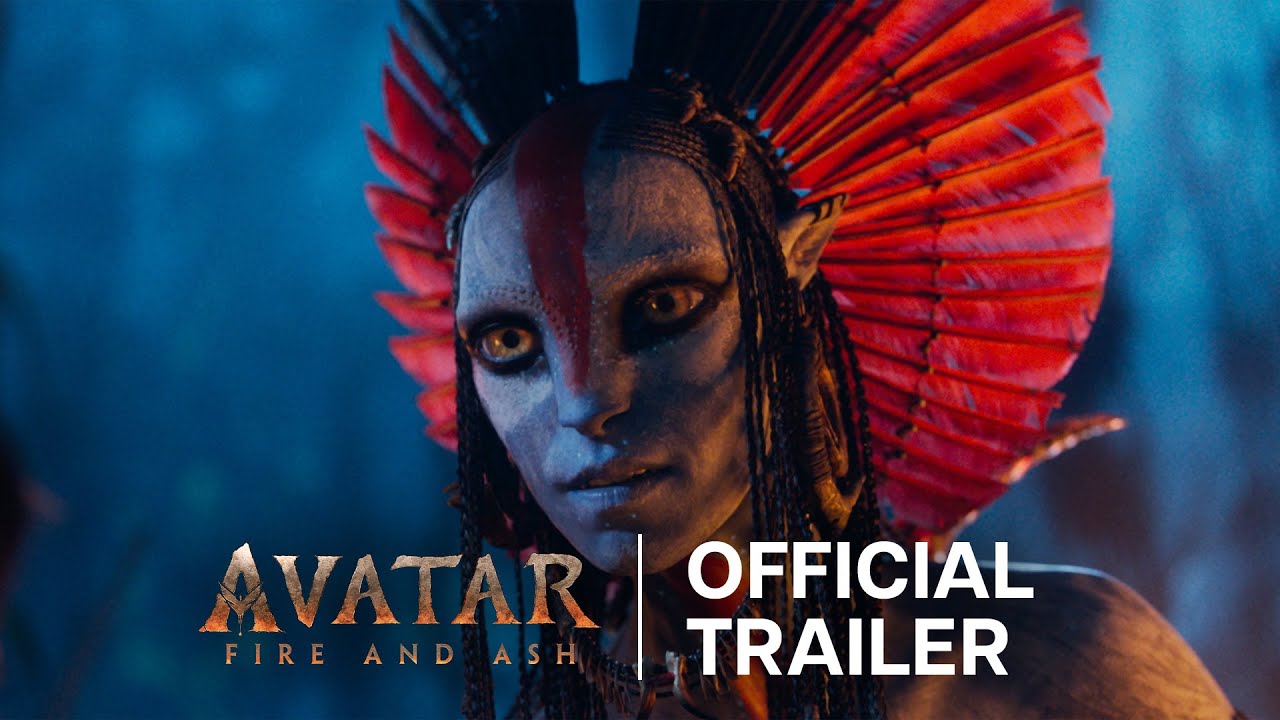
As a compromise, the Sullys all agree to briefly leave the reefs of the Metkayina clan and hitch a ride with the Wind Traders, led by Captain Peylak (David Thewlis), on one last family road trip to drop off Spider back home with the Omatikaya in the forest. Flying on the air merchant’s ships, guided by giant floating jellyfish-like creatures, is where they first encounter the vicious, volcano-dwelling Mangkwan clan in a barbaric sky raid that evokes the high-octane savagery of Mad Max: Fury Road (2015). Also known as the fire-worshipping “Ash People,” their nihilistic Tsahìk leader Varang (Oona Chaplin) rejects the Na’vi god Eywa by scalping the braided kurus (or head tentacles) of her fellow natives for sport.

Combined with his bullets and steel artillery, Varang’s bloodthirsty, irreligious tribe could be the key that Quaritch needs to complete his objective: capture Jake Sully and turn him over to the RDA as a traitor to the human race. Thus, the two join forces, paving the way for James Cameron to evolve Quaritch once again. From facing an existential crisis as a revived soldier in a Na’vi avatar to now fully embracing his native traits, Stephen Lang’s portrayal of Quaritch’s metaphoric transformation is glorious to watch unfold. Driven by his love for Spider, and led astray by Varang’s corrupted outlook on Eywa, Quaritch becomes the one thing his human counterpart once sought out to destroy, only much deadlier.
Stephen Lang Builds Upon Quaritch’s Iconic Villain Status
Avatar: Fire and Ash further cements Quaritch as one of the greatest cinematic villains of our time. The more he gives himself over to Varang, both mentally and physically, the more unsure he becomes of his purpose working for the human race. It’s parallel to Jake’s evolution in the first Avatar, but he instead chooses anarchy over peace. Oona Chaplin (Game of Thrones) is an effortless scene-stealer as Varang. An imposing force who balances calculated leadership with chaos, she’s the perfect muse to lure Quaritch toward a new kind of cultural dominance. Their twisted romance is a major highlight — the kind of toxic relationship where they purely can’t get enough of taking advantage of each other.

Courtesy of Disney
The image of Quaritch, wearing red Mangkwan makeup, next to Varang on her mighty Nightwraith beast is enough to steal the franchise title for deadliest power couple. Luckily, Sam Worthington and Zoe Saldaña defend their throne, delivering their best performances as Jake and Neytiri to date. When separated, they shine in their own standout action sequences. When together, they receive the most complex thematic material to wrestle with. Tormented by their inability to grieve properly because of their constant running, Avatar: Fire and Ash presents the couple with extremely difficult crossroads that draw them to opposing sides. It’s not their love that comes into question, but who is willing to go the furthest to secure Pandora’s future.
The Trial of Payakan the Outcast Tulkun
Worthington and Saldaña keep audiences on the edge of their seats at every turn. Britain Dalton’s take on a grieving brother in Lo’ak is just as moving. Taking over as narrator for Avatar: Fire and Ash, Lo’ak’s narration offers a fresh perspective that continues to flesh out the Sullys as a relatable family unit. His subplot with trying to revoke the banishment of Payakan, everyone’s favorite outcast alien whale from The Way of Water, leads to hearings with the council of elder Tulkun. Yes, James Cameron takes ample time to focus on what is essentially an ocean court hearing with colossal alien whales, and it’s shot so majestically with vibrant color that it reaches Tolkien-esque levels of high fantasy.

As previously mentioned, Jack Champion (Scream VI, Freaky Tales) is one of Cameron’s secret weapons, and the iconic Sigourney Weaver is connected to this grand plan. Seen as divisive by some, Spider and Kiri are the vessels through which Cameron seeks to challenge what modern moviegoers have come to expect from science fiction on the big screen. Although their respective arcs certainly take multiple weird developments (remember, this film was originally rumored to be titled The Seed Bearer), the characters always ring true. With Champion, Cameron brings out yet another incredibly sincere and often heartbreaking performance from a young teen actor. Weaver, meanwhile, crafts a stellar late-career turnout that is nothing short of honest and brave.
Cameron’s Sci-Fi Epic is Brazenly Earnest
Where Avatar: Fire and Ash can be knocked down a peg from its spectacular predecessor is in repetitiveness. Some viewers will argue that it’s too familiar to The Way of Water, simply because the Sullys find themselves in similar situations. Getting held hostage by the antagonists and the return of Tulkun hunting are the main examples. While it’s an overexaggeration to call it the exact same plot as before (at that point, you’re outright refusing to engage with the film’s text), Avatar: Fire and Ash does sometimes put itself on a track that runs in circles. Yet, just when you think that you’ve seen it all, the movie hurls either an audacious curveball, an emotional gut punch, or both!
This is how writer-director James Cameron ultimately gives Avatar: Fire and Ash its own identity. He progressively pushes audiences out of their comfort zones, immersing them in utterly mesmerizing 3D and groundbreaking VFX along the way. This only deepens our connection to the Sullys, as it truly feels like we are at Jake and Neytiri’s side as they go to hell and back for their children. When the dust settles from Cameron’s jaw-dropping action set pieces, Avatar: Fire and Ash proves to be equally as effective when it is completely earnest with its characters’ emotions. Cameron lets his cast pour themselves on screen, even through performance capture, in ways that far too many modern blockbusters are afraid of.
Avatar: Fire and Ash hits theaters on December 19!
Release Date: December 19, 2025.
Directed by James Cameron.
Screenplay by James Cameron, Rick Jaffa, & Amanda Silver.
Story by James Cameron, Rick Jaffa, Amanda Silver, Josh Friedman, & Shane Salerno.
Produced by James Cameron & Jon Landau.
Executive Producers: Richard Baneham, Rae Sanchini, & David Valdes.
Main Cast: Sam Worthington, Zoe Saldaña, Sigourney Weaver, Stephen Lang, Oona Chaplin, Cliff Curtis, Britain Dalton, Trinity Bliss, Jack Champion, Bailey Bass, Kate Winslet, Giovanni Ribisi, Joel David Moore, CCH Pounder, Edie Falco, Brendan Cowell, Jemaine Clement, Filip Geljo, Duane Evans Jr., Dileep Rao, Jamie Flatters, Matt Gerald, & David Thewlis.
Cinematographer: Russell Carpenter.
Composer: Simon Frangle.
Editors: Stephen E. Rivkin, David Brenner, Nicolas de Toth, John Refoua, Jason Gaudio, & James Cameron.
Production Company: Lightstorm Entertainment.
Distributor: 20th Century Studios.
Runtime: 195 minutes.
Rated PG-13.