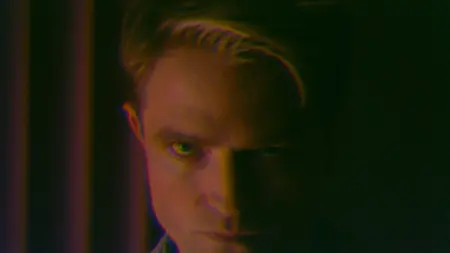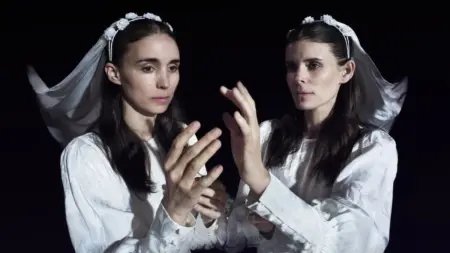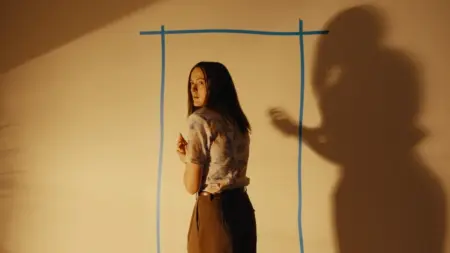


On the eve of David Leitch’s The Fall Guy, starring Ryan Gosling (‘Barbie’) and (‘Oppenheimer’), releasing in theaters, it is a movie that helps to truly encapsulate to audiences how underappreciated the stunt community has been within cinema for decades. Stunt people can be classified throughout their entire career as the audacious yet unsung heroes of the silver screen. In recent years, Hollywood has sustained criticism for their lack of recognition, failing to produce a quantifiable amount of accolades to recognise their achievement and relentlessly committed contribution to film. Audiences have recently been pushing for award ceremonies, such as the Academy Awards and Golden Globes, to generate fresh categories to accredit the daredevils that electrify non-stop fight sequences or the gut-wrenching airborne stunts that have recently graced franchises such as Mission Impossible. Whilst many actors leave the precarious and fear-inducing feats to their stunt doubles, a handful prefer the challenge, contributing a sense of authenticity to their film, such as the distinguished Tom Cruise (‘Top Gun: Maverick’).
In no particular order, let’s examine and discuss a select few of the most impressive cinematic stunts, ranging from the past to the present and from practical achievements to spectacular acts defining the movie experience.
Ben-Hur (1959) – Chariot Race
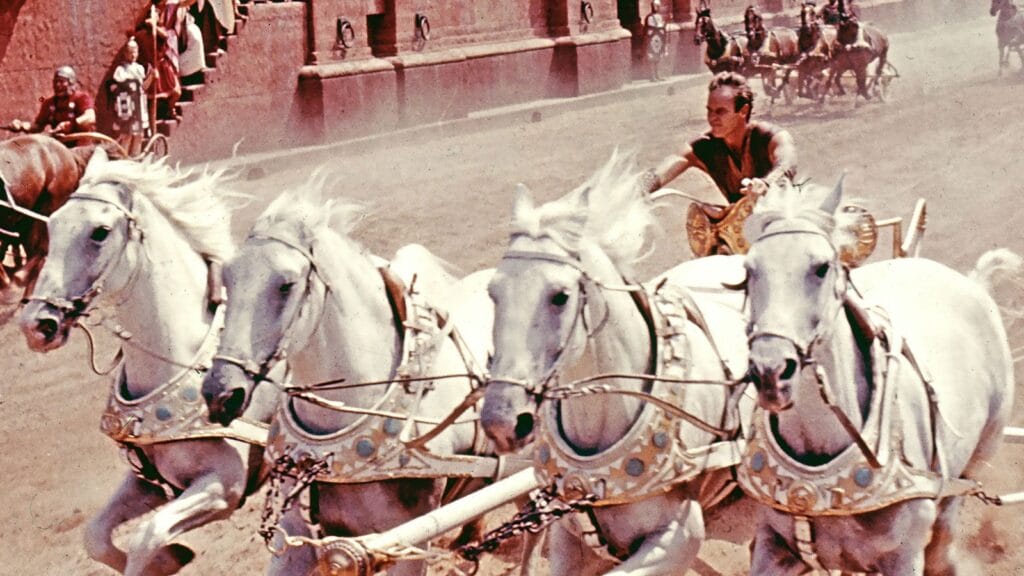
Starting the list with perhaps one of cinema’s earliest stunts, albeit still one of its most iconic, the legendary ‘Ben-Hur’ is notorious not just for its striking runtime of 3 hours and 42 minutes but also for how impressively the 1959 release aged. Perceived as a movie that defied the technological filmmaking restrictions of its time, it provides an early cinematic marvel towards the end of the second hour, featuring a practically shot chariot race scene that has since been rumored to have resulted in the death of a stuntman.
Providing context to the scene, Judah Ben-Hur has been invited to participate in a chariot race at the colosseum against the undefeated Messala. The dramatic race is fiery and intense, with Messala deploying dirty tactics damaging the chariot of Ben-Hur with his own, whilst simultaneously whipping our hero. Yakima Canutt (‘Gone With The Wind’) was a renowned stuntman during this period and the fearless daredevil involved in the filming of the race segment. However, it is alleged that Yakima’s son, Joe, who was the body double of the lead Charlton Heston (‘Planet of the Apes’), received the brunt of the more dangerous element of the stunt, being thrown from his chariot during the sequence when one chariot collided with another. The moment was caught on camera and made the Final Cut, and despite appearing potentially fatal, he bizarrely escaped with just a slash on his chin that required stitches.
Despite long-circulating rumors of a stuntman’s death, it is believed no such event occurred. Having been refuted multiple times, including by Charlton Heston (‘The Ten Commandments’) who referred to such whispers in his autobiography, denying that anyone was ever mortally injured.
Steamboat Bill, Jr (1928) – House Collapse
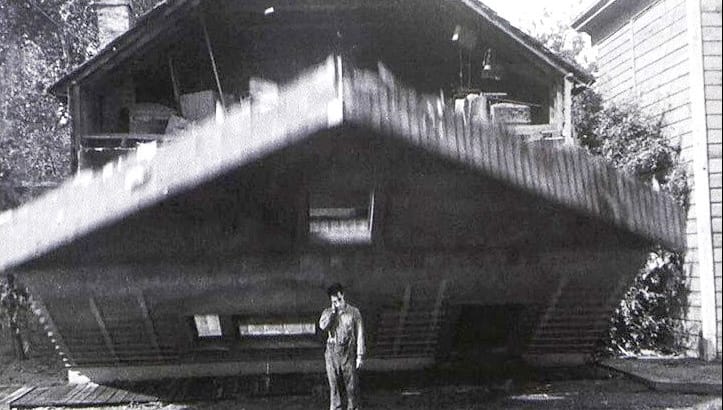
In the age of CGI & major action stunts budgeted at millions of dollars, it’s hard to imagine how a stunt from the 1920s is still as impressive as our modern-day performers. But it’s absolutely accurate & indicted into the memories of classic film lovers comes the stunt that is prominently described as silent film star Buster Keaton’s (‘Sherlock Jr’) most dangerous on-screen thrill. During a tornado, he finds himself lying on his bed and blown in front of a house, finding shelter from the storm underneath the bedframe. Before the house topples onto him a gentleman jumps from its window and onto Keaton, temporarily stunning him. Stumbling to his feet he glances around at the destruction, with the window to the upper levels crashing down in his direction, unbeknownst to him. With fortunes-favour, he finds himself standing unaware within the only providing safety, whilst the remains of the home are scattered around him.
Some may describe it as visually underwhelming today, but it was befittingly deemed revolutionary for the period in which the film released, as Keaton had to be painstakingly accurate to avoid any fatal consequence.
Indiana Jones: Raiders of the Lost Ark (1981) – Boulder Escape

Beginning with an escape sequence that embarked the Indiana Jones film series on a journey to attaining iconic movie status, and performed by the lead Harrison Ford (‘Star Wars: A New Hope’), it rightfully has allowed the over 40-year-old franchise to stand the test of time and remain as an iconic moment of cinema.
After Indy intricately surpasses the temple’s dangerous mechanisms, he reaches the shrine where the ancient Chachapoyan Fertility Idol artifact lies. He attempts to deceive a booby trap protecting the Golden Idol by replacing the 2000-year-old treasure with a bag of sand. Unfortunately for our fedora-donning protagonist, his scheme fails and a variety of self-destructive traps are unleashed as a result, most notably a giant boulder. This enormous trap leads to a captivating chase/escape segment where Indy frantically evades giant cobwebs and miscellaneous ancient temple decorations before he can leap out to safety.
Ford himself is seen performing the stunt, unlike his prolific career stunt double Vic Armstrong (‘Empire of The Sun’). During the chase, Ford trips on the ground before recovering his run, allegedly a blooper that complimented the moment and consequently made the final cut. Although the scene is only short, coming in at just 2 and a half minutes of the film’s total runtime, it has become a beloved and often parodied scene throughout cinema.
‘Mission Impossible: Ghost Protocol’ (2011) – Burj Khalifa Climb
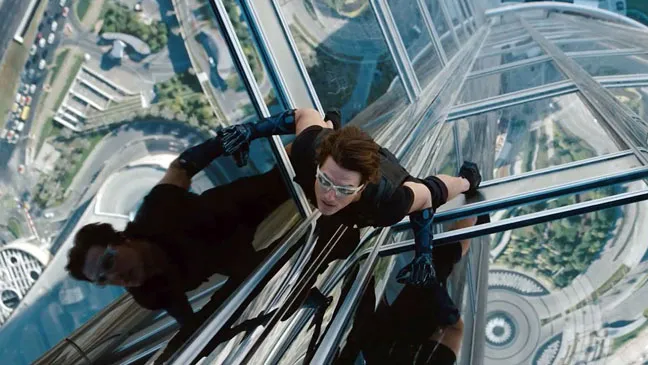
It’s no surprise that ‘Mission Impossible’ will populate this article heavily thanks to the crazy (but applaudable) antics of Tom Cruise, and whilst the earlier ‘Mission Impossible’ films have their own creative stunts, it is ‘Mission Impossible: Ghost Protocol’ that is truly lauded for possessing one of cinema’s most courageous and renowned stunts. Inspired by ‘The Dark Knight’ sequence with the truck flip also being filmed in IMAX, director Brad Bird yearned for a cinematic experience that elevated the expectations of stunts to a new realm of possibility, of which he rewarded audiences with in ‘Ghost Protocol’.
Performed by Tom Cruise (‘Top Gun: Maverick’), who is no stranger to overcoming an indomitable feat, the beloved actor conquers a battle against death by scaling the Burj Khalifa in Dubai. In the film Cruise returns as Ethan Hunt, tasked with clearing the name of his secret service after an attempt to stop a dangerous terrorist in search of nuclear codes ends in catastrophic tragedy at the Kremlin, with the IMF being incriminated.
Supported only by a wire tethering Cruise to the 163-floor skyscraper, audiences found themselves transfixed with both admiration and fear as the star battled against terrifying crosswinds, posing a significant risk to his life. In addition to his climb, Cruise sprints alongside the exterior of the building, where he leaps off and then swings back in a superhero-esque style towards the Burj Khalifa, where editing magic finds the action hero captured by co-stars Jeremy Renner (‘Avengers: Endgame’) and Paula Patton (‘Warcraft’).
The Dark Knight Rises (2012) – Plane Hijack
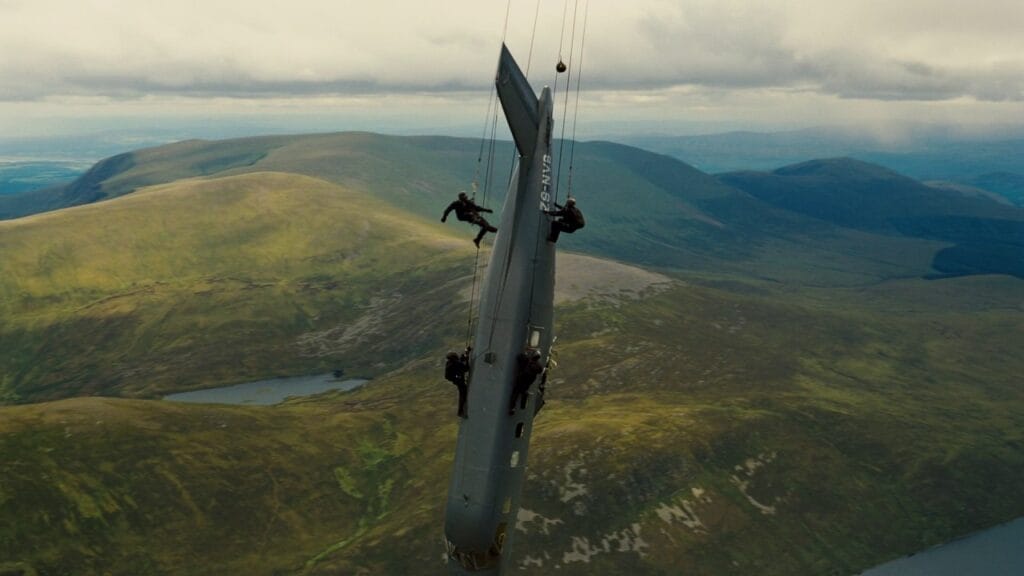
Superhero movies have received plentiful critique for overreliance on CGI and VFX, occasionally favoring visual spectacles over anything else. However, in an unsurprising yet typical Christopher Nolan-esque fashion, ‘The Dark Knight Rises’ (2012) features a practically filmed plane hijacking scene orchestrated by the film’s antagonist Bane, played by Tom Hardy (‘Warrior’). Audiences follow as Bane has been captured by the CIA and is being moved to a secure location, but in typical supervillain fashion has anticipated such and hired goons to dismantle the operation. Said goons pose as CIA members until their true allegiance is revealed, introducing the pivotal hijack scene. Bane’s newfound army latches their plane onto the secret service, where it sways violently before a momentous hole is blown inside, allowing for the villain’s escape. Finally, the masked antagonist releases the plane, where it plummets from the skies onto the Scottish countryside, the location of where the stunt was filmed. Whilst the stunt is practical and fuelled by Nolan’s (‘Oppenheimer’) passion for authenticity, the plane that falls is admittedly a prop.
All of this was meticulously planned by a co-ordinated team, resulting in the jaw-dropping opening to the conclusion of a beloved trilogy. Less ambitious directors may have filmed such through the use of CGI, but Nolan’s more practical methods aid in the realism of his media, generating a remarkably better overall product. CGI is perhaps less demanding and more efficient considering the dangerous nature of the production, but in actuality, Nolan’s stunt crew managed to shoot the scene in just 2 days — despite prepping for 5 — thus producing one of ‘The Dark Knight’ trilogy’s most recognizable escapades.
Mad Max: Fury Road (2015) – Pole Jumping
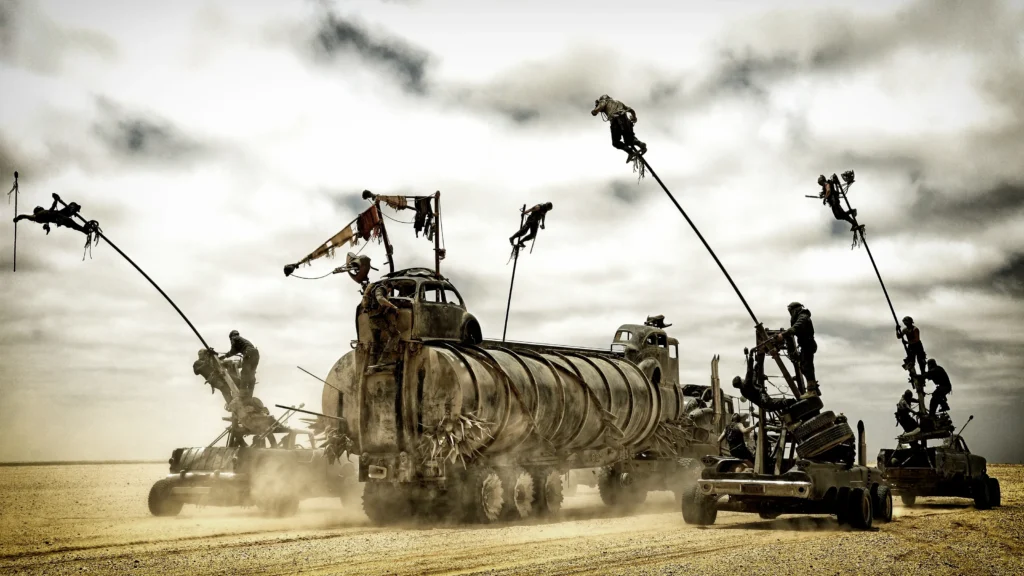
Helmed by George Miller (‘Furiosa’) the Mad Max franchise has amassed a dedicated fan base over the years, but ‘Mad Max: Fury Road’ (2015) garnered a reputation as one of the greatest action films of modern Hollywood, and rightly so. ‘Fury Road’ is a spectacle thanks to its engrossing storyline and killer performances, but its success can also be attributed to the monumental and fear-inducing accomplishments of the stunt team. Throughout production, the ethos of director Miller (‘Three Thousand Years of Longing’) that he instilled into his production crew was, “If you’re going to go out into the desert and have two vehicles colliding, why do it artificially?” The filming period lasted for many months in 2014 and featured multitudinous stunts, never shying from the threats to production they posed whilst upholding a high standard of crew safety throughout the shoot.
In an interview with Rolling Stone, stunt co-ordinator Guy Norris (‘The Suicide Squad’) explained how the use of CGI would have limited Fury Road’s wow factor, and thus practical stunts were prioritised allowing the film to feel more “real”. Norris worked with stunt crews of up to 150 people at once, who had to participate in grueling training regiments of up to 8 weeks to successfully take visual inspiration from the Cirque du Soleil for the pole jumping sequence. It’s here bandits jump from pole to pole, which are attached to moving vehicles racing through the open desert in an enthralling car chase. Upon viewing it seems impossible that the majority of action was practical and not digitally produced, as it so seamlessly blends in, dramatically enhancing scenes but not stealing the focus. The film is charmed with an ethereal-like presence due to this, elevating it to the heights of Hollywood’s greats and providing an extravaganza of action that the audience adores, which is recognized by its 10 Academy Awards nominations and 6 wins.
Mission Impossible: Rogue Nation (2015) – Plane Hang
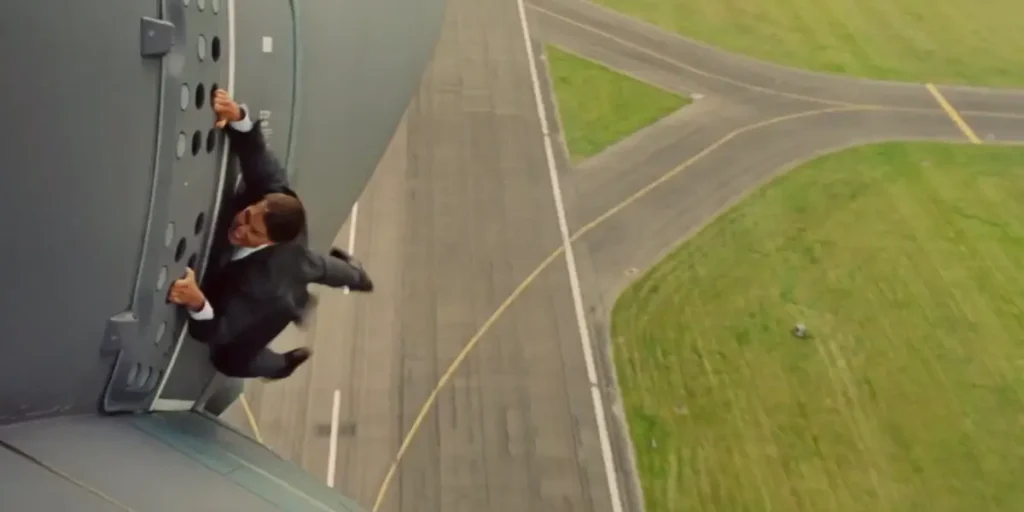
Unsurprisingly, Mission Impossible makes another appearance on this list. While not every iconic stunt from the film may be listed here, it is a tribute to Tom Cruise, his production crew, and the stunt performers that surround him of how meticulously well-crafted each idea and stunt performance is in these films. Fans have reveled for years in the powerhouse performances delivered by Tom Cruise (‘Mission Impossible: Dead Reckoning’), which are aggrandized by his unwavering and obsessive dedication to on-screen realism.
Marketed as an incomprehensible feat of cinema prior to the film’s release, Cruise finds himself barrelling over grass with his infamous sprinting technique in the opening of the 2015 feature. Setting the tone for the rest of the film, as well as the ensuing sequels, he latches onto the plane as it takes off, whilst awaiting for Simon Pegg’s (‘Luck’) Benji to open the door to safety.
Unexpected to many, it appears Cruise is human and not immune to danger, despite his box office persona. During the stunt, the Hollywood hero is held to the plane by wires attached to a full-body harness, as well as wearing goggles to prevent any loose debris or birds from flying into him. A perhaps unanticipated danger to anyone other than the conscientiously trained eye of stunt co-ordinator Wade Eastwood (‘Edge of Tomorrow’).
In an interview with The Hollywood Reporter, director of photography Robert Elswit (‘Ripley’) revealed that neither the plane nor Cruise was created digitally, with VFX only used to remove cables and a mounted camera. Adding to this, he states that the stunt was planned attentively to minimize any risk whilst maintaining its thrilling experience, with a stunt double bravely test piloting the sequence the day prior to shooting. Elswit elaborates on Cruise’s mentality stating that “when he wants to do something, he’ll figure out a way to do it”.
John Wick: Chapter 4 (2023) – Sacré-Coeur Steps Brawl
Considered a love letter to the modern action genre, the ‘John Wick’ franchise is adored by audiences. Wick himself, Keanu Reeves (‘The Matrix Resurrections’), has expressed a sincere appreciation for his four-man stunt crew, consisting of Jeremy Marinas, Dave Camarillo, Li Qiang, and Bruce Concepcion, by gifting them Rolex Submariner watches, each with an engraved message, during the conclusion of production on ‘John Wick: Chapter 4’.
Furthermore, Reeves provided t-shirts to all 35 stunt people reflecting the number of times they had ‘died’ during filming, with some featuring abnormally high figures as a result of the 222-step ascending staircase fight.
During such, our indomitable star brawls countless enemies through the use of acrobatics, fists, and weaponry, steadily rising to the summit for his conclusive confrontation against Bill Skarsgård’s (‘IT’) villain Marquis. Just when audiences have momentarily basked in his success, they are met with an unexpected kick to Reeves’ chest, sending him tumbling back down the 222 steps similar to a slap-stick style akin to the humorous fashion of Seth MacFarlane (‘Ted’), with John Wick continually descending. Vincent Bouillon (‘The 355’) was the talented yet bruised stunt double who performed Wick’s 44-second-long battle against gravity and concrete.
‘The Fall Guy’ (2024) – A World Record-Breaking Cannon Roll
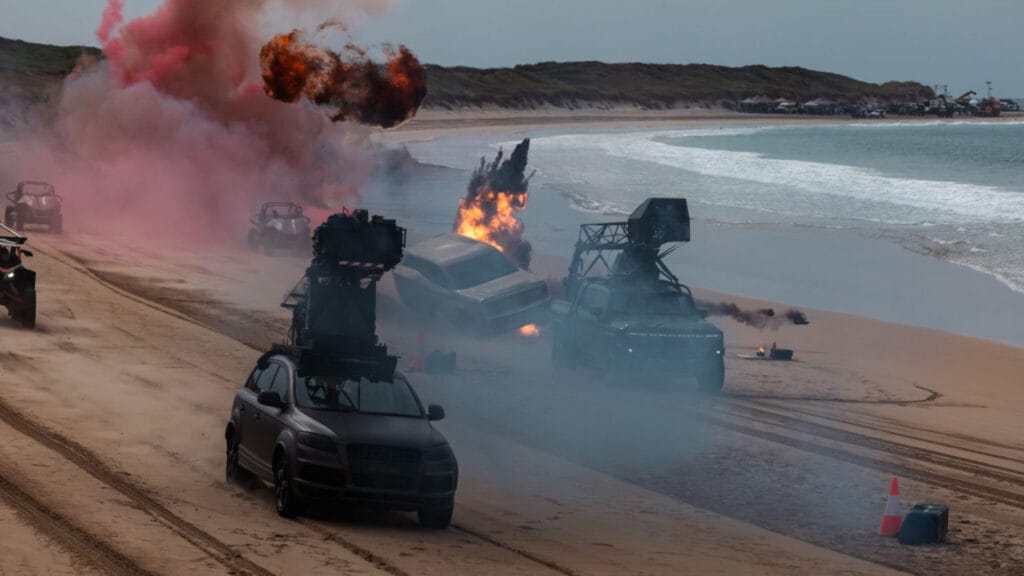
There may be no better way to end this article than appreciating some of Hollywood’s finest stunts than by discussing one of the recent record-breaking stunts that will arrive in theaters with The Fall Guy. Ryan Gosling (‘The Nice Guys’) is considered nothing short of a viral acting sensation following the major $1 billion success of Barbie, but his recent acknowledgment of stunt performers and their lack of recognition through cinema has only bolstered his online appreciation further, steadily becoming one of the most likable actors in Hollywood.
‘The Fall Guy’ (2024) follows retired stuntman Colt Seavers who returns to the industry after an A-List actor mysteriously disappears. Seavers soon finds himself enwrapped in a sinister plot that pushes his stunt-performing abilities to the limits. During a special screening of the film in March, Gosling praised stunt performer Logan Holladay (‘Ghostbusters: Frozen Empire’) for his dangerous 8-and-a-half record-breaking cannon roll performance – a classic Hollywood stunt involving a “cannon-like apparatus beneath a car that shoots toward the ground”, subsequently launching the vehicle in the air before it continuously rolls. The previous record was held by Adam Kirley (‘Argylle’) for his work in stunts ‘Casino Royale’ back in 2006 where he succeeded in performing 7 cannon rolls.
Holladay’s stunt has been heavily used in the film’s promotion in a bid to entice a wider audience through its impressive practical commitments. Such cinematic dedication often goes underappreciated, but lead actor Ryan Gosling has ensured that anyone who listens becomes aware that performer Logan Holladay is the breakneck daredevil behind such a magnificent and unforgettable feat.
Therefore, when looking at Hollywood, nor cinema as a whole, it can certainly not function or provide such performative art without the tireless efforts of the often uncredited stunt people. They invigorate the silver screen through movement alone, even if just momentarily. Endless hours and inspirational levels of dedication are required to pull such wonders off, which audiences may never truly understand, yet this should not stop them from appreciating it. It’s time for Hollywood to recognize such proud contributors to the cinema industry by introducing stunt-related categories at recognized award ceremonies, allowing us to celebrate the achievements of these un-seen stars and provide them with the long overdue credit they deserve.